I Believe The Children Are Our Future

Teach them well and let them lead the way

Has education in this country ever properly served black children? Sadly, the answer is no. Never has the education system in the United States provide black children with a equal and adequate opportunity to learn and succeed in this country. But still, we fight.

Show them all the beauty they possess inside

This summer I am engaged in two projects of education reform, and I’ve never been more excited to change the world. Not the entire world, but my world. The world that I live in, a world in which very few numbers of black children are suffering in school districts that are failing them. A world into which my two little brown babies will enter, one this year. A world that does not value them. A world that does not believe they can learn. A world that considers them expendable.

Give them a sense of pride to make it easier

The first fight is in San Francisco Unified Public School’s special education department. EdTrust West gave them a “D” when it comes to educating low-income children and children of color. The achievement gap between white students and students of color in SF rank them near the bottom (144 out of 146) of California school districts for both low-income students and students of color. One large reason for that is their special education program. Like many large urban school districts, they enroll disproportionate numbers of black and Latino children in special education, and specifically enroll Black boys in a category of special education called “emotional disturbance” at a rate of 7 times that of other children. Special education in SF is generally an educational wasteland once one is placed in it; while children are supposed to be educated with their same-age peers in non-special ed classes as much as possible, in actuality they are segregated amongst themselves receiving a subpar education that does not challenge them and that leaves them unprepared to lead productive lives after graduation. My job this summer is to analyze their data to provide a solid, clear picture of where they are now and provide guidance as to where they need to focus their efforts to get better. I’m working through an awesome organization called Education Pioneers, which brings together grad students with extensive work experience prior to grad school to work on high impact projects in education reform.

Let the children’s laughter remind us how it used to be
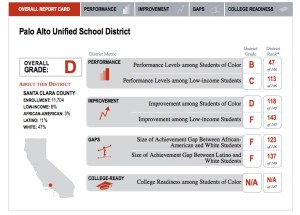
My second fight is at home, right here in Palo Alto. While students of color do well compared to other students of color in the state, the achievement gaps are still huge. Part of the problem here has to do with the fact that 50% of black students in Palo Alto aren’t eligible to attend California’s state universities after graduating from high school. To get into a University of California or California State University, one has to have satisfied something called the “A-G” requirements in high school. Many high schools in California align their graduation requirements with these A-G requirements to make sure every graduate can go to one of these colleges. But not Palo Alto.

Why? Because many of the classes they offer are above what is required by A-G; to offer what would be required by A-G would be, according to some teachers, “dumbing down” of the curriculum. Students don’t take what is required to meet A-G because the classes are too hard. Parents put their kids in summer tutoring and afterschool tutoring just to be prepared for, and pass the class. If a parent cannot afford, or isn’t hip to the tutoring game, then a student will have a hard time even getting through the basic-classes-that-arent-really-basic. Instead of seeing alignment as an opportunity for equity, where a regular class can be added, and the steroids class can be made into a honors, so that there are classes are accessible to all students, the teachers are floating the thinly veiled racial rhetoric of lowering standards.

I decided long ago

Never to walk in any one’s shadow

So I am just all over education news, education articles, education blogs. Someone asked me, given my wild and crazy career path to where I am now, how I got to education as a passion. And the truth is, it wasn’t a passion really until I had children. I didn’t even like kids! But the funny thing is, as soon as I had my children, I started to feel like ALL children are my children. Rather than feeling selfish about securing educational benefits for my kids, I feel like I need to secure educational opportunity for all kids. My heart aches for every child. I never imagined I would feel this way.

If I fail, If I succeed

At least I lived as I believed

I started my SF job yesterday. An hour commute both ways. I collapsed in my bed last night. Tonight, after work, there is a Palo Alto school board meeting. I’ll be there. I’ll be there.

No matter what they take from me

They can’t take away my dignity

Because the greatest love of all is happening to me

The greastest love of all is inside of me

~ The Greatest Love of All, Micheal Masser and Linda Creed

Mothering Without Shame

Photo credit: thinkloud65

Written by CocoaMamas contributor Rachel B.

“I don’t want you to make the same mistakes I did.”

There is not a black mother on Earth who has not said those words to her daughter.  They are said in anger, resignation, frustration and guilt.  We, like any and all mothers, want the very best for our daughters.  We want them to explore every possibility and to experience things that were beyond our reach.  We also want them to avoid the pitfalls, the traps and the trick doors that we befell us.  Instead of imparting to our daughters wisdom, we often give to them our shame and regrets.  We tell them if only we had listened to so-and-so, not gone to that place, stayed there, or hung out with those people, our lives would be radically different.  We are so quick and so sure that the blame lies entirely with us despite many of us being aware of our unique position at the intersections of gender, race and class.  If we had turned left instead of right or had looked up instead of down, life as we know would not be so hard.

We say these words to our daughters knowing that both black and white spaces endanger a black girls’ journey to self-fulfillment.  We know we are judged by a different set of rules.  Our actions, whether positive or negative, acquire a supernatural ability to exalt or demote the entire black race.  We are also keenly aware of the pervasive double standard that still in full effect in our own communities regarding the actions of black men/boys and black women/girls.  Black respectability politics have placed black women as the gate keepers of our culture although many of us resent it.  While teaching our daughters how to navigate a world that has a morbid fascination with our degradation, we seem to follow one of two paths; hanging our heads in shame or distancing ourselves from our pasts.

“I don’t want you to make the same mistakes I did.”

What are those mistakes?  More often than not, they are sexual in nature.  We feel that we gave it up too soon, too easily, to the wrong person at the wrong time.  We tell our daughters’ we were hard headed, naïve, foolish, stupid and spiteful.  We found ourselves in a position where our private vulnerabilities became public shame.  We are so quick to assume and claim responsibility; we ignore the other very real circumstances that lead to make those choices in the first place.  It is painful to even remember that we had to have sex for survival, that those were in positions of power and authority took advantage of our lesser position.  If we had just listened, we never would have been in that car, in that room, at that party, with that boy, with those men.  If we had just listened, everything would have been ok.

If we are not using our shame to deter our daughters, then we are holding up as an admonition to our daughters those who seem to shamelessly embody the loose morals and decay of our culture.  The baby mamas, poor women, junkies, and the sex workers are plentiful and disposable warnings to keep our girls on the straight and narrow.  We point to them to illustrate what will happen if they don’t heed our warnings.  We may have pity, arrogance, condensation, disgust in our voice but the end result is that for our daughters these women and girls cease to be complex and complicated people and become caricatures.  Their “mess” highlights our accomplishments, refinements, education and position.

It is tempting to believe that if you just follow the rules, somehow you will be protected or at the very least buffered from the sexualized racism that is so omnipresent now.  We see the billboards stating that we are a danger to our children, read the “studies” that declare with  authority that we are not desirable, hear at any given time “hoe” and “bitch” out of thumping cars, while walking down the street, or as a “joke”.  We feel the pain, hurt, confusion, and helplessness though we do our best to be as dignified as possible.  We have to be dignified because we know that we are always being watched.  We look into our daughters’ eyes and see sweetness, innocence, intelligence and curiosity.  We watch them as they run and laugh impervious at the moment to the harsh realities of the world.  We as mothers want nothing more than to let our daughters have those moments but we also know the world will not allow such frivolity.  We don’t mean come off as harsh.  We don’t mean to be so judgmental or to suck our teeth at the girls who we determine to be “ghetto”.  We really don’t mean to hiss that “she” is a “fast ass” and predict she’ll end up in “trouble”.  When communications between ourselves and our daughters is at its worst, we yell out in frustration “You want to end up like her?!”

The reality is that no matter what we do or don’t do, black women and girls will continue to be under attack.  Although Mrs. Obama is accomplished in her own right, she continues to be exposed to some of the most vicious racist and sexist attacks.  A maid who was recently sexually assaulted in New York by one of the most powerful men in the world, bravely reported the attack, and underwent an invasive exam afterward has had her honesty questioned, her identity and that of her daughter exposed in French media and her role as the victim questioned.  Even where she resides has been tarnished as an AIDS building.  Even in death, black women and girls have to prove our worth to have justice served.

Our daughters will be the next generation that will be under attack.  They will be the ones who march, speak, protest, write, dance, paint, sing, and pray in creative protest.  They will have at their disposal their own talents that will enable future generations of black women to reclaim their narrative.  What will not help is shame or separation from their sisters.  When we insist that the fault was all ours, they internalize our shame.  When we use those who are the most vulnerable to as a deterrent, we make those girls the other.  What our daughters need is for us to be tender with ourselves.  When we look at our past with soft eyes, we do the same to others.  Our daughters will see that and not accept debts that they did not incur.  When our daughters are witnesses to our healing, they in turn will learn to do the same for themselves and others.

children of privilege

Written by new CocoaMamas contributor Mikila. Welcome her to CocoaMamas!

I recently read an entry regarding children of privilege.  The writer discussed an issue one of her friends was having with her daughter’s growing attitude toward clothing and items of luxury.  The mother of this entry felt her daughter had an unhealthy reaction to her parent’s ability to buy her things.   I too am concerned about my children but I worry about the opposite effect of mine and my husband’s success.

Both my husband and I grew up in very humble beginnings, and worked extremely hard to have a better life than our mothers.’  I constantly wonder that if I over indulge my children will they become selfish and self-centered individuals, or will they reject their comfortable lives altogether out of guilt like some my college classmates did.

Years ago, there a was a Cosby Show episode where Vanessa (played by actress Tempest Bledsoe) was embarrassed that she was rich, all to be informed by her dad Cliff that she need not worry.  He sternly informed her that she wasn’t rich, but that he and her mother were.  I remember watching that episode and thinking, “Is this a joke, I wish my parents were professionals like Claire and Cliff.”

I grew up in the Hamptons on Long Island, NY and was often embarrassed that my mother was on Section 8, while my friends drove themselves to school (many in BMWs and Land Rovers).  I used to wonder what it would be like to live in house where bills were paid, and I didn’t have to work to make extra money to help my mother buy food. It wasn’t until I went to college that I met people who lived on the other side wishing they were me.  I am sure many of you think this is silly and most wealthy black kids don’t wish they were poor, but I have met many who acted exactly like Vanessa Huxtable for the entire 4 years that I knew them.

When I was in undergrad, I remember a lot of my black classmates trying very hard to act like they were poor kids from the ghetto, when in reality they were the children of wealthy professionals.  They entered school one way and left pretending to be another.  These children of privilege denied their lives in an effort to embrace some fantasy world of black poverty they somehow deified.  As the daughter of a mother who worked 2 sometimes 3 jobs, while trying to get 1 degree I loathed the acts of disgrace my peers displayed for 4 years.  Their parents had studied and worked hard to create this life that they pretended never existed.  I often watched on the sidelines wondering what they saw that was so great.  I wished to be in their shoes, and they were pretending to be in mine.

What is it about pretending we enjoy so much?  Why is it that other ethnic groups strive for success and often “fake it till they make it,” while black children of wealth try to pretend to come from less out of some false guilt that they cannot not save all the black kids from the ghetto.  I’ve spent my whole life creating what I believe is a life of comfort, and now I toil over how to raise well balanced children who contribute to society.  They are not pretending just yet, but in time they will encounter people who will either try to make being poor cool, or make them feel guilty about their parent’s status.  These kids will not even realize they are offending the very people they long to imitate.

Thinking back to my years in undergrad, I realize what may have been missing with some of those kids.  I realize most of them were never exposed to the “poor” children from the projects and felt pretending to be them would connect them to roots they feel were ripped away from them with their parent’s success.  Somehow in an effort to protect them, their parents had completely removed them from a society that lacked money, but many times had wealth of culture.

I now strive to expose my children to many different cultures and ethnic groups, while letting them embrace their Caribbean-American heritage.  I want them to be down to earth individuals who are thankful, yet kind to others no matter where they are from.  I also hope they don’t wish they are someone else, and just try to be the best of themselves that they can be.

Mikila is a 35 year-old mother of 2 beautiful children:  an 8 year old son, and a 4 year old daughter.  She graduated from college in 1998, and will be attending Law School August 2011 to study Child and Education Advocacy. She is very passionate about helping parents of special needs children, as she is learning more about how to help her own daughter navigate this world.  She has a super supportive husband who is a very active participant in their children’s upbringing. Mikila is also a partner in a debt management consulting firm. A born-again Christian, Mikila also enjoys volunteer work, music, and helping her children grow into the people they are destined to become.

My Brown Boy?

Written by new CocoaMamas contributor HarlemMommy.  Welcome her to CocoaMamas!

As a Black woman, I was prepared to nurture my brown child.  Showering her with love for her complexion. Empowering him with the strength of his heritage. I had so many books about African-American heroes and trailblazers. Seriously, my grandmother got me a complete set. Lena Horne, Crispus Attucks, Oprah. My kid was gong to love himself, his people and his color.

My husband loves Dave Matthews Band. He played high school lacrosse. Yup, he’s white.

My son? Handsome as all get out and a smile that’s out of this world. Brown? Not so much. He’s Black. He must be; he’s mine.  He’s also my husband’s child. How do I nurture that?

In The Girl Who Fell From the Sky, the main character, Rachel, is often asked where she got her blue eyes. The question is intrusive, but not completely unexpected. The way her grandmother answers however is poignant. “You know Roger’s granddad had these eyes.” This is a lie. A lie told to “protect” Rachel from the white mother who tried to kill her as she herself committed suicide.

Rachel, however, sees the lie for what it is; an attempt to remove her mother, her whiteness, and her complications from her new life. This obviously pained Rachel. If you have to deny a parent, you have to deny a part of yourself.

There’s the rub. You can’t deny a child’s parent and expect the child to be unaffected. Whether you deny the Mom because she’s white or say negative things about Dad because he’s always late with child support.

So where does that leave me? Before meeting my husband, I had a good beat on the world. Biracial people are Black. Yes, race is a social construct, but if you’re Black and something else, then you’re Black. It’s cool to be Black and that’s how society will see you, so that’s who you are. Duh.

It felt good to know so much and not feel ambiguity about race. Then I met this white guy. Then I fell all in love. Now we have this impossibly adorable munchkin we get to raise into a man. A Black man?  Can I call him my little brown boy if he’s not that brown?

Would it be fair to my Scooba to tell him that he’s Black because that’s how society will view him? What if, because he’s so light, people view him as white? How would I feel if he identified as white? Is that “passing”? I would be devastated if he identified solely as white, regardless of how society views him. I would have failed him as a Black woman; as a Black mother. It would mean he was ashamed, that he felt Black was less-than. That he felt I was less-than.

Children are not carbon copies of the parent. You can set a foundation for a child, but he ultimately must get in where he fit in. But how would any of us feel if a part of us that we felt was fundamental to our being was not fully reflected or embraced in our child?

Can I expect him to identify solely as Black? To deny either his Black or white side would be unfair. So when he asks what he is, we’re going to say he’s Black and white. As for how society sees him? That’s society’s problem. Scooba has the right to define himself; as do all of us. President Obama identifies as Black and his white mother approved of this. Am I a jerk that I can’t be selfless and let my son identify as white if he wants to? I’m gonna be that jerk.

Husband and I need to work twice as hard to ensure he sees both parts of himself represented in books we read to him and the media he sees. This means we read Whose Toes Are Those and sing Sweet Honey in the Rock. He’ll see plenty of images of white people, so we’re covered there. We’re going to be extra vigilant not to put him in a box or let others do so either. Scooba determines who he is and where he wants to stand in the world. Is that naïve? Perhaps, but we are not post-racial, so race still matters; and I at least want to have a plan when it comes up. I will fortify my son to stand up for who he is and allow him the space to establish that for himself.

HarlemMommy is a breastfeeding, cloth diapering mother of one. She works with middle schools and loves to read. Her husband is very funny and they love to travel. She also writes at www.BoobsAndBummis.wordpress.com.

Blessed to Be a Blessing

Written by new CocoaMamas contributor Tracy B. Welcome to CocoaMamas Tracy!

I am blessed in that I am surrounded by beautiful Black men. These include (but are not limited to) an older brother, younger brother, husband, and two perfect boys who love their mommy dearly.

When I look at them, I see strength, intelligence, perseverance, purpose, promise and my reasons for living. But somehow, in the midst of all of the positivity and goodness I see in them and feel from them, it saddens me to know that the world doesn’t see the same thing.

For my older brother and I, life has been challenging. Our father was killed when we were very young – and while it has certainly had a profound impact on me, I can scarcely imagine what it has been like for my brother, his namesake. I have watched him grow into an inspiring young man who continues to overcome adversity and defy odds daily. He is a father, a husband, a brother and a mentor and I don’t know who I’d be without him.

My younger brother is a gift from God. He was born when I was 12 years old and has been a joy to our family from the start. Young, smart and saved, he is also an anomaly. A college graduate with a promising future, he is one of those young black men we don’t normally hear about. He loves God and his family and the world is a better place with him in it.

Photo Credit: TellMeWhyImWrong

I married a man who was made to be a great father. When I see the way my husband lights up when he holds our youngest son, I can only smile with pride. This wonderful man brought our first son home from the hospital alone as I recovered from a stroke after his birth. He gently fed our first born with a syringe because he knew that I would want to continue to nurse him when I was able to come home. He takes pride in being a father and he loves his sons tremendously.

Because I am surrounded by strong men who each love me in their own special and beautiful way, I feel extremely blessed. I cannot imagine how anyone who would encounter any of these men would see anything but smart, loving and caring individuals – most of whom would give their last to help someone in need.

I never really thought much about what it was like to grow up as a Black male in America. How could I possibly know what life was like on that side of the spectrum? Being a Black girl, growing into a Black woman – that’s what I know and it is an experience that continues to provide lessons and opportunities for understanding. Becoming a mother was one of the most powerful and scary things I have ever endured.  And as I watch my beautiful young boys grow, I am afraid for them.

It is no secret that Black men are not viewed positively in this world. We could blame television, rap music, or any number of disparate images – but that doesn’t mean a thing. Truth is, when my brothers, my husband, my sons walk out the door, they are seen as criminals, thugs … threats.

I have seen women clutch their bags as my husband passes by because to them he’s a scary, big Black man who’s surely going to rob them. White people have scowled at and scolded my playing toddlers with such hate and disdain in their voices and faces that I wanted to hide my babies away.  People looked and instantly judged my younger brother in his locks and baggy pants, assuming that he was just an everyday thug menace to be monitored.  All the while they remain true to who they are and keep proving the world wrong, but I still worry for them.

I know that they have to experience life – for better or for worse – as who they are. It is beyond our collective understanding why Black people have been burdened with being hated, used and abused. This is not a diatribe about race relations – or at least that was not my intention when writing it. This is a writing to express how much I wish the world would change. I wish I could just love my Black men freely, without fearing that they will be taken away or hurt. I wish I could raise my precious sons and send them out into the world without worrying whether they will encounter racism in school, on the playground, or anywhere – because it is painful and they don’t deserve to have to endure it.

Somehow I hope that they will be able to fly above all of the hate and pain and disappointment in the world. Just as they all are blessings to me, I hope that they will be able to find peace and prove wrong all of the stereotypes that have been passed down from generation to generation. I pray that when they look in the mirror each day they see what I see. May they see their beauty so clearly that it is reflected off of them so brightly that anyone who encounters them can’t help but stand amazed – by their character, their commitment to greatness and caring for their families and themselves.

May my brothers, my husband and my perfect, precious sons know in the depths of their souls that they are loved, that I am proud and that God made them all for a divine purpose. And it is a blessing to be Black. It is a grand responsibility to be a Black man and I am here to help them be the best that they can be – thankfully blessed to also be a blessing.

Tracy B. is best known as an expert communicator and brand development professional. With extensive experience as a journalist for prestigious national publications, Tracy honed her skills and natural talent for recognizing newsworthy subject matter, topics and personalities in positions ranging from General Assignment Reporter to Managing Editor of daily newspapers as well as monthly magazines. A mother, wordsmith, world traveler and woman of many talents, Tracy B. is gifted while yet demonstrating her truest desire to leave a positive mark on the planet. Using powerful and transformational words as vehicles of communication, bridging divides and authoring an American fairytale one day at a time, Tracy intends to change the world, endeavoring to, in her own way, make each day more meaningful than the last.

Black Teachers are Umm…Black Too

My mother is a teacher. She has been a teacher all my life, first at day cares and preschools, then at a family day care in our home. A few years ago, she began teaching in the public school district in Philadelphia. She teaches in an elementary school that is 96% black, with 95% of the children eligible for free or reduced lunch. The school is located in a high poverty, as well as high crime neighborhood. Children come to school with no supplies, sometimes no clean clothes, and often hungry. My mother and her colleagues often not only teach the children, but they feed and clothe them. My mother did not have to become a public school teacher. She chose to because she loves black children.

So when Joel Kline, the former head of the New York City Public Schools, and DropOut Nation, a blog that covers school reform, both criticized the NAACP for joining forces with the American Teacher Federation in their effort to close 19 NYC schools, I instinctively gave pause. Both sources made the claim that effectively said that the NAACP were “hurting black children,” who, in their opinions, the group was supposed to be protecting. The teachers’ union and the NAACP say the lawsuit is based on the fact that the City should be fixing the schools, rather than shutting them down. In their view, the City’s process of gradually phasing out the schools means that the students left behind inherently get a worse education than the students in the schools that replace the shut down schools. The City is also allowing charter schools – which notoriously do not have to hire unionized teachers – access to the facilities previously held by the phased out schools. The City argues that the unions and the NAACP is standing in the way of reform and meaningful student, and parent, choice, and that all the union cares about are teacher jobs. They consistently express their “disappointment” at the NAACP for failure to protect black children.

But aren’t black teachers black too? Continue reading “Black Teachers are Umm…Black Too”

On the Legacy of Brown

“…Brown, seen solely as a school case, must be considered a failure.”

– Robert L. Carter, federal district court judge for the Southern District of New York, former general counsel of the NAACP’s Legal Defense Fund, presented part of the oral argument in Brown v. Board of Education in front of the Supreme Court.

Brown v. Board of Education is known for overturning the legal doctrine of separate but equal, which was settled into national law by Plessy v. Ferguson. Plessy was a case that said that a Louisiana statute that MANDATED blacks and whites sit in separate cars was legal. That court essentially held that separate could be equal, and any connotations of inferiority felt by black people was of their own doing, not by the law itself. Brown overturned that, saying that the state cannot enforce laws that required separation, that de jure segregation was inherently unequal because it connotated that one race, i.e., whites, were superior to the other, i.e., blacks.

Prior to Brown, the LDF hadn’t attacked segregation in public schools on its face. Rather, it had made the claim that blacks schools were not equal in facilities, curriculum, etc., and fought for the courts to order school districts to equalize black and white schools. In many cases, this strategy succeeded. But the LDF realized that they could do more; victories challenging the basis of segregation per se in higher education showed that there really was something inherently unequal in state-sanctioned separation. In law schools, for example, access to other students who were to be future colleagues, an alumni network, prestige and traditions the Court agreed were “intangibles” that equalization of facilities could never overcome.

So Brown was decided this day 57 years ago, and “separate but equal” was declared unconstitutional. Continue reading “On the Legacy of Brown”

“No One Can Say Anything To Me…”

So….Ellen Pompeo is running around giving her opinion on race relations, and what black people need.

(h/t @daowens44 on twitter)

The relevant parts are between 45 seconds and 2:45.

As you can see in the video, Whoopi asks her about her plans to adopt a baby of color, and what people have said about that. Ellen Pompeo says, with a certain amount of what she must of thought was black girl sass, “No one can say anything to me cause I had a baby of color…” [Yeah. I paused too.] Then she goes on her rant about HBCUs and the NAACP. She doesn’t think we need “black schools and white schools,” referring to Historically Black Colleges and Universities. She doesn’t think we need the NAACP awards; we only need “People Awards.” And I don’t think she is referring to the magazine.

What makes Meredith Ellen feel this way, let alone think she has a legitimate voice on these issues, that actually don’t affect her, considering she would have never even attended an HBCU or would get an award from the NAACP**?

Cuz can’t nobody say nuthin’ to her cause she already has a black baby. And a black husband. And who really cares what Jill Scott has to say, right? The experiences of black mothers can’t really be worth as much as those of a white mother of a black child, huh?

Hm. Continue reading ““No One Can Say Anything To Me…””

Looking for Some CocoaMamas

If you hadn’t noticed, it’s gotten a little lonely around here 😦 So I’m looking for some CocoaMamas to join me.

Are you a black mama? Do you blog? Do you want to? CocoaMamas is looking for a few writing Mamas or Mamas who want to write. I’d love to mentor Mamas who want to get into the blog writing business and feature already established writers. I’m interested in ideas on how to make the site better and more useful or informative.

Reply in the comments or email me: gradmommy [at] gmail [dot] com. I really look forward to hearing from you!

From the Crates: These Are My Confessions

originally posted January 2010

The following is an abridged and edited version of a post I wrote more than a year ago, but I thought it was fitting for a Mother’s Day post.

I am not a good mother. At least not by the standards that have been set up for the current generation of a certain ilk of  mothers. A generation who is expected to place their children at the center of their universe, and make all decisions about their adult life revolve around what is supposedly best for the child. A generation that is expected to sacrifice their own happiness to make sure their children are happy. A generation that has been fed the idea that having children is a choice, therefore if you choose to do it, you must accept all the self-sacrificing consequences that go along with it. Continue reading “From the Crates: These Are My Confessions”