Reclaiming the Narrative

Written by CocoaMamas contributor Rachel Broadwater; a version of this first appeared on Love Isn’t Enough here & here.

After years of black motherhood being equated with abandonment and neglect, it was pure joy to see the Obamas walk across that stage to accept the nomination and then the results of the election.  Those nights – and those ever since – have been an affirmation for those of us who were what they are: A strong, loving, playful, and spirit filled African American family.  The Obamas, of course, are not the first nor will they will be the last, but they are in the here and now, tangible and concrete.   It is important to note the Obamas – including Marion Robinson, First Lady Obama’s mother who has been hailed by both of them as being instrumental in the development of their daughters – deserve every bit of praise.  It is clear that they not only are extremely devoted to their children but also to their own relationship.  If there were to be a soundtrack for the Obama family, it would be Stevie Wonder’s “Knocks Me off My Feet”.

They are the flip side to the many single black women – grandmothers, aunties, sisters, and every other in between – who are indeed mothering under siege.  These examples seem to be the only dots on the spectrum.  For those of us who seem to embody the Obama model it can be a lonely, isolating and conflicting experience.

I am a 34 year old mixed race woman – Puerto Rican father and African American / Cherokee mother – who identifies herself culturally as an African American- who mothers 2 amazing little girls: my daughter, 8, and my niece, 9.  I have been married to an awesome guy for 10 years and on our second wedding anniversary our daughter was born.  I work in pharmacy, a profession where there are more women than men.   Because of this, I would find myself in conversations with the pharmacist- sometimes white but frequently themselves or their families hailing from the Middle East or South East Asia – about parenting.  There was almost always a look of surprise and wonderment when I would talk about the regular every day struggles of mothering.  I could almost see the thought bubble: “Oh my God she is just like me!”  Usually at some point in time they would admit to being pleasantly surprised at how devoted I and my husband were to our girls.  I was different, you know, unlike “those other” parents.  Meaning “regular” black people.  I would insist that every mother regardless of race, sexual orientation, religious affiliation, socioeconomic or marital status wants the best for her child whether they have the resources or not, and I was not, in fact, an anomaly.

But I admit that I do feel invisible. There are very few mediums where black mothering is normalized.  Normalized brings to mind for many a two parent, heterosexual, often Christian family.  That is not what I am talking about.  I mean I want to see black and brown mothers in advertisements for safety systems, breastfeeding campaigns, and educational enrichment pitches.  I want to see sensitive portrayals of black and brown women as being nurturing, caring, responsible, patient and concerned about their children.  I would no longer have to endure a picture of a black child automatically followed by these or any combination of words: challenge, crisis, chaos, dangers, death, neglect, and dysfunctional.

To black and white people I did right.  I got married then had children.  “You are a good mother” they nod approvingly.  It’s like because I married when I married that I automatically get 500 points on the SAT’s of parenting.  Why should that be?  There is so much discussion concerning the ills of out of wedlock mothering in spiritual, economic, and emotional terms.  Single mothers have their actions shredded apart.  People feel it is justified by pointing to the high incarceration rates, poverty, violence etc. but is it any more right for a married woman to have a baby to save a relationship? Is it right for a married couple to bring a child into a household where the father is emotionally distant or even cruel because of their own unresolved demons?  There might be a temptation to point out that society “pays” for out of wedlock children but don’t we “pay” when children are conceived under the matrimonial fairy tales that don’t work out.  But there are a whole lot of ways to pay for a baby.

There seems to be a concerted lack of nuance in the discourse in both white and black spaces. If white spaces don’t acknowledge my presence black spaces insist only on the respectable.  In a way I can’t say that I blame them.  Slavery did not allow for slaves to be recognized as humans much less families.  Even if an enlightened slave master allowed for slaves to be married, it was never legally binding.  At any time these two people, who chose each other despite the pure hell of slavery, could be separated and sold along with any of their children or told to mate with another salve who had their own family or did not and simply had no desire to breed.  When freedom was won the majority of slaves legalized their marriages.  They may not have had much but they had each other.  Literally.

So against that backdrop it is no wonder when pastors look out into the pews of their church and see the couple sitting next to each other, an arm draped across their partners back, maybe with a child or two on either side, maybe in between, they are not necessarily seeing patriarchy and submission.  What they see is a stone in the eye of the naysayers who use charts, polls, and studies to prove that these people sitting in church on a Sunday morning don’t exist.  There is no doubt that something pulls at you when you see a couple married for 40 plus years helping each other put their coats on.  It is pride, love, joy, hope, an abundance of every bit of positive energy in the world.  It is also tempting to stay rooted in that energy.  It is so warm and wonderful.  It makes me believe that I too will be in that number.  To believe that this is the right way, the only way, the best way.  But I can’t and I won’t.

Poor mothers do not automatically equate poor mothering.  The No Wedding, No Womb and Marry Your Baby Daddy/Mama movements although conceived with good intentions have left so many important threads blowing in the wind and it seems like few are interested in catching, examining and then tying them together.  Lack of comprehensive, fact based sexual education, the denial of mental health services (both in idea that it is needed and actual services), the lack of safe spaces or even language for men and boys to discuss their own feelings that are not steeped in patriarchy and the sustained unwillingness to deal with the effects of physical, mental, sexual and emotional abuse and how that affects interpersonal relationships all impact both parents and children alike.

The first step to correct this is the insistence that black women take back their own maternal narrative.  Take it back from whoever is mishandling it, whether the person is wearing a three-piece suit, a black dress with pearls, pastoral robes or jeans and t shirt.  This is your story.  You and your child’s.  There will be laughter and tears.  There will be slammed doors and cuddles on the couch.  There will be fear and certainty.  There will be clarity and bewilderment.  These things will happen at different times or maybe all at once.  Doesn’t matter really.  When you tell your story I will sit down and make myself comfortable, ready to listen to you.

Jumping That Broom

Yesterday was National Black Marriage Day, a day that celebrates and promotes marriage within the Black community.

According to many opinion article writers, a forthcoming book by one of my professors, a “movement” championed (and also derided) by many in the black blogging community, and a recent report on the state of Black children, the issue of marriage among Black people is cited as the #1 reason – and also #1 solution – for why Black people are in the situation in which we find ourselves today. The breakdown of the “family unit,” as many call it, is hurting black children. From what I can see, most of these reports/opinions/etc. take the approach of the Moynihan report and cite that the issue is black single mothers raising children without black fathers. Something about the lack of a father in the home – and hence the breakdown of the family unit – has caused such damage that only the revival of marriage can fix.

I think this is… how can I say in the most polite way…misguided.

My issue with this whole propaganda machine is this: marriage and the multitude of support needed for black children to succeed and thrive are two totally different things. While they need not be mutually exclusive, one can exist without the other.

I am black, and I am married with black children. So I am not anti-marriage. I love my husband, and plan to be with him until death do us part. For real. I think that children can benefit from having both of their parents in their lives as much as possible, given that both of those people are available and willing to do the job. But it doesn’t necessarily work that the converse is true: that children must suffer if they don’t have both parents – a man and a woman – in their lives as much as possible. There is just very little evidence for this.

Research is showing that children who grow up in same sex coupled households do just as well as children who grow up in opposite sex households. Census data shows that children raised in same sex households do as well in school as children raised in opposite sex households. Children of lesbian co-parents do as well, and perhaps even better than children of heterosexual married couples. There is little evidence that children need both a man and a woman in the household to succeed.

That many call the fact that over 70% of black children are born “out-of-wedlock” a crisis is a crisis. The statistic is that black women are choosing to have children with men to whom they are not married. The crisis, to those who call it that, is that some moral value has been violated – obviously these women had sex before marriage. I suppose a second value violation, although it’s hardly moral, was the failure to use birth control. But are these two facts really of crisis proportions? What is the real problem?

I was pregnant with Big A before we got married. I was also college educated, had my own place to live, with my own job, and was about to go to graduate school. I had had sex before marriage, and failed to properly use birth control. An issue that I was pregnant? Of course. A crisis? No.

People often point at the 1950s and 1960s as the hey-day for marriage in the black community. Blacks supposedly had the highest rates of marriage among any racial group in the country. Since that time, however, the rate of marriage has been on the decline, not just for Blacks, but for everyone. But to me, it’s not just a coincidence that the culmination of the Civil Rights Movement and the decline of marriage occurred around the same time (and don’t forget about the womens movement.)

Just like many things were fractured in age of integration, so was the black community. I think that what is a crisis is not the decline of marriage, but the decline of community. Marriage is not supported only by those two people who stand at the altar and profess their love; family and friends are invited to serve as witnesses and to pledge their support to that union. In the 1950s and 1960s, new marriages began in the comfort of a community where people loved that couple, counseled that couple, saw that couple in church every Sunday. They likely lived around the corner from their Mamas and Daddies, sisters and brothers. When they had their first child, the grandmother came and stayed for weeks helping out; the entire family brought over food. Black women married and worked and raised their children, but also helped raise other people’s children too. Children were supported by more of the village concept, where my mama know your mama and if your mama sees me doing something wrong, your mama will punish me just like my mama would. Before integration, children saw businesses run by their own people, people whose name they knew and who knew their name. School teachers lived on the block, and knew every child’s family because they also went to church together. So children were not only supported by the institution of marriage, they were supported by a strong community that knew each other and did for each other.

Integration changed that. Integration, as it’s played out, has created huge rifts in the black community along class lines as some have moved on up to the big time, getting their piece of the pie while others are holding on to the promises but have been left looking up from the bottom of the well. The same fractures that were created among slave negroes and house negroes have been recreated for the 21st century. And now, someone is feeding to us that marriage is the ticket to our salvation? Naw, son.

What has always been the backbone of the black community is exactly that – community. If black people want to get married – that’s great. More power to them. But our children don’t need marriage; they need community. They need the support of any and all loving adults who can care for them, married parents or not. There was a time, which is still true now in many areas, where grandparents, aunties and uncles, where considered essential parts of black children’s’ lives, in both married and non-married families. But not as much anymore. When I read the reports that bash parents for failure to parent, I wonder from where these survey takers think the current parents learned to parent? And where did their parents learn to parent? There was a time that even if your parent was not doing all that you needed, your best friend’s mother was, and you were learning right along with him. Now, you have to set up playdates. The natural community fluidity and trust is gone. Parenting is often happening in a vacuum. What happened to the community that nurtured and mentored young parents on the way to go?

Our little family, the four of us, live 3000 miles from our biological family. But we’ve created, as many transplant Black families do, our fictive kin right here in the Bay Area that serve as our “family” of aunties and uncles and cousins. In the black community, nuclear families have never had to go it alone. But now, it’s not natural. We have to work to make a family seem real.

With integration, the black community adopted the American mantra of “every man for themselves.” And that has been what has destroyed the black community. The decline of marriage has been a collateral consequence.

So when these groups, movements, days, etc., claim to want to celebrate Black marriage, I have to take a *pause.* Because while I feel that their hearts are in the right place, I think their energy is totally misdirected. Instead of “promoting” marriage, how about community building, i.e. creating spaces where marriages can thrive? In those same spaces, not only will marriage thrive, but also other forms of families and ultimately, supports for children.

Whether a child succeeds should not depend on whether their parents are married or not. By putting our feather in that hat we are walking a very narrow path indeed, and deflecting energy and resources from where they could best used.

putting a whooping on spanking statistics

I know I am opening up a huge can of worms (or whoop-ass, however you want to see it), but I came across this article while studying for finals last week and finally had a moment to read it today. It is fascinating….ALL parents should read it. Specifically, it shows how spanking studies over the past 40 decades have been skewed toward the researchers’ philosophical bias*, but against actual statistical results: while many researchers are philosophically opposed to spanking, methodologically sound research does not make the case. When meta-analyses of spanking research that meets high methods standards are performed, spanking has not been shown to be any more “harmful” to a child than any other tool of punishment, including time out.

Most spanking research that tries to make the case that spanking is harmful fails to distinguish:

1) qualitatively between abuse and spanking (defined by hitting on the bottom or extremities with an open hand without inflicting physical injury while meaning to correct behavior) within the study,

2) between the ages at which a child was spanked (spanking a teenager is different than spanking a young child), and

3) the quantity of spanking (getting spanked once a month is different than being spanked, as one survey studied, “156 times a year . . . up to 13 times the normal average.”)

And while abuse certainly is harmful, the biased researchers will analogize to spanking by using a “continuum” theory that has never been empirically tested. In other words, anti-spanking researchers will say “spanking is on the same ‘continuum’ as abuse, and therefore parents who spank somehow ‘transform’ into parents who abuse.” Studies have actually found that abusive parents have very different personality traits than non-abusive parents and that:

Research that discriminates between abuse and physical discipline indicates that you cannot predict that a child will have behavior problems simply because his parents use spanking. (pg. 42 of the PDF)

The author uses anti-spanking laws in Sweden to show how a national spanking ban can have counter-intuitive results. In Sweden, parents are not allowed to do anything to their children that they would not do to their neighbor. The rhetoric used is often something along the lines of, “Can you hit an adult who doesn’t do what you tell them to do? Well, then, why should you be able to do that to a child?” That includes not only spanking, but also pulling a child’s arm to move them in the direction you’d like them to go (With my three year old, we’d never go anywhere.) The law, which many other countries also adopted, is based on the U.N. Convention of the Child, which mostly all countries have adopted except the U.S. and Somalia.

The problem is, according to this article, as a result, apparently Swedish children are out of control. There has been a perceptible rise in teenage violence since the ban went into place (although violence in Sweden is still very low compared to American standards) and Swedish teenagers who have grown up entirely under the spanking ban believe that their parents have no right to punish them at all.

There is so much more in this article, and if you ignore the footnotes (although there is a lot there to be interested in), this 76-page article is really not that long. And if you’ve followed me here or on gradmommy, you know that I am not one to spare the rod, so I found the article downright refreshing.

But I also find this article fascinating in how it sort of contradicts itself.

Part of the argument is about how what parents know to be true instinctively – he talks about how parents who were never spanked themselves go on to spank their children – have turned to childrearing advice gurus and statistics to justify or “learn” how to raise their children.  Most parents who spank don’t do it because some book told them it was the right thing to do, but because it was a cultural parenting tool that has been handed down through generations as an effective tool for discipline. We learn how to parent through how we’ve been parented. Yet, the only way he has to debunk all the junk science out there about spanking is to do it through statistics; he has to use the same platform to out-do what he’s fighting.

To be fair, I do know some parents who say they are purely philosophically against spanking because they see any hitting whatsoever as violence on any scale, but they are very few and far between. I can really only think of one who has NEVER resorted to citing a study that justifies his or her viewpoint. And even those who are philosophical in their viewpoint have a limit that I find hypocritical: what exactly is the outer bound of the non-violence? Is mental pain okay? Taking away a toy is painful to a child. Why is that kind of pain and “violence” okay, but hitting is not? At that point a person usually has to resort to, “Well, but the studies show that….”

Read the article (or don’t, and just trust what I say about it is true) and let me know what you think. I can say so much more in the comments. If spanking is shown to not be harmful to children, would that change your mind about doing it? How does it make you feel to know that the research has been purposeful skewed due to researcher bias based on a philosophical viewpoint? Is the only way to fight statistics with more statistics?

What do you think about parents’ tendency these days to rely more on “expert” opinions and statistics about childrearing and parenting than on our own traditions and instincts?

*(Parenting research is fraught with researcher bias. I am no exception; when I defended my dissertation proposal last week about parenting and special education I was called on my almost overt bias against special education placement. So I understand where it is coming from. But I had 7 people in that room on purpose to keep me in check because I acknowledge and own my bias. Anti-spanking crusaders? Not so much.)

30 looks good on me

(cross-posted on gradmommy)

Yeah, I think it does 🙂

Although I’d planned today to be different, due to some exigent circumstances, it was just like any other day. But different.

Hubby co-oped for me this morning so I could study for the exam I need to take tomorrow. Then we (hubby and I) had lunch at the cheapest place we could think of: soup, salad, and bread sticks at the Olive Garden. $8.50 each. Didn’t the bread sticks used to be garlic? Now they are just…regular. Nothing Italian about them. Like you can buy at the supermarket and put in the oven yourself. Whole meal would have been less than $20, even with tip, but I needed a cup of coffee.

The kids were not very good today – perhaps too much wax in the ears – but I told them that because I loved them and it was my birthday, they could have cupcakes. There is a fabulous cupcake store (yup, they only make cupcakes) around the corner, so we stopped in to get a quarter-dozen:

The one second to the bottom was mine: carrot cake. Amazing, I used to HATE carrot cake. Now, it’s my absolute favorite kind of cake. Funny how things change.

I went to yoga. I missed on Monday, and my body has been calling for it ever since. I always manage to be late. Today was no exception. I hoped to have my cupcake with the kids when I came back, but apparently daddy had had enough. And apparently the kids hadn’t wanted to wait for me.

The kids gave me cards. When I told my mother, she said, “Oh, did they make them?!” When I said no, I sort of had an Amy-Chua-Tiger-Mom-moment, like, OMG, why didn’t my kids make my cards, this is so subpar, they could have made them, etc, etc. Crazy how little nuggets of nuttiness can be planted in the parenting head so quickly. And then I remembered this:

The inside of the card said, “SEE BACK.” He needed enough room to tell me how much he loves me.

Everything and all is right in my world.

dream on, dreamer

Over at my personal blog, I’ve been blogging about how I’ll be turning 30 in 15 days. I’ve been blogging about how that feels like a huge milestone for me. How I never imagined I’d get to thirty. How I hardly ever really imagine, or dream, about the future at all.

When I realized this, that I don’t truly dream about the future, I was sad. I felt like I was missing out on something that most people love about life – the ability to dream big, work toward that dream, and (hopefully) get there one day. I thought about why I don’t do that.

Continue reading “dream on, dreamer”

Move and Stand

I used to think that people couldn’t change. I used to think that no matter what, when folks entered a “discussion” there really wasn’t a lot of true back and forth going on, unless it was just the back and forth of voices going in one ear and out the other. I used to think that either people were truly set in their ways because they really believed in them, or because they were too proud to allow another opinion to seep into their consciousness.

I think there was a time that I was both of those things. I took a stand – I didn’t believe in being equivocal. “If you don’t stand for something, then you stand for nothing” was my motto. Everything had a right side and a wrong side and I didn’t really care much for people who couldn’t pick a side and then stick to it. Wishy-washy-ness just seemed like the creed of the follower, the person who didn’t have opinions of their own but could easily be swayed one way or another. It also seemed like intellectual laziness, too – I thought that if you just thought long enough about something, the right answer would come to you.

And then I had kids. I changed. But other folks with kids….they haven’t.

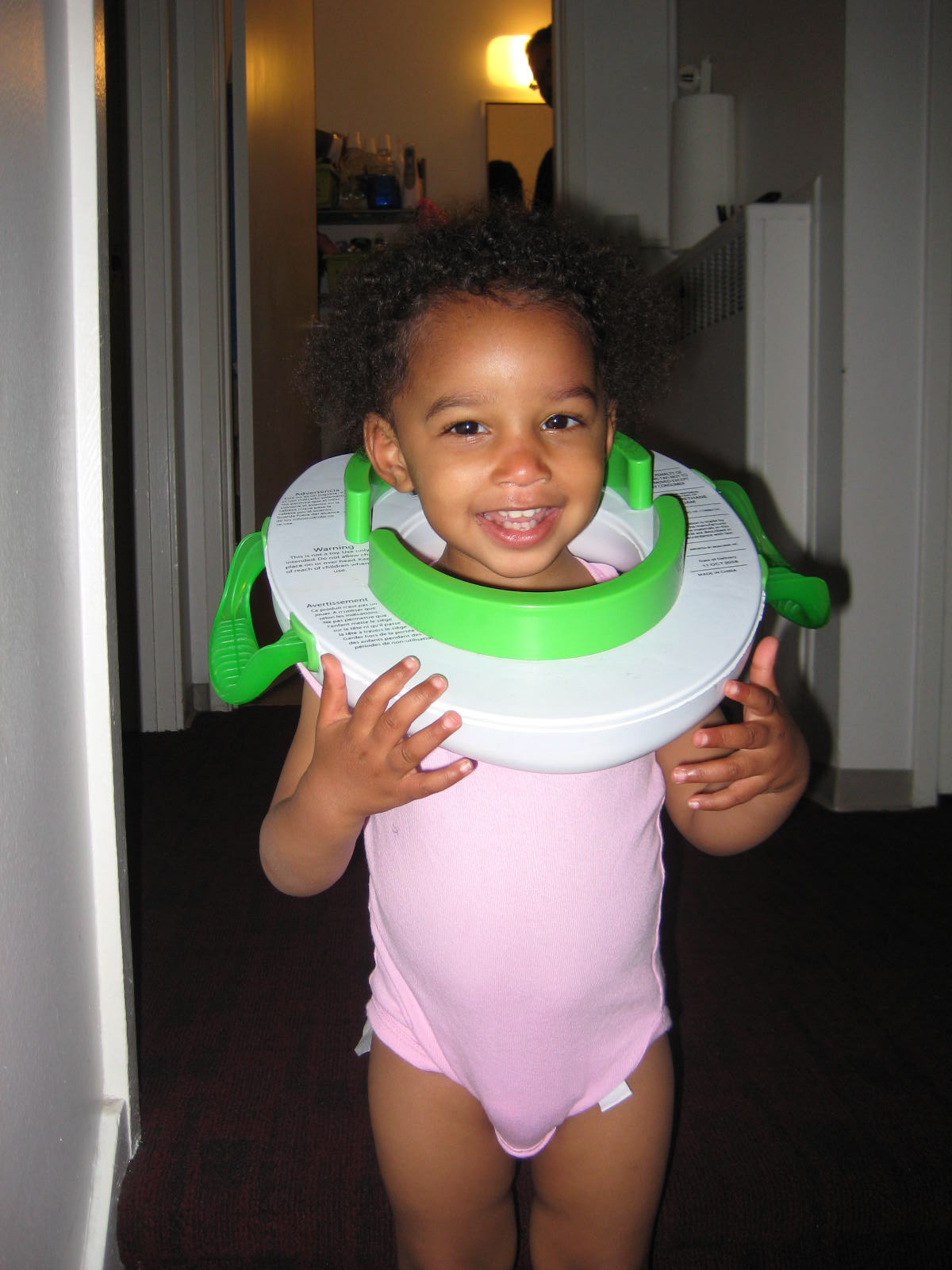
It’s amazing to me how childrearing has been happening for thousands of years but yet there still is no right answer. But instead of just accepting that, we keep fighting about it. We take stands every generation on something only to have that stand be overturned the next generation, and turned back the generation after that. This morning I saw a story on potty training, and how it was the newest front in the mommy wars. The story says that moms today are being pressured to potty train their kids “earlier and earlier,” but I know that older folks were telling me that back in the day kids were potty trained at two. So this “new” pressure isn’t really new; it’s just a generation gap, a old war that’s being recycled.

Little A way before the potty training bug bit her

Back then the stand was that no child wants to be potty trained – who wouldn’t prefer to pee and poop as you go, not stopping your daily activities, and have somebody else change you? Of course you need to go hard on the training. In the 50s, 90% of kids where potty trained by 2. Then the next generation came in and said – “Hey, wait! That’s emotional abuse! Let kids take their time, do it on their own time. They’ll be more successful, and you’ll save their psyche in the end too.” So 50 years later, by the 2000s, potty training wasn’t achieved until 3 and later. (And the diaper companies cheered.) Now, with more and more kids in day care and preschool, the centers are like – whoa….3-year-olds in diapers? If the child can say, “Change me!” then that child can go to the toilet! When parents start putting the hard work of toileting and diapering 30 pound children on somebody else, that somebody else is bound to start complaining.  It’s also some of the backlash against this child-centered parenting.

It’s telling how rigid some folks are on these issues. I’m happy to say that many of the conversations we’ve had on this blog have greatly impacted my own parenting. I am one of those people who used to be rigid in my beliefs, because I thought taking a stand meant something about me as a person. I still do. But now I think that being able to be flexible in one’s views – not wishy-washy, but being able to move, and stand, move and stand – is the better place to be. When we’ve argued about spanking, I’ve cut back on my spoon action a bit to contemplate what my other mamas have said. Our homeschooling discussions have really made me reconsider whether public schools can – and will – ever properly serve black children. I’m glad I’m out of the potty training phase with my kids – finally – but if we ever have another one, I’m sure I’ll deliberate about what approach to take given my experiences and the experiences of others – instead of being dogmatic about one way or another.

I still think its fascinating though: How can it be that after all this time, after all these children, that we are still learning – and fighting about – “what’s best?”

LNWA (Little Negroes With Attitude)

I coulda choked a child this week. Sike, y’all know I’m just playin’. But for real, my five-year-old could of really made me catch a case this past week. It seemed like all the patience I’ve ever had to muster I mustered this week.

How could this sweet face, the face of the baby boy who made me a mama, suddenly start talking to me like he’s the massa and I live in the slave quarters down the road?

Him: :: opens the refrigerator ::

Me: “Boy, you better close my refridgerator.”

Him: “But I’m hungry. And you need to make me something to eat.”

Me :: staring, trying to figure out where this little monster came from ::

Him, staring me dead in my eyes like he’s as tall as me: “And anyway, it doesn’t belong to just you. We all live here.”

:: You know, in all fairness, I agree with him. We all do live here, and I believe in sharing. But it was the way he said it. Hands on hips, little neck shake, eyes all wide,  like he was doin’ somethin’. Did this little nucka just put forth an argument, I mean really tell ME that he can open the fridge when he feels like it? Oh Hell Naw! ::

Me: “Like hell it don’t. Do you pay any bills? Do you have any money? :rant really begins: Do you know what electricity is? Every time you open that refrigerator, you are using electricity. And that costs money. :voice really raises: Do you have any money? huh? I can’t hear you?  If you don’t pay any bills, then it doesn’t belong to you! And anyway, I’ve told you about talking to me like that!  Look at me, boy! Don’t tell me I have to cook you something to eat! I cook for you because I love you! Ask for what you want, but YOU don’t tell ME anything! I don’t HAVE to do anything but be black and die!”

As you can see, the attitude this child displays annoys me to the core, making me take the conversation way off base, and probably not addressing the actual issue. It would be a lie of me to say that I don’t know where they are getting this behavior from. I truly believe its the influence of the bad-ass kids they are around all day. I see how these other children at nursery school treat their parents, and I get embarrased for the adults. It reminds me of Bernie Mac (RIP) and his act about punk-ass parents. These parents who negotiate with their kids as the kids are hitting them, speaking in a soft, soothing voice as the kid is steadily yelling and hollering, chasing a child who is running around a store. I suppose I should be happy that my children have the God-given (and wooden-spoon enforced) sense not to act out that way in public. I’ve even had parents come up to me asking how do I get my kids to behave. I guess we go through these episodes at home just so they can get it out of their systems so they won’t act like monsters when we are out in the world.

But still: if I hear “I want” or “I told you” or “Get me some” or “I don’t want to” another time, y’all might have to come get me. Especially for my 5-year-old. It’s one thing when your child is practically cussing you out in 3-year-old babyish talk. But this nice-diction-full-sentences-ish….SMH.

this belly

When I’m pregnant, I love my belly. I love the soft, gentle roll of it, how it perfectly comes to resemble a watermelon, Big A’s favorite food, complete with the stretch marks that look like the rind. I love the ligna negra that extends from the public bone, a dark reminder of being connected to all other women, especially Cocoa women, who have traveled this road before me. I love how the extended curve in my lower back accentuates the swell, making what is usually a malformation of my spine that yoga teachers seek to “correct” a beautifully natural and perfect “S.”

I marvel at how the body can stand the imbalance by perfectly balancing it all, how other matter shifts to accommodate the growing miracle inside. When I’m pregnant, I love my body. Every single piece of it, and especially my belly.

But…

In the entire rest of my life, the 28+ years that comprise the 30 years less the 18 months I’ve been pregnant, I’ve come to hate this belly. I hate the way it looks, with stretch marks that used to be stretched now just emaciated and weak, shriveled and wrinkly. It’s a potbelly – bloated and big, with people often asking if I’m pregnant. It sucks to have that happen almost three-and-a-half years after your last baby. And with small breasts and hips, and that curvy lower back, the belly just sticks out all that much more. I hate to touch it, a handful of skin and flesh that rolls through my hand like cookie dough.

Mostly, I hate the way it feels, on the inside. My belly holds all of my stress, and it’s been this way since I was a little girl. When the cops raided the drug dealer’s house next door, I couldn’t eat for days afterward, the indigestion was so bad. When there was tension in my house, the first thing to go was my ability to pass my bowels – I was forever constipated. When I worked as an investment banker, I was in constant pain due to gas. Today, things are much the same. My stress is manifested in my belly – gas, bloating, constipation, nausea, indigestion, and even my bladder is now involved due to chronic inflammation in the entire abdominal region. My head is starting to hold some stress too, now; although I think I like my forehead 🙂

It seems to only make sense that the part of my body that I hate the most is the part that gives me the most trouble; it’s hard to know which came first – the hate or the hurt. Either way, I deal by covering it up – the hate with my flowing scarves, tied artfully around my neck, the ends covering the shame of my big, non-pregnant belly and the hurt in whatever way I can – I’ve developed a unconscious fear of eating, one that few people know about. Shame and pain – it seems they are always inextricably linked.

#blackparentquotes

I was all set to write something serious tonight, something that would really make us all stop and think. And then something came across my Twitter timeline that had me falling OUT and I just had to share it.

The hashtag was #blackparentquotes.

Sometimes I don’t get Black Twitter hashtags. This one I totally did. I obviously was raised by Black Parents. And I obviously am one. I found myself having heard or having said so many of them, I was simultaneously shocked and amused. Here are mine, that I came up with:

“Get your hands OFF my walls!”

My mother STILL says this. When I was a child, I could NOT understand. I never felt that my hands were dirty. But today – my walls are filthy. Why? CUZ I HAVEN’T TOLD MY KIDS TO KEEP THEIR HANDS OFF THE WALLS! Children have nasty hands. They refuse to use the banister to walk up the steps. As Andrea and I commiserated over Twitter, they act like they can’t stand on their own feet. Why are you leaning?! STAND UP!

[Child says something smart.] “Who you talkin’ to?”

My five-year-old is in this stage now where I say this probably every day. Now, back when I was growing up, this statement was followed by silence, actually waiting for a response. You had betta said, “Nobody,” so the retort would be, “That’s what I thought, cuz I know you wasn’t talkin’ to me like that.” Today, I’ll still say, “Who you talkin’ to?” but I will continue with a talk about being respectful and not talking to me that way. Then I’ll tell him how he should of said what he said. These kids don’t even know…

[Mom on the phone. Child is looking at the mom.] “Why you in my mouth?”

A variant is “Get out of my mouth!” Kids just don’t know how to eavesdrop on phone conversations without actually looking. I learned how to avoid that one quick. I don’t even talk on the phone now. But I do have to shuttle my kids away when I’m trying to have an adult conversation. I get the urge sometimes to say this, but I don’t think they’d get it.

[Mom and child walk into the store.] “Don’t ask for nothin’…”

This was just an ongoing instruction. She didn’t even have to say it.

Child: But [so-and-so’s] mom said they could do it! Mom: “Do I look like [so-and-so’s] mama?”

Nope. You sho’ ’nuff don’t.

“Put some shoes on your feet!”

That was my dad! All the time. I think it was a thing about stepping on something, or catching a cold. But I know it’s the reason  insist on walking barefoot in my house all. the. time. That’s the rebel in me.

“Just wait till we get home.”

I don’t say this. We’ve already had the spanking conversation on this site. Let me just say I have my spoon in the car. No need to wait.

And my favorite (can’t take credit for it though*):

Child: Mommy, can we go to McDonald’s? Mom: You got McDonald’s money?

YES! I say this to my kids ALL THE TIME!! It applies everywhere! “Mommy can we go…” “You got some money?” I try to make it clear to my children at all times that only people who earn money can spend money. They get money sometimes and they have to save some of it and they can spend some of it. But outside of that – naw. It even applies when my son wants to talk about stuff that is “his” – what?? Nope – if you don’t pay any bills in this house, then nothing belongs to you.

What are your favorite #blackparentquotes? Share in the comments!

* i am not a tweet stealer. that ish is not cool.

it’s always sunny in california

Excerpt from “The Best Interest,” LBC (c) 2010

And so at one moment on that cloudy, damp, and rather cool March day, the day after her 29th birthday, she knew who they said she was, an accomplished young woman, wife and mother, and brilliant, they called her. How does she do it all? Yes, with bipolar disorder that she’d endured for over twelve years, who was right then having a really bad episode, but still one whole person, who could predict what would happen next in a logical fashion. Intelligence evidenced by high scores on the law school admissions exam. Admitted into one of the top three universities in the country. Confident, self-assured, determined. In one moment she knew things were bad, awful, interminable in that moment but the moment, even if it lasted for weeks, was temporary, and she could handle temporary as she’d handled temporary before. Because she had to do this.

But inexplicably in the next moment a separation occurred and she was not one anymore and what was once temporary was then permanent. She’d heard of this before. She’d seen seven therapists in the past twelve years. Some of them helpful, many of them not. One whose wife died, one who was a student, one who worked at the university, even one who was pregnant at the same time she was, but in twelve years, never…They’d all asked, when she’d been very low, Nana, any suicidal thoughts? And, yes, she’d thought about suicide, and, yes, she’d thought about dying. In an abstract way, she thought about who’d come to her funeral and how hard would her mother cry, or what might happen if she stepped in front of the bus instead of getting on it. How would her bones crush and would she die instantly or would she feel pain? But she always came back to herself and her flesh and she’d touch herself and she’d be there alive. Those were just thoughts, nothing more.

But the thoughts that day were of self-inflicted death and they were real, not of her imagination. She felt death from the inside, cold and hard and permanent as it seeped outward. She saw the plan as it emerged in her mind and it was so easy, so alluring, so neat. Much simpler than when she was in the car that morning, as she drove the kids to day care. Then she thought about swerving into incoming traffic but she didn’t want to hurt anyone else or hitting a tree but they all looked too puny to do the job well. The visual of the pills was clear and direct, nothing to work out, nothing to decide. Just lie down and die. It was a picture of justice, an answer to the problem of her and her badness.

“Just do it.” She heard that voice clearly. Her voice saying, Just Do It. She was saying things she never heard herself say, and that voice was frightening.

Another voice, her motherly, sensible, rational, together, voice said, “Call someone.” By instinct, like a child who can rattle off the phone number of a neighbor to call in the event of an emergency, she picked up the phone and pressed call. Sorry I can’t come… she hung up, and pressed call again, this time to her husband at work. It rang and rang and rang and before she even heard the rejection of You’ve reached, she hung up. Her hand shook and then her arm and within seconds her whole body was shivering. She looked over her shoulder, and her own body moving made her think that other things were moving in the room. She saw the plan again, and felt her body walking up the stairs, toward the bathroom, toward the medicine cabinet. Sertraline, Cymbalta, Topamax, Geodon, Lithium, Triliptal, Lunesta, Ambien, Paxil, antidepressants, anti-psychotics, sleeping pills, hundreds of multi-colored tablets, oblong, circular, square, pills that she took to try halt and prevent the episodes, to stay steady, to achieve a state of equanimity. So many pills; one would never know that as a child she couldn’t take pills unless her Daddy crushed them up and mixed them in applesauce. For a moment she stood there and in that flash of lucidity she noticed the irony of how she took pills that help and pills that help the pills that help; pills that made her sleepy when sleep was inappropriate, jumpy when jumpiness looked crazy, but also calm when calming was longed for. No one would be home for hours.

Her unfamiliar voice taunted her, “Easy way to die.”

She was not so sure. But she said, “I want to die.”

Her voice said, “Let’s go.”

She ignored her and questioned her and said, “Do I?”

She stared at the life-taking pills for what seemed like hours but could have only been seconds, and she asked herself again, “Do I really want to die?” She gripped the sink and dropped her head.

And sitting there were the children’s toothbrushes, well-loved and well-worn. One blue and one pink; the little girl’s with bristles going every which way, the young boy’s neat and orderly as if right out of the package. Why or how this pierced through, one only knows, but she thought of how her children still followed her around the house the way they used to when they were babies, even when she went to the bathroom to do a number two, the smell didn’t bother them. How they pulled on her clothes and constantly demanded her attention: Mommy, mommy look at me, look at me, while they did things they knew they shouldn’t do, like stand on the couch or throw toys, their need for their mother’s attention just that great even though reprimand was sure to ensue. How they’d ask with earnest eyes Mommy are you mad at me when she’d chastise them for standing on the couch or throwing toys, or put them in time-out or tapped their hands with the wooden spoon. How they assailed her with Can you do this mommy while they’d stand on one leg or turn around in a circle or do a favorite yoga pose. How her baby girl and little boy preferred their mother 90% of the time to any other person and were so hurt by her that 10% when she became a person neither they nor she recognized. The mother’s world turned to water as she turned around, left the bathroom, and again picked up the phone.

“Hello? Hello? Baby, are you there?”It took her several moments to respond in between sobs as she tried to catch her breath.

“Baby. I can’t do it anymore. I want to go to the hospital and stay there.” That was it. She had nothing else to say.

Silence. Then a long sigh. “Okay. Okay. I’ll be there in a minute.” He’s going to be so mad at me, she thought as she waited. The front of her shirt was thoroughly soaked. As the door opened, she began, “I’m so sorry, I’m sorry, I’m sorry,” as soon as she thought he was close enough to hear. But when he sat next to her his whole torso collapsed and he just looked at her and she realized that he was tired of having to tell her, “It’s okay.” She stopped apologizing.

But not for long because in the emergency room there were many little shameful events. Events that she responded to by being sorry. Sorry that her husband had to witness the nurses questioning, “Well, why would a pretty girl like you want to hurt yourself?” And really expecting an answer. Or overhearing the cops posted outside her bed talking about the “nutjobs” they’ve had to watch over the past few days. Or during the shift change watching them point her out like she was an exhibit at the zoo.

Around six he said, “It’s getting late.”  “And someone has to pick up the kids.” And of course it was not just someone, it’s him, he had to pick up the kids because she, the psychiatrist on duty had just told them, was about to be admitted into the hospital, taken up to the psychiatric ward. “Okay,” she said, “You should go.” She didn’t want him to leave, she was terrified, but she didn’t want him to see anymore of her degradation. She didn’t know what was up there and she wanted to be able to take it in and understand it before he did. She told him she would just be going to sleep. She didn’t look at him. “The kids, they need their routine. Stability. They need you.”  She paused again, wiped her eyes. “Make sure you give them a bath, read them a story.” Her husband looked at his wife, and let out a deep sigh. He said nothing, just grabbed both of her shoulders, hard, and kissed her on the forehead. He turned, and walked away.

“How are you feeling this morning? Your breakfast is waiting for you in the lounge.” On her first full day in the hospital, she asked her nurse if she could take her breakfast in her room. She dreaded what, and who, she would find in the lounge. The answer was a polite but unyielding no. “You’ll feel a lot better once you get up, get dressed and eat. So let’s go.” Her nurse took her by the arm and gently but firmly pulled her out of the bed.

It was hard not to look into the other patients’ rooms as she walked down the hall. There was a woman she noticed last night who seemed to constantly be on the verge of hysterical tears. This woman, thin and blond with glasses, always had a tissue in her hand, close to her face, and her knees drawn into her chest. Another woman, at least 60 years old, was waif-like, nothing but skin and bones. And another, young, with skin like milk and jet black hair cut into a chin length bob, whose entire room was covered in sheets. All were white. All of these women were being coaxed out of their rooms, into the lounge for breakfast.

They sat at a small dining table that would seat about 10 people, but there were only seven of them that morning. There was construction being done on the floor that day, so their introductions were conducted over the dull noise of a jackhammer. Of the seven women, she came to find out, five were mothers. Five of the women at the table, situated on the 4th floor of the University Hospital, on the psychiatric wing, were away from their children.

Deadlines make me feel like this. Caught in a downward tailspin. So hard to get out. Thank God for the sunshine and the no-rain. I need to make it through this week. Cause I can’t go back there.