Politics of Black Hair

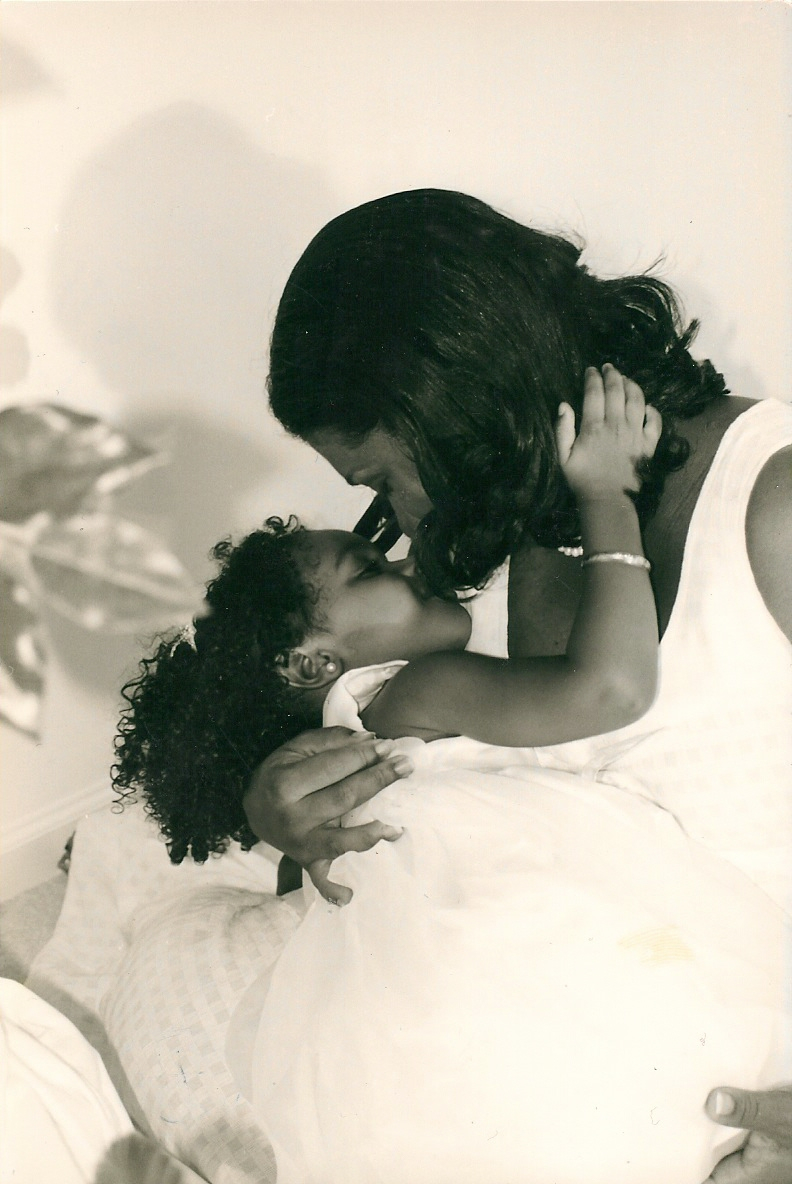
When rocking my daughter to sleep, I often spend time delighting in the patterns her hair makes on her head.  Like many people, her curl pattern is not uniform; it’s looser in the front and top, creating a soft crown of hair that I love to touch.  The hair in the back is more tightly wound, creating beautiful coils that dot her scalp.  The hair on the sides gently fan out in little waves, framing her tiny ears.

When I take her out in public, however, I sometimes forget to see the beauty of her hair, scanning as I am for the disapproval of others.  I find myself apologizing for the lint that her curls tend to trap.  If she’s just come from her father’s care, I interrogate him: “did you brush it before you left?!?”  In response to suggestions that her hair is short, I tensely explain, “it is growing; it’s just curly, so you can’t tell.”  The well-intentioned offers by relatives to “cornrow it so that it can grow” do not help.  In response, my back stiffens, and I plaster a smile on my face: “oh no; she’ll never sit for that.”

And, she won’t sit for it.  My 15-month old doesn’t like to be restrained, and since learning to walk and run, she doesn’t have to be.  But the truth is, I don’t want her hair braided or corn-rowed, because I like her poofy little afro.  Her short hair isn’t bothering her none, and it certainly doesn’t bother me.  My daughter is beautiful every day, whether her hair is long or short, lint-speckled or fresh from a washing, curled tight or billowed around her head like a halo.

I wish I could tell people this.  Tell white folks who have no experience with black hair that her coils are near perfect in their uniformity; that although more complicated to handle, black hair is the most versatile in the world.  Tell black folks who should know better that black hair needs moisture, not grease; gentle detangling, not too-tight cornrows; that every kink, standing for itself, does not have to be brushed out.  I’d like to tell everyone to abandon their obsession with long locks for my girl; stop teaching her at such an early age that she is less beautiful with tightly coiled hair.

But mostly I just smile and nod; it seems like such an uphill battle, and at this point in my life, I’m used to it.  After having worn locs for 2 years, a cousin asked me before I got married, “you’re gonna perm your hair for the wedding, right???”  When I go to the salon to get my hair re-tightened, the other stylists insist on standing near my chair, staring at my hair, and asking inane questions like “how does it stay???” Just yesterday, I thumbed through the pages of Essence magazine, and found not one article on natural hair care.  There was no end, however, of articles offering maintenance tips for chemically straightened hair.

I don’t begrudge other women the opportunity to make hair choices that are right for them.  But it saddens me that my family and friends don’t always appreciate the beauty of textured hair.  I don’t understand how you can be a licensed hair stylist but have absolutely no understanding of the basic mechanics of dreadlocs.  It’d be nice if acknowledgment and celebration of natural hair on black women went beyond a superficial pop-culture fixation on larger-than-life afros and perfectly groomed locs.

Until that day comes, I continue trying to shield my daughter from an onslaught of messages that undervalue her beauty, while navigating an aesthetic landmine of my own.  I’ve been talking about cutting off my locs and rockin’ a short afro for 2 years now, but I can’t work up the courage to do it; it seems I, too, am invested in a white beauty standard that prizes long hair.  Taking scissors to it all, however, just might be what liberates me from all this hair oppression, finally freeing me to delight in my child’s hair–and my own–whether we’re inside the house or out.
WebMD Can Kill You

As anyone with an Internet connection who’s ever wondered about that weird bump on their back, that unfamiliar sensation in their chest or that rumbling in their tummy knows, the one thing you don’t want to do before going to see your doctor is look up your symptoms on WebMD. 

WebMD and similar medical information sites are the opposite of the doctor’s creed: “first do no harm.”  When you type symptoms into these sites, they invariably find the most lethal, life-shortening diseases imaginable.

Thanks to WebMD and its progeny, a few years ago, I thought the benign mass my doctor found during a routine examination would turn out to be an extremely rare and incurable form of bone cancer.  Earlier this year, WebMD had me convinced I was suffering from esophageal cancer.  In the back of my mind, I had already started thinking about contingency plans for the kids’ parenting, whether or not my life insurance was paid up, etc. 

It turned out I had a small stomach ulcer that was completely cured with a few weeks of medication and sensible eating.  That episode also cured me of self-diagnosis via WebMD.

Apparently, I should have passed the lesson down to my daughter.

On the first day of school last week, my 13 year-old daughter rushed me at the door as soon as I got home.  “Mommy, I got a fever at school!”

I felt her forehead.  She felt mildly warm, but nothing alarming. “Umm-hmm. Did you take anything?”

“No.”

“Take some Advil.” 

She scowled at me, clearly annoyed that I wasn’t fawning over her.

There was no school for the rest of the week because of Rosh Hashanah.  I knew whatever was causing this mild temperature spike would be over in time for school on Monday.  She, of course, was not so convinced.

The next day, she again announced that she had a fever.  Not enough of a fever to cause her to cancel plans with her best friend, nor enough to choose to stay home instead of seeing Wicked with me.  It was just enough of a fever for her to demand peppermint tea from Starbucks before the show and to try to get me to run down and buy her concessions during the show’s intermission. 

I agreed to the peppermint tea, but refused the snacks.  WebMD didn’t say Twizzlers can help reduce a fever or soothe a sore throat. 

“You don’t care that I’m sick!” was the not-unexpected response.

The next day, she announced, “Mom, I have strep throat.”

“Really? And this is based on….”

“I looked up my symptoms, and I have all the symptoms of strep.”

I felt her forehead.  Not even slightly warm this time.  “You don’t have strep.”

“Why not?”

“For one, you don’t have a fever anymore.  This isn’t strep.”

“Mom, I’m really sick!  You have to take me the doctor!”

I wanted to laugh, but didn’t.  WebMD strikes again, I thought.

Being the unsung dramatic actress that she is, my daughter did not let the strep thing go until I finally agreed to take her to her pediatrician.

The nurse checked her temperature (normal), ears (uncongested) and throat (slightly reddish but otherwise unremarkable), and then asked, “So what’s been going on with you?” 

My daughter began reciting the list of symptoms of strep throat from WebMD.

 “Okay, honey, but is that what’s going on with you?”

“Yes!”

The nurse took a throat culture.  We waited the required five minutes for the results.

“Good news!  It’s not strep.  There’s a nasty throat virus going around, but it typically clears up in about 3-5 days, which is about where you are now.  So you should be able to go to school on Monday.”

I shook my head.  It cost me $55 for the doctor’s office to confirm the “nothing’s wrong with you” diagnosis that I had made in my living room.  My daughter felt vindicated by the mention of “throat virus.”  I thought of my mother, who would have blown sulfur powder down her throat and made her drink two tablespoons of cod liver oil.

I gave my daughter the “don’t self-diagnose using WebMD” speech afterwards, but I don’t hold out much hope.  After all, she’s a kid with an Internet connection and access to a site that helps reinforce her belief that she’s much smarter than Mom.  I just hope she doesn’t self-diagnose herself into hospice care before she makes it out of 8th grade.

A Weighty Issue

I took my kids to the pediatrician for their back-to-school checkups recently.  Health-wise, both kids checked out just fine.

But as is the case every year, my kids’ doctor pulled me to the side to mention my daughter’s weight.

“She’s gained 12 pounds,” her pediatrician mentioned in a whisper.  She showed me the height/weight charts for her age, showing her weight hovering slightly above the top line for her age group.  Oh, she said in passing, she also grew an inch.

I did my best not to Kanye shrug.  “Did she mention to you that she’s doing yoga?”  I asked.

“Yes,” the doctor said, then gave me the name of a nutritionist.  She also ordered some blood work to check my daughter’s blood sugar/insulin and cholesterol levels, among other things.

Everything came back normal, as it always does.

My daughter is a muscular girl.  She always has been.  She is as strong as an ox.  I outweigh her by a good thirty pounds, and she picks me up like it’s nothing.

She doesn’t play any sports now, but was heavily into gymnastics for about four years.  She has tried every sport from soccer to softball.  She swims, ice skates and bikes.  Last year, at 12, she did adult aerial acrobatics classes.  This year, she is taking adult yoga classes with me.

And did I mention she’s a size 6?  Hardly a size worn by the clinically obese.

Yet, ever since she was a baby, doctors have plotted her weight on a graph and told me, in hushed tones, that her weight was in the upper percentiles for children her age. 

Her plots on the height/weight graphs have remained remarkably consistent since birth.  She’s of average height and above-average weight, according to the “official” weight charts. 

For some reason I can’t fathom, her doctors have equated “above average” with “abnormal” and “weight problem.”  This infuriates me.  Humans come in a range of shapes and sizes, heights and weights.  The fact that my daughter’s weight has plotted consistently on the height/weight graphs since birth strongly indicates that this is just how she’s built, period. 

I always feel like there’s some implicit indictment of my parenting involved in these discussions.  Every year, the doctor grills me about what the kids eat.  “Do they drink soda and processed juice?  Do they drink milk?  Do they eat vegetables?  Do they eat fried foods or fast food?  Do they eat sweets and candy?”

My answers always seem to surprise her.  The kids get soda only when we go out to eat at restaurants.  The only juice I buy is orange juice, which they drink mixed with seltzer.  My daughter drinks fat-free milk, and my son prefers rice milk.  They love vegetables, especially spinach.  Fried foods are rare, and they mostly can’t stand fast food.  You’d have to force-feed them McDonald’s, which they’d promptly regurgitate.

The doctor always looks at me like she doesn’t quite trust these answers, even when the kids give consistent responses.  For many years, I was also overweight.  In these questions, I saw the assumption that here we were, this fat black family, greasing it up on Popeye’s and ribs and fries with nary a veggie in sight. 

Except the kids weren’t, and still aren’t, fat.   The reality that we have a healthy diet, that we generally don’t eat “soul food,” and that my kids are quite physically active, doesn’t jibe with the chronic-obesity-in-the-black-community stereotype.

This year, it annoyed me a bit that my daughter’s doctor hasn’t seemed to notice my own fairly dramatic weight loss.  Hey, I wanted to shout, I’ve dropped close to 70 pounds in the last two years.  Can you stop looking at us as a bunch of fat black folks now?

Apparently not.

Before we left the doctor’s office, I told my daughter, as I do every year, not to worry about the doctor’s comments about her weight and to just keep doing what she’s been doing.  

I said to her, “I know how and what you eat.  You have a very healthy diet.  You eat very little junk food, and only as an occasional treat.  You work out.  Whatever your weight, you haven’t gone up in size at all in the last two years.  Don’t worry about what they’re saying.”

I am trying to raise a teen black girl with a healthy body image.  If my daughter were in fact in danger of having a real weight problem, I would be on the case.  I struggled with my own weight for most of my life, and I feel like I have finally figured out how to maintain control.  If I were concerned about her weight, I would be working with her to count her calories, to honestly assess her food intake, and to balance it against her activity level.  She would be drinking more water and getting more daily exercise.

She’s already doing all of that.  My own weight loss efforts have provided her with good examples of how to lose weight and keep it off the right way.  Her body type is what it is.   The last thing she needs is to become insecure and anorexic because she’s not tall and thin.  She will never be tall and thin.  And that’s OK.

As long as she remains within her own range of normal, I’m not worried about her weight.  In my opinion, as long as that remains the case, her doctors shouldn’t be worried, either.

Ya’ll have me thinking…

I’m constantly thinking about parenting, specifically, how to do it in a way that will “guarantee” that my son grows into a responsible, healthy, spiritual, generous, socially active, loving, compassionate warrior. There are times when the task is daunting, especially when I dare venture into the world of popular media culture.

Yes, I’m talking the world of “106 and Park”, the various music award shows, and lord help me, the radio stations with POWER, KISS, and LIVE in front.  Each time I’m more distraught, terrified even at the thought that the young folk today are being “raised” on sex, sex, and more sex.  Casual sex.  Unprotected sex. Irresponsible sex. And my worst fear: Teen sex.  They can’t escape it-  the teenage musical icons: Rihanna, Drake, Lil Wayne, and even Miley Cyrus have ALL made sexually provocative and explicit songs and videos.  It absolutely boggles my mind.

I’m sure we could all share anecdotes about young girls and boys reciting sexually explicit lyrics, simulating the infamous ‘stripper dance’ to the obvious delight of all within visual distance.  I imagine we’ve all swapped stories, appalled by the mamas who let their young daughters go out dressed in ‘booty’ shorts and barely there tops, quickly passing judgment on their questionable parenting styles. How many of us were ready to storm BET after watching Lil Wayne, Drake, and whoever else perform “I wanna ….. every girl in the world” while those young girls came out on stage, dancing and performing for the audience?  Yet since then Drake has become one of the biggest selling rap artists in the last few years.

I bring this up because media is a powerful cultural transmitter. Society’s values, norms, and even expectations are reflected in the music, film, television, and even social networking sites.  Research shows that young people interact with some form of media for multiple hours everyday. They can’t escape it.

So I have a question, should we do everything in our power to keep children from interacting with media, in hopes to keep them safe from it’s influence?  Do we stage local and national protests? Do we write letters? Do we boycott? What do we do?

Or do we even care?

Growing Up Too Fast

I was in the car with my 10 year old daughter listening to a segment on a morning radio show in which a listener asks the host for advice. In this particular letter the listener was a young lady who was in an abusive relationship, had been taken advantage of as a pre-teen.

I took it as an opportunity to discuss a few things with my daughter; first & most importantly she will NOT be dating anyone at age 12 (as had the young lady who wrote the letter). Secondly, if she ever, at any age, found herself in a position where a man was hurting her physically then she was immediately to tell someone. Perhaps the subject matter was a little strong for a 10 year old, perhaps not. I need her to know that there is no reason to ever be physically abused by someone. I needed her to know today and forever that that is the case.

As a person who was in a violent relationship it is especially important to me that women and girls understand that there is no normalcy, no rationalizing and no expectation that they be understanding or patient in these situations. Make a plan and GET OUT.

Things I didn’t discuss with my daughter but need some attention:

  1. Why is a 12 year old allowed to be alone with a high school boy?
  2. How do you have 4 children before age 23?
  3. What kind of people allow a 27 year old man to date a 12 year old? I don’t care how young he looked and how old she looked, somebody knew how old they actually were and should have said something!
  4. As a community, how can we make it clear what is acceptable to us, for our children. It seems that shame is non-existent these days

I’m very interested to hear your thoughts on this topic; how you have addressed or plan to address the issues brought forth.

Related links:

RAINN Rape, Abuse and Incest National Network

Love Is Respect – National Teen Dating Abuse Helpline

Pre-teen Bean

When my niece, who we affectionately call Sydni Bean, was born, I released all the built up anticipation and excitement of being a first-time Auntie by writing on my high-school classroom board, “I’M AN AUNT,” along with all of her vital statistics in perfect bubble-letters. It has been nearly 13 years since then and I am still in awe of her beauty and brilliance. She is perfectly cool, much more like me, than she realizes. She has all of her mother’s intellect, and her father’s bravado, but she gets her unwavering sensitivity from me.

This past Thanksgiving as her father was projecting images of all the kids onto my  livingroom wall he came across a picture that she said she didn’t want shown. She said, “I don’t like that picture, it looks like I have an afro.” So I ask, “like that would be the worst thing in the world?”  And she piped back, “yeah, it would!” I think I would have been able to more effectively articulate the “Black is Beautiful!” discourse that I know I have in me, if I wasn’t hurt personally as I stood there, with my afro, poised to affirm my niece’s beauty. Hurt, not as much by her desire to disassociate herself with the fro, as I was by the smile I also noticed on my husband’s face when she said it. It would have been funny to me too I guess, if I wasn’t so “sensitive.” (That being said I have also had a heart-to-heart with my husband where he admitted he likes my hair “straight-er.”)

My family, like many black families, has some ugly hair politics. I too, am to blame. I have not consistently worn my hair natural and I think it is because I fall in and out of love with my natural hair. I do not love my hair in either state, truthfully, and I’m also just not a hair person, but when I periodically “loved my hair,” it was either in a permed, short, precision cut, or in a perfectly unruly head of natural twists. Go figure?

Recently, my niece has expressed a desire to her mother to wear her hair natural. (She has never had a perm, but by natural she just means curly, not flat-ironed) She also, cut it in a bob. My sister sent out the pictures, and asked the troops (my mom, me, her other aunts, etc.) to be affirming. My mom responded by stating something like, “where is the flat-iron?” 😦 which I now understand she believes was only because she presumed when my sister said a “bob” that she meant a straight-bob. I saw the first pic and said it was cute . . .

though I secretly could not understand why it looked so overproducted and wet. 😦

I saw the second pic, and i FELL IN LOVE . . .

I thought it was not possible for it to be any cutter and immediately responded by sending her other pics of women with fros and was so stinking delighted that i had someone else on the fro team. 🙂 Then i got the pics from a Bar Mitzvah she attended post-poof . . .

and I’m like what happened??????!!!!!!!?????????

I know that being a pre-teen is hard, cause let’s face it, it’s just not our best moment as women. But isn’t it supposed to be easier when we get older? Aren’t we supposed to “know better,” and love ourselves more?

Tanji is a wife and mother of three. She has two boys and one girl. She lives in Philadelphia, her favorite chocolate city. She is an educator and her first “baby” is now a Howard University graduate and a Cocoa Mama.

Whose Children Are These?

I am conflicted when I read about the orphans taken out of Haiti in the days after the devastating earthquake there.  By now, we’ve all heard the story of the missionary group that improperly removed children from Haiti, despite repeated warnings to their leadership that they lacked the authority to do so.  Lest we conclude this was just the mistake of misguided, but well-intentioned ordinary people who didn’t know any better, the U.S. government has also been responsible for improperly conceived plans to take children out of Haiti.  Governor Rendell of Pennsylvania, with the support of the Obama administration, successfully organized an airlift of 54 Haitian children who were supposedly in the process of being adopted, despite being aware that not all of the children were orphans, or even in the adoption process.  It is not, however, only rescue missions and airlifts that give me pause.  In the days after the earthquake, a feel-good story surfaced of a widowed white woman who had all but completed the adoption process for twin babies in Haiti, a boy and girl.  With the help of the U.S. embassy and a non-profit group, she was able to hasten her adoptive childrens’ arrival in the U.S. after the quake.  When reading the article, I scanned the page for a picture, wanting, in particular, to see the little black girl.

Children need and deserve supportive homes where they will be loved and taken care of.  My child is in a home with two parents who adore her and are committed to her well-being, no matter the sacrifices that her well-being will require.  I am in no position to deny that to any other child, regardless of whether that child is of the same race as his or her adoptive parents.

There is something unsettling, however, about the speed with which these children were improperly (and, likely, illegally) taken out of their home country.  I see a troubling arrogance behind the intentions of the missionaries and the U.S. government: the assumption that anywhere but Haiti would be better for those children; the assumption that the life Americans could provide for the children would surely be better than any life Haitians could provide for them in Haiti.  The assumption, even, that whites looking to adopt these children would necessarily be capable of raising a black child in the United States.

Staring at the picture of the little girl, I first wondered, “has this mother mastered the most basic of parenting tasks for those fortunate enough to raise a black child—that of grooming a black child’s hair, in all it’s curly and kinky glory?”  More substantively, I questioned whether she had grappled with the harder questions, like how race will impact the twins’ educational experience.  Has she considered the assumptions that teachers may make about their intelligence and capability on account of their dark skin?  Is she, and the other white adoptive parents implicated in these news articles, prepared to confront the lack of celebrated role models for their adopted children; to counter societal preferences for blue eyes and straight blond hair that their brown children do not have?  In the hopes of raising a “colorblind” child, will these parents errantly avoid discussions about race and racism in their home, thus leaving these babies to draw conclusions based on their observations of a world that inevitably places black and brown people at the bottom of a social hierarchy?  Have these parents confronted their own beliefs about race, both conscious and unconscious?  Have they considered how their own understanding of race, or a lack thereof, will affect their ability to parent these children?  Considered, even, whether their own psyches harbor the very same assumptions that allow missionary groups and government officials to disregard the right of a sovereign black nation to control when and how their children might be removed from their country?  Do any of these white parents believe themselves to be superior parents for these black children because they are, well, white?  Note, I haven’t even begun to address what the adoptions mean for the loss of Haitian identity among these children.

My suggestion is not that being white should necessarily preclude white people from adopting black children.  No race has the monopoly on properly raising children, and black children do not “belong” to only black parents.  Indeed, to open your heart and home to a child you did not conceive is a beautiful thing.  But like any adoptive parent, you shouldn’t be deemed fit to adopt a child if you’re not prepared to address the unique circumstances of that child.  Growing up as a person of color can be challenging enough; to grow up without parents who can understand—or worse, refuse to acknowledge—that experience is doubly difficult.  It would be a mistake for a white parent to assume that because race is not a factor in their own life, that it won’t be a factor in the lives of their black adoptive children.

Even I, a black mother, struggle with properly contextualizing race in my daughter’s life.  And if I can struggle, then I’m left wondering about how these white adoptive parents are faring.  Who, I wonder, are the best parents for these black children?  To what type of family can a black child properly be said to belong?

Is your vagina angry?

Last week I had the extreme pleasure of seeing a student performance of Eve Ensler’s The Vagina Monologues. Approximately 40, brave undergraduate women participated. Far more of them were white, but there was also a handful of black women, including one of my advisees. She played the role of “The Angry Vagina.” It was a fantastic performance, she was convincingly angry, her vernacular was appropriately explicit, she checked hypothetical partners (and gynecologists) for all hypothetical atrocities. I couldn’t help feeling like she had been chosen for this role because she was black (we discussed this and she agreed), even though it also seemed like the role was inauthentically black (we both agreed as well). It didn’t seem like what any black woman I knew would say.

While I applaud Eve Ensler for her progressive theatrical piece, and I have willingly seen now a professional and student production (and left the latter happily with my “Team Rihanna” and vagina buttons), I wonder what black woman would say about sex, body image, rape and sexual assault, etc., if given the platform. I’m thinking about Tricia Rose’s phenomenal book, Longing To Tell. I am also fearing that black women are not really ready to talk openly about the issues raised in that book, that they feel protected by silence and anonymity. I see this explicitly in my current book project.

One of the interesting things about Vagina Monologues is that there is only one very recently written piece about childbirth. It was quite curiously an afterthought. I am certainly liberal enough to think that a woman’s body is not entirely reserved for  bearing kids, however would black women have omitted this altogether from our stories about our vaginas?

My vagina is feeling a little spent! 🙂 Three kids later, multiple partners in, one rape, and countless dreaded gynecological visits, I’m feeling like at the very least I should be other-bodily-part centered. Like, I would love to be more focused on my stomach, thighs, or my arms. Last night in a spirited conversation about weight loss with two other black women, one of my homegirls told me, “you know sex is supposed to help you shed calories!”  I said something like, “I’m married and I don’t have sex,” which thankfully is not true, but I wanted to say something like, “who cares about the vagina, and all activity therein, I want Serena Williams’ abs and arms not her . . . . vagina.” Damn, I don’t even have a working, blog-friendly, authentic vocabulary for it!?!

I do not think my vagina is so much angry as it is exhausted.

Tanji is a wife and mother of three. She has two boys and one girl. She lives in Philadelphia, her favorite chocolate city. She is an educator and her first “baby” is now a Howard University graduate and a Cocoa Mama.

Good Fortune and Good Luck

Although “Mazel Tov,” a Hebrew phrase, translates literally as “good luck,” the expression really means “good fortune has occurred,” hence its use as a term of congratulations.  I had a baby girl 8 months ago: Mazel Tov to me! I have been lucky enough to be able to stay home with her since her birth, and with the exception of the nine hours a week that I teach and hold office hours, I will continue to be her primary caregiver until she is at least 15 months old.  At that point, I will need to take more hours out of the day for work.

I had it all planned out: at 15 months we would enroll her in the on-campus day care program, a mere 5-minute walk from my office. We live near campus, so there would be no commute; only a leisurely stroll across well-manicured lawns to her classroom.  I could stop by to have lunch with her, or stop by, just because.  She would never be too far away, and she would never have to stay longer than necessary.  At the end of the day, we’d walk back across lush campus greens together.

Well, you know what they say about the best-laid plans.  The on-campus daycare has elected not to renew its NAEYC certification (the gold-standard for child care facilities), it is losing its manager of over 20 years due to retirement, and faculty are starting to pull their children out, citing a decrease in the quality of care, insufficient “free-play” for the children, and an environment that is not as warm or nurturing as other day care facilities in the area.  I am no longer mapping out our walk to school together in the mornings.  Instead, I am now considering one of the best Jewish day-school infant programs in the city.  Although the program is described as secular, a non-Jewish colleague who enrolled her child fondly recalled that her child grew up singing “cute Jewish nursery rhymes.”  I now envision my daughter doing the same, using Hebrew words to tell me about body parts and manners.

I’m worried.

Jewish religion and culture are as beautiful and relevant as any other religion and culture, and have impacted my own life in both significant and superficial ways.  The problem is what consideration of a Jewish day care program has forced me to confront: I do not have access to a “Haitian” day care program; there is no “black” day care facility.  For much, if not all, of my daughter’s education, she will engage with a curriculum that will, at best, ignore her experience as a person of color, and at worst, focus only on the oppression of people of color in this country. As if to signal things to come, there is not one picture of a black child in the day care program’s brochures.

Raising a black child is not for the faint of heart.  A mere 8 months into her life, my husband and I regularly question the choices we make regarding the formation of her identity: is she playing enough with other children of color?; should we only hire black babysitters?; Spanish is nice, but maybe we should expose her to French or Kreyol…; does she see enough women of color?…does she meet enough women who look like me?  We are committed to creating an environment that will affirm the color of her skin, the shape of her lips, the texture of her hair: the artwork on our walls intentionally feature black women; her bookshelf is filled with stories about children of color; we will not be bringing the March 2010 issue of Vanity Fair into our home.

And now, we must start thinking about the educational environment that is best for her.  What does “best” mean?  Surely, it must mean a day care that meets the highest child-care standards.  It must also mean a day care that gives her a couple of minutes to stack the darned blocks whichever way she wants.  But does it also mean a day care that will celebrate the beauty and worth of her cultural background?  I am under no illusion that the on-campus facility would have taught her songs about Haitian independence, the words to “Frere Jacques,” or the accomplishments of black women in the Americas.  It is one thing, however, to be one of several black children in a mainstream day care program; it is quite another to be the only black child in a Jewish day care program.  Can I enroll her in this program without somehow undermining the sense of pride we are trying to instill in her regarding her own racial and ethnic identity?

We have officially entered the morass of steering a child of color through the American education system.  Good fortune has certainly occurred, but moving forward, I now need wishes of good luck.