Mama Media Monday

There is a lot going on with cocoa mamas in the news every week, so I’ve decided to set aside Mondays to talk about a few of them. Here’s what’s up this week:

Many Moms Have Kids With Different Dads, U.S. Study Finds

Apparently over a quarter of all women who have two or more children have these children with two or more men. For black women, this rate is 59%. And, according to the article, the trend is across demographics of income, education and marital status – even married women who work and are not poor have more than one father for their children. But what irks me about this title, and the rest of the article, is how mother-centric it is. It does take two people to make a child, does it? I mean, if this is true for women, mustn’t the same be true for men? Why isn’t the title “Many Parents Have Kids With Different Partners”?

Almena Lomax dies at 95; civil rights activist launched Los Angeles Tribune newspaper

I’d never heard of Almean Lomax, and I think that’s a damn shame. This trailblazer was a journalist unlike any other, who is notable not just because she started a black newspaper of incredible importance to black folks in the 1940’s and 1950’s, but because she was unafraid to do what others would not.

“She was a terrific writer…the only one of all the black newspapers at the time who really was fearless about exposing things as they were. She didn’t soft-pedal anything,” said veteran civil rights lawyer Leo Branton Jr.

Not only was she fearless in her writing, she was fearless in her life. After her divorce in 1959, she moved her SIX kids – ages 4 – 16 – from L.A. to the deep South so she could cover the height of the Civil Rights Movement from the ground, much like war reporters do now. According to the article and her children she regretted it later, because of the trauma that such racism left on her kids. But I admire her willingness to get in the trenches, so to speak. Often I wonder about the impact we can make from the outside looking in. While we want to protect OUR children, are we losing something – being selfish even – by not being in physical solidarity with the most oppressed among us? Or is our selfishness justified, as long as we use our outsider status to the utmost in service of those in the war? What does that utmost look like?

What’s Really Behind Black Child-Abuse Stats

A new study debunks the long-held belief that racial bias by those who report abuse is behind the disproportionately high numbers for black children.

I don’t read The Root on a regular basis, and this article* is an example of why. The article is about a report that  supposedly debunks a myth that racial disproportionality in child abuse statistics are largely driven by racism or racial bias. The report is supposed to say that instead black parents are disproportionately more likely to be cited for child abuse because black parents are more likely to be poor.

But the problem with this Root article is that it never tells you how the report debunks the myth. How did the researchers get from “there is no racial bias in how professionals judge was is/is not abuse” to “it’s all about poverty”? The article gives me no reason to believe the report, except that the Root says that the report debunks the myth. Isn’t the point of the news to digest the information for me, so I don’t have to read the report? The Root has this kind of shoddy “reporting” and writing consistently; I really cannot understand why black folk continue to read it or take any stock in what they have to say. I understand that media outlets for black news are few and far between, but we have to be able to do better than this.

Do you all have any news about black mothering or black childrearing to share? Send it to me or post it in the comments!

Have a great week,

LaToya

*I actually have a lot to say about the report itself, but I’m going to save it for another post, later this week.
putting a whooping on spanking statistics

I know I am opening up a huge can of worms (or whoop-ass, however you want to see it), but I came across this article while studying for finals last week and finally had a moment to read it today. It is fascinating….ALL parents should read it. Specifically, it shows how spanking studies over the past 40 decades have been skewed toward the researchers’ philosophical bias*, but against actual statistical results: while many researchers are philosophically opposed to spanking, methodologically sound research does not make the case. When meta-analyses of spanking research that meets high methods standards are performed, spanking has not been shown to be any more “harmful” to a child than any other tool of punishment, including time out.

Most spanking research that tries to make the case that spanking is harmful fails to distinguish:

1) qualitatively between abuse and spanking (defined by hitting on the bottom or extremities with an open hand without inflicting physical injury while meaning to correct behavior) within the study,

2) between the ages at which a child was spanked (spanking a teenager is different than spanking a young child), and

3) the quantity of spanking (getting spanked once a month is different than being spanked, as one survey studied, “156 times a year . . . up to 13 times the normal average.”)

And while abuse certainly is harmful, the biased researchers will analogize to spanking by using a “continuum” theory that has never been empirically tested. In other words, anti-spanking researchers will say “spanking is on the same ‘continuum’ as abuse, and therefore parents who spank somehow ‘transform’ into parents who abuse.” Studies have actually found that abusive parents have very different personality traits than non-abusive parents and that:

Research that discriminates between abuse and physical discipline indicates that you cannot predict that a child will have behavior problems simply because his parents use spanking. (pg. 42 of the PDF)

The author uses anti-spanking laws in Sweden to show how a national spanking ban can have counter-intuitive results. In Sweden, parents are not allowed to do anything to their children that they would not do to their neighbor. The rhetoric used is often something along the lines of, “Can you hit an adult who doesn’t do what you tell them to do? Well, then, why should you be able to do that to a child?” That includes not only spanking, but also pulling a child’s arm to move them in the direction you’d like them to go (With my three year old, we’d never go anywhere.) The law, which many other countries also adopted, is based on the U.N. Convention of the Child, which mostly all countries have adopted except the U.S. and Somalia.

The problem is, according to this article, as a result, apparently Swedish children are out of control. There has been a perceptible rise in teenage violence since the ban went into place (although violence in Sweden is still very low compared to American standards) and Swedish teenagers who have grown up entirely under the spanking ban believe that their parents have no right to punish them at all.

There is so much more in this article, and if you ignore the footnotes (although there is a lot there to be interested in), this 76-page article is really not that long. And if you’ve followed me here or on gradmommy, you know that I am not one to spare the rod, so I found the article downright refreshing.

But I also find this article fascinating in how it sort of contradicts itself.

Part of the argument is about how what parents know to be true instinctively – he talks about how parents who were never spanked themselves go on to spank their children – have turned to childrearing advice gurus and statistics to justify or “learn” how to raise their children.  Most parents who spank don’t do it because some book told them it was the right thing to do, but because it was a cultural parenting tool that has been handed down through generations as an effective tool for discipline. We learn how to parent through how we’ve been parented. Yet, the only way he has to debunk all the junk science out there about spanking is to do it through statistics; he has to use the same platform to out-do what he’s fighting.

To be fair, I do know some parents who say they are purely philosophically against spanking because they see any hitting whatsoever as violence on any scale, but they are very few and far between. I can really only think of one who has NEVER resorted to citing a study that justifies his or her viewpoint. And even those who are philosophical in their viewpoint have a limit that I find hypocritical: what exactly is the outer bound of the non-violence? Is mental pain okay? Taking away a toy is painful to a child. Why is that kind of pain and “violence” okay, but hitting is not? At that point a person usually has to resort to, “Well, but the studies show that….”

Read the article (or don’t, and just trust what I say about it is true) and let me know what you think. I can say so much more in the comments. If spanking is shown to not be harmful to children, would that change your mind about doing it? How does it make you feel to know that the research has been purposeful skewed due to researcher bias based on a philosophical viewpoint? Is the only way to fight statistics with more statistics?

What do you think about parents’ tendency these days to rely more on “expert” opinions and statistics about childrearing and parenting than on our own traditions and instincts?

*(Parenting research is fraught with researcher bias. I am no exception; when I defended my dissertation proposal last week about parenting and special education I was called on my almost overt bias against special education placement. So I understand where it is coming from. But I had 7 people in that room on purpose to keep me in check because I acknowledge and own my bias. Anti-spanking crusaders? Not so much.)

Do Black Mothers Raise Daughters, Love Sons?

I’ve seen and heard the saying, “black mothers raise their daughters and love their sons” repeated enough to know that some people actually feel this way. Sonja Norwood, mother of Brandy and Ray-J, even weighed in on the question for Essence last year.

My 14-year-old daughter has accused me, on many occasions (usually when being denied something she wants), of liking her little brother better, or loving him more. I would be lying if I said I never treated them differently. I never thought that saying applied to me, though, because I think that I treat each of my children in accordance with their particular needs. 

But a recent conversation with a woman I know gave me pause. My friend admitted that she does more for her son than her daughter “because he needs more from me.” She asserted that her girl is more self-sufficient, more reliable than her son, even though he is older, and that her son “needs her more.”

That may be true. But is it fair?

Maybe girls are just more responsible than boys, period. My daughter is more responsible than my son, but I assumed it was mostly due to their age difference. My daughter is almost 5 years older than my son. She’ll be a freshman in high school in the fall, and he’ll just be entering 5th grade.

Truthfully, my daughter was more responsible at 10 than my son is now. For instance, at 10, my daughter started riding the public bus to school by herself. She had paid close attention to how we got from point A to point B on the buses and subways. She didn’t need instructions on how to get to school. She needed instruction on how to avoid trouble on the bus. I told her, “Sit near an older black lady, in the front. She’ll make sure nobody messes with you.”

My son, however, freaked out the one time I thought I would have to put him on the public bus to go to school. His school bus didn’t show up, and I couldn’t take him to school because I had an early morning meeting. It’s a straight shot from our house to his school on the nearest MTA bus, just as it was for my daughter. I told him all of this.

He cried.

“I’m not ready!” he shrieked. I sent him to school in a taxi instead.

Because my daughter is more responsible than her brother, I expect her to be responsible all the time. When she’s irresponsible, I get angry because “she should know better!” When my son is irresponsible, I chalk it up to his immaturity. When my daughter is petulant, whiny, tantrum-prone and defiant, I can’t stand it. When my son acts that way – well, he’s still a little boy. My daughter feels and deeply resents the difference.

My daughter says I “baby” my son and that I “forced” her to do more at his age than I force her to do. I deny it. But maybe it’s true. I admit I sometimes forget she’s still a kid. Or that I, too, can be petulant, whiny, pouty and tantrum-prone. Maybe my standards for her are a little higher than they are for him. That’s a balance I need to evaluate and correct if necesary.

I don’t think I “raise” my daughter and “love” my son. I do make distinctions between them based on their age, what I perceive to be their respective level of maturity, and their personalities. I think it would be unfair if I did anything else.

I check myself to make sure I give them equal time and affection. And as my son approaches his 10th birthday, I am giving him more responsibilities, such as household chores. He is fast approaching his teens, and I know it’s time to stop treating him like the baby of the family.

Still, I suspect there always will be an imbalance of some sort. Imbalance doesn’t have to mean unequal or unfair. The burden is on me to make sure that even if I’m not treating them the same, that I am nonetheless being fair.

Tell Me Lies

At a brunch to celebrate my graduation from law school, I opened gifts in front of my friends.  The ritual made me so uncomfortable, I gushed excessively over every gift, and closed the brunch with an overwrought thank-you speech in which I forgot to thank my then-future husband for organizing the event in my honor.  At my wedding shower a year later, the process again made me nervous, causing me to forget to hug one guest after opening her gift, despite having hugged all the other guests in thanks for their gifts.  Two years after that, I flat out refused to publicly open gifts at my baby shower; my husband did the honors instead, dutifully modeling board books and newborn clothing so attendants could “ooh” and “ahh.”  By the time my daughter’s first birthday rolled around, I wasn’t taking any chances; the invitations read, “please, no gifts.”

I recently thought about these experiences when reading about why children lie.  Apparently, we don’t properly teach them the value of truth-telling, insisting on punishing them when they are truthful about a misdeed, instead of being happy that they told the truth.  The second reason that kids lie, however, is because they see us lying. Even young children, not yet adept at effectively masking their disappointment, know from watching us that they should act happy when receiving a pitiful gift like a bar a soap.

My thoughts turn, then, to the value of social lies.  Even though we feel obligated to tell them, social lies don’t make us feel very good.  Those young children are unable to look researchers in the eye when asked why they like that bar of soap.  And my discomfort regarding the lies I feel obligated to tell when receiving gifts is what drives me to avoid the situations all together.  Although I may be grateful for a particular gift, it is often the case that the value of the gift pales in comparison to the value of the gift-giver herself.  Accordingly, I just don’t get very excited about it.  Opening gifts at parties just amplifies the lie.  For me, celebrations are about being witness to the moment of joy we can share right now through song, dance, and laughter; not about your gift.  Nevertheless, I stress out over my “thank-you performance,” often replaying the scene in my mind afterwards, fearful that I wasn’t “happy” enough.  I wish I could just say, “thanks for whatever it is you got me; now let’s go dance!” instead.

I’d like my daughter to learn to mark milestones through warm memories, but the truth is that people who love her will also mark her milestones through material things, and my responsibility is to teach her to receive such things graciously, even if she has no need or desire for it.  My responsibility will be to teach her to lie.  I’m not sure how to feel about the lies I will be encouraging by teaching her to “act happy enough” even if she doesn’t want, need, or like a gift.  Given my particular incompetence in this area, I’m not even sure I’ll do a good job.

Social lying seems to be part of what we are expected to teach our children to do.  Does it have to be this way?  What social lies do you encourage your children to tell?  And is it worth the mendacity the encouragement cultivates?

lights, camera, cocoas

This is not so much a post as it is a plea. 🙂 I think it may be time to expand the format a bit! I’ve been thinking of ways to incorporate our writings into a screenplay, possibly even one centered around a live reading. It could be a great way to promote the blog and generate more buzz. I thought by introducing it here first we could even let our readers weigh in. Without overdoing it . . . too much reading would make for a dry film . . . if we had to choose one post from each writer to construct a representative narrative what would we choose? Could this be our first CocoaMama’s play date? Also. how could we incorporate some reader responses too?

Growing Pains

I am nursing a sore shoulder and back today (let’s observe a moment of silent thanks for prescription painkillers) after spending the evening at a skate party in celebration of my daughter’s 11th birthday. Even though no one in our family skates, she had a great time tiptoeing around the rink with her friends while her 3 year old sister pulled my shoulder out of the socket.  I loved the fact that the party was actually fundraiser for her school’s PTA so all the kids were already there (yay for no actual coordination required from me!).  My daughter was absolutely thrilled that her whole family was there, trying to stay on our feet.

The painkillers helped my shoulder for sure but there isn’t really an antidote to the pain that can accompany the blending of families and lives. Taking a look at our line up I sometimes wonder, always give thanks that we’ve managed to blend as well as we have.

Who is in the family? Her oldest half-sister (a freshman in college, cleared her busy schedule), her baby half-sister and my (almost) ex-husband were all on skates. My sister, niece and nephew were there and at home we had my mother and grandmother, ready for birthday cake. I almost forgot my oldest child, her big brother who was too cool to skate. On the surface it might seem odd that all these relationships that didn’t end exactly right can produce a family fun night.

In the beginning there were challenges for sure. The mom of my big girl (the college freshman) wasn’t very warm to the idea of me spending time with her daughter even after 2 years of being with my ex. After I had a child with him the relationship between the she & I improved and our kids spent more time together.  Maybe she was waiting till I knew what her suffering (in re: him) was about! And then I had baby number 2, and my big girl was so happy to have a little sister that we couldn’t have kept them apart if we tried.

For my daughters, my husband is the only dad they’ve known. The fact that our marriage didn’t work out doesn’t change that fact. So he will be here for birthdays and holidays. Hopefully people that he & I have relationships with in the future will understand that and be accepting. My point is that it can work, even when puzzle pieces don’t seem like they’ll fit. With patience and perseverance (and the occasional painkiller) anything is possible


dream on, dreamer

Over at my personal blog, I’ve been blogging about how I’ll be turning 30 in 15 days. I’ve been blogging about how that feels like a huge milestone for me. How I never imagined I’d get to thirty. How I hardly ever really imagine, or dream, about the future at all.

When I realized this, that I don’t truly dream about the future, I was sad. I felt like I was missing out on something that most people love about life – the ability to dream big, work toward that dream, and (hopefully) get there one day. I thought about why I don’t do that.

Continue reading “dream on, dreamer”

Backing Up The Back Up

Those of us who are computer savvy know that there are traditional ways of saving data (File -> Save) , advanced ways of saving data (File -> Save As) and new media ways of backing up the data (drag and drop on to external, email to yourself, dropbox.com, etc.) How many of us have the same advanced contingency plans for our parenting?

It has occurred to me that I had more of a parenting safety net when I was deferring parenthood then now that I have three children. I don’t know how many Cocoa Mamas are still on the condom AND birth control AND rhythm method plan but I remember, well, the rigid discipline of that engagement. It was a way of backing up the back up plan, that just no longer rests with my leisurely approach to motherhood.

One related secret confession is that I do not have any life insurance for myself or my children. What does it mean that my five person family has no “death plan.” Having faced, on the ground, the logistical nightmare of trying to bury my little cousin without income or insurance last year was a vivid, yet stalled, rude awakening in this regard. I may be a little too chill. I have no real set “plan” for how I am governing my children’s lives. We are winging it big time.

Tonight I thought, again, about the quite possibly urgent need to engage my oldest, in particular, in extra-curriculars. (He is finally taking piano once a week). I think about parents who spend most of their non-working hours strategically placing their children in competitive athletics, music or some other socializing force. I often see parents who are acting more out of self-interest in doing so. The stereotypical “at home” mother who is “living through her children,” is one generic example of this. However, even the structured arrangement of your child’s free time can be a way to back up their back-up plan, helping to create a “future” for them that is both economically viable and otherwise personally fulfilling.

In my marriage, as a related side note, I am the one who is most inattentive to the pursuit of home ownership. I know, theoretically, it is a way to increase wealth and create a “fail safe,” but I am not what you would call a motivated buyer.

My fear, as a mom, is that one day my world will get so completely turned on its head that all the love, patience and “dreams” I contribute; will fail to matter because I have let them down in some bare bones, irreconcilable way.

Short of a Y2K paranoia, I am seriously starting to wonder if my parenting/partnering is tightroping without a net.

Power to the Bebow

My daughter has recently become obsessed with the Reading Rainbow Theme Song. Tweeners like me know the ditty by heart, but when my toddler sings it, it sounds something more like this:

BYE-BYES *indecipherable* SKYYYYY
*indecipherable* HIIIIIIIIII
*babble* OOK!
*babble* OOK!
BE BOW-BOW!

Fittingly for a child singing about rainbows, she’s also started learning her colors:
“What color is the sky?,” I ask.
Blue!
“What color is the grass?”
Geeeen!
“What color is your skin?”
Rown!
“Yes, Baby,” I respond; “Your skin is a beautiful, beautiful, brown.”

It frustrates me that I don’t have more names for the spectrum of colors in the brown category. When pointing out the skin color of white characters in her books, I can use words like white, cream, peach, pink, rose, and tan. When the characters are black, I’m stuck with brown; maybe mahogany or cinnamon if I’m feeling really creative.* My lack of words for brown says as much about our dismissal of all things (and people) black and brown, as much as my internalization of that dismissal.

Despite the hole in my vocabulary, however, I’m trucking along anyway, determined to continue talking about skin color with her because I know the best way to raise a racist child is to avoid talking about race. I also know that in failing to talk about skin color with children, we teach them that the subject is taboo, making it difficult for them to have productive conversations about race later in life. I am reminded of this when my students, six weeks into a course on race in the public education system, still clam up at the start of class, awkwardly stumbling into language about “blacks” and “the races” only after insistent prodding by me. I am reminded of this by the guilty silence of my colleagues in response to observations at a recent faculty meting that we haven’t had a scholar of color give a talk at the school in two years. I am reminded of this by the radio silence I encountered in response to my explanation to a white peer that I picked a particular pre-school for my child because there were black dolls in the classrooms.

I am determined to raise a child who is comfortable talking about race, skin color, and it significance in our society. Although it’s likely wishful thinking, maybe her generation will revolutionize the discourse on race in our country, finally acknowledging worth and beauty in the rainbow of skin color among human beings. In the spirit of such a revolution, I say Power to the Bebow!

*The author welcomes suggestions!

Move and Stand

I used to think that people couldn’t change. I used to think that no matter what, when folks entered a “discussion” there really wasn’t a lot of true back and forth going on, unless it was just the back and forth of voices going in one ear and out the other. I used to think that either people were truly set in their ways because they really believed in them, or because they were too proud to allow another opinion to seep into their consciousness.

I think there was a time that I was both of those things. I took a stand – I didn’t believe in being equivocal. “If you don’t stand for something, then you stand for nothing” was my motto. Everything had a right side and a wrong side and I didn’t really care much for people who couldn’t pick a side and then stick to it. Wishy-washy-ness just seemed like the creed of the follower, the person who didn’t have opinions of their own but could easily be swayed one way or another. It also seemed like intellectual laziness, too – I thought that if you just thought long enough about something, the right answer would come to you.

And then I had kids. I changed. But other folks with kids….they haven’t.

It’s amazing to me how childrearing has been happening for thousands of years but yet there still is no right answer. But instead of just accepting that, we keep fighting about it. We take stands every generation on something only to have that stand be overturned the next generation, and turned back the generation after that. This morning I saw a story on potty training, and how it was the newest front in the mommy wars. The story says that moms today are being pressured to potty train their kids “earlier and earlier,” but I know that older folks were telling me that back in the day kids were potty trained at two. So this “new” pressure isn’t really new; it’s just a generation gap, a old war that’s being recycled.

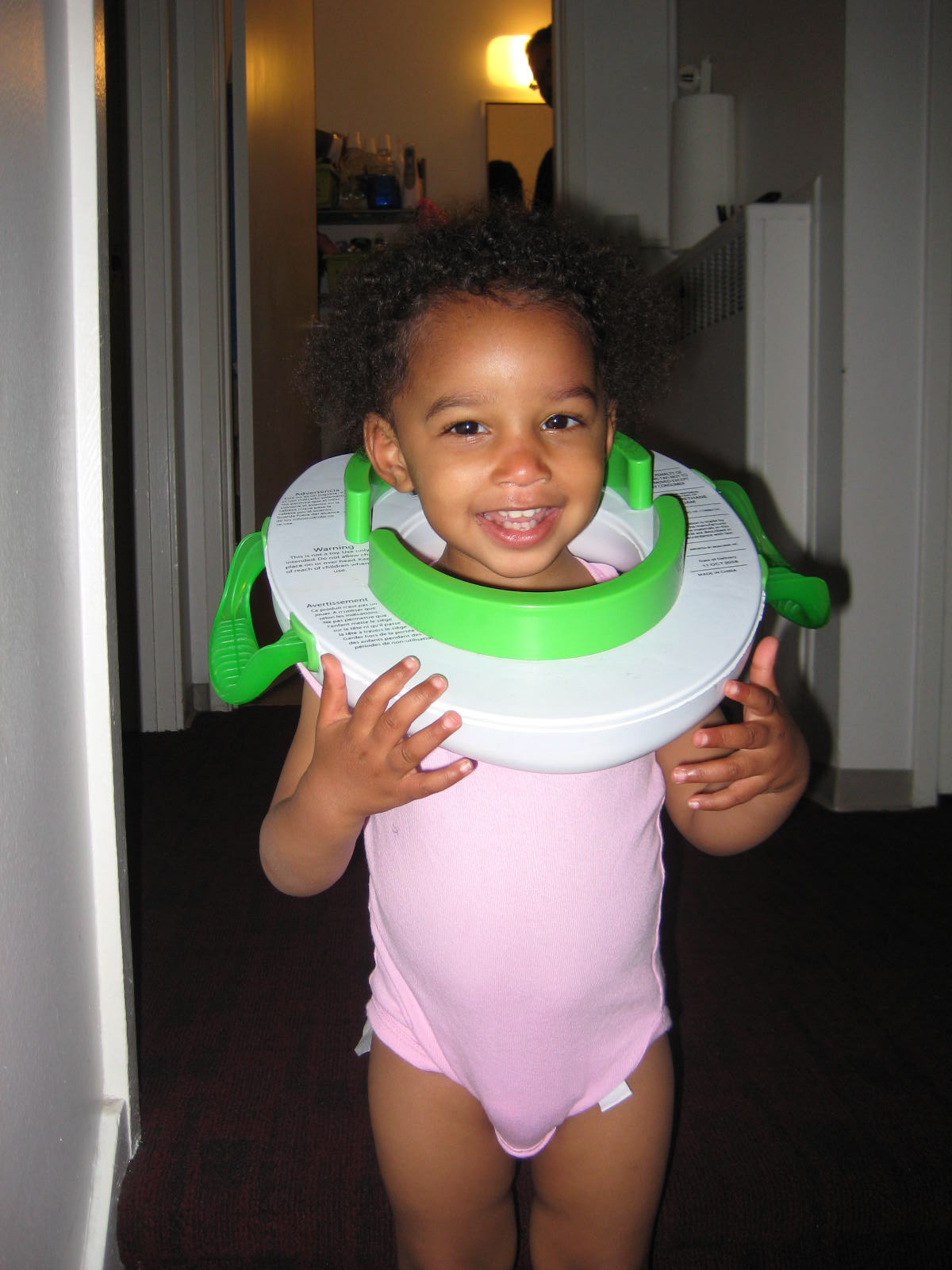
Little A way before the potty training bug bit her

Back then the stand was that no child wants to be potty trained – who wouldn’t prefer to pee and poop as you go, not stopping your daily activities, and have somebody else change you? Of course you need to go hard on the training. In the 50s, 90% of kids where potty trained by 2. Then the next generation came in and said – “Hey, wait! That’s emotional abuse! Let kids take their time, do it on their own time. They’ll be more successful, and you’ll save their psyche in the end too.” So 50 years later, by the 2000s, potty training wasn’t achieved until 3 and later. (And the diaper companies cheered.) Now, with more and more kids in day care and preschool, the centers are like – whoa….3-year-olds in diapers? If the child can say, “Change me!” then that child can go to the toilet! When parents start putting the hard work of toileting and diapering 30 pound children on somebody else, that somebody else is bound to start complaining.  It’s also some of the backlash against this child-centered parenting.

It’s telling how rigid some folks are on these issues. I’m happy to say that many of the conversations we’ve had on this blog have greatly impacted my own parenting. I am one of those people who used to be rigid in my beliefs, because I thought taking a stand meant something about me as a person. I still do. But now I think that being able to be flexible in one’s views – not wishy-washy, but being able to move, and stand, move and stand – is the better place to be. When we’ve argued about spanking, I’ve cut back on my spoon action a bit to contemplate what my other mamas have said. Our homeschooling discussions have really made me reconsider whether public schools can – and will – ever properly serve black children. I’m glad I’m out of the potty training phase with my kids – finally – but if we ever have another one, I’m sure I’ll deliberate about what approach to take given my experiences and the experiences of others – instead of being dogmatic about one way or another.

I still think its fascinating though: How can it be that after all this time, after all these children, that we are still learning – and fighting about – “what’s best?”