
she’s always in my head

The mommy wars are battling in my head. They sound something like this:
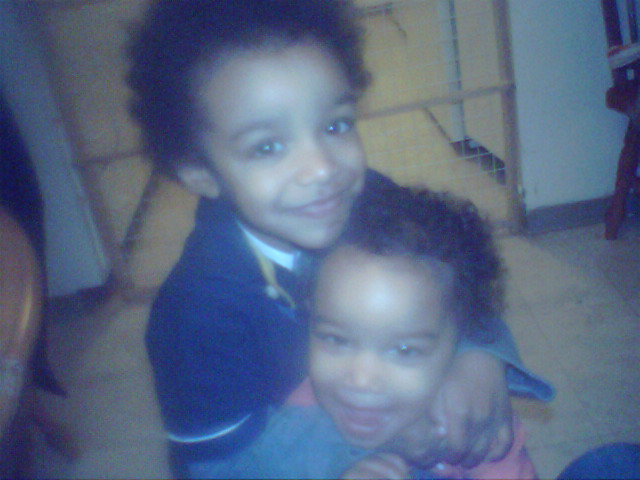
he's not really choking her...lol

I can’t believe you chose to work this summer. You hardly get to see your children. I enjoy working. The two hours I spend with my kids in the morning are really great. It’s true that I don’t always get to see them before they go to bed…What kind of mother are you? You don’t get to see them go to bed, read them that story, even tell them you love them? That’s just a shame. Well, yes, it is sad that I don’t do that during the week, but by working, I’m bringing in much needed income so they can have other things…What is more needed than a mother’s love and time? Money can’t…Yes, but, they spend the majority of their time in preschool anyway, where they are very happy, happier, I think, than if they were sitting at home with me all day. And they are really well adjusted kids, who have tons of friends but still are attached to their parents. I think we have a great balance…Balance? You think it’s balanced to have other people – strangers really – raising your kids? Haven’t you noticed some of the bad habits they’ve picked up from these so-called friends? Well, yes, but…But nothing! You’ve abdicated the responsibility of raising your children to someone else, who isn’t necessarily doing a good job! And you didn’t have to – you chose to! Didn’t your son just ask the other night if you could come home earlier so you could read him a book before he goes to sleep? How did that make you feel?? Well, awful…

The lady in red has a lot to say.

When I decided I wanted to go from my PhD and JD and become an academic, it was for a myriad of reasons. Primarily it was for the lifestyle – the ability to do what I wanted as a career – study what I wanted, make my own life. It was also because I’m generally not a good employee. I don’t respect authority the way I “should,” I don’t like bureaucracy, I don’t kiss a$$, I don’t like small talk, I don’t do face time.

But I also knew that I wanted to work. Being a stay-at-home mom was never an option for me. From the perspective that I grew up with, a black woman who didn’t work was lazy, no matter how many kids she had or how much money her partner made. “Leave It To Beaver”‘s mom was not our reality; Claire Huxtable was. And furthermore, if you didn’t work as a black mother, then you thought you were “better than” the rest of us, with your nose turned up and all. Truth be told, it was not until I moved here, to this very wealthy suburb, that I even knew black mothers who didn’t work. I did not know any black mothers who had nannies or au pairs. And for me, even if the money was flowing copiously, as fascinating as they could be, being immersed in little people’s lives constantly is not engaging or enriching enough for me. And planning charity events would not be either.

This summer, I’m working a 9-to-5 to get a sense of what I might be missing by only going academic. And while I thought I would really not like it so much because of the bureaucracy, face time requirements, and other general BS, it’s really been the lack of time that I can spend with my kids that has really been the largest drawback.

And that’s a huge surprise to me.

At least in grad school, I’ve been a quasi-stay-at-home mom. Working around my class schedule, I can co-op at the preschool, pick my kids up from school in the middle of the day, be available to pick up a sick kid, skip class if I really need to. While I know being an academic is more structured than my life currently, I still see that lifestyle as much more flexible than being an associate at a law firm or working a 9-to-5.

But I’m still working. And hence the mommy wars are constantly going at it in my head.

The mommy wars are partly about privilege, and I think no woman can see the gift and the curse of working and having children more than a black woman. For me, being in this profession as a huge privilege, a privilege that feels uncomfortable. There are very few female law professors. There are even fewer black female law professors. And there are even fewer black female law professors with PhDs. I am (or will be) a rarity. And being rare, in academia sometimes, is a privilege. It’s hard to admit your privilege, especially when you understand the structure of opportunity in our society. Especially when you do not come from a historical place of privilege, and most of your family is not there with you. Yes, I’ve worked hard and yes, I’m bright, but I also had opportunities that had nothing to do with who I am but everything to do with where I happened to be, the chance of being born to certain parents and interacting with certain people who gave me a chance.

It seems that sometimes the meme of being Black in America is that we have to live the life that’s been handed to us. Especially for black women, especially for black mothers, not working a 9-to-5, or a 8-to-6, or a 7-to-7, as I remember my mom doing, is not an option. We, as black women, pride ourselves on working, pride ourselves on doing everything, pride ourselves on not being indulgent or lazy – sometimes taking that to mean that we should be at the bottom of the hierarchy when it comes to taking care of needs. And at one point this was our only reality. We had no choice.

These messages taught me to believe that even if I wanted to not work, being able to live the life that I’ve fashioned for myself feels…wrong. That to decide to use my talents to make life a little easier on myself is somehow…lazy.  And being on the “side” of the mommy wars that favors being at home more than being at work, well, that just feels like being a traitor.

I didn’t write this because I have an answer. Five years into this mommy thing and thirty into this black woman thing, and I’m still just trying to ask the right questions.

Defending Who?

I hate a lot of things about the criminal in-justice system. One of the reasons I wanted to be a lawyer was to reform the system. I don’t think I’ll ever come close to actually doing that, but if I practice law one day, it will be as a public defender. I think people should be held accountable for their crimes against others, but not treated as less than human, either in prison or out. I absolutely agree with Michelle Alexander and the premise of her book “The New Jim Crow”: the criminal justice empire is modern day American apartheid. The other day, I tweeted my support for the prisoners in Pelican Bay who are enduring a hunger strike to protest their living conditions in prison. It looked like this:

gradmommy
while i’m not a prison abolitionist, i am for humane treatment. indeterminate solitary confinement is cruel & unusual. http://t.co/azauUeJ
7/18/11 7:53 AM


I tweeted this on the same day that this young black man was shot to death by the San Francisco Police in the middle of the afternoon in the Bayview, a small but solid population of black folks: (WARNING: THIS IS VERY GRAPHIC – IT SHOWS A PERSON DYING IN THE MIDDLE OF THE STREET)


The original reports were that the young man was unarmed, running from the police because he didn’t pay his $2 transfer fare on the bus. The early reports, and certainly what was believed by the people on the street at the time, was that the police shot the boy for no reason whatsoever, simply because he was running. The scene, caught of course on cell phone video, was reminiscent of the New Year’s Day killing of Oscar Grant, and brought back to memory for all black folks (and I’m sure others) of the racial tensions between Bay Area Police and a small, but present, black minority population.

Evidence quickly came to light, however, that this young man’s death – 19 year old Kenneth Harding – may not have been the work of trigger-happy racist police. A witness – a black man – came forward with a cell phone video in which a small silver gun could be seen only 25 feet from where the man lay dying after being shot by the police. The police allege that the man shot at them first as he ran, and the video appears to confirm that there was a gun at the scene. He also had gun residue on his hand. The video also shows another man picking up the gun at the scene, perhaps in an attempt to hide it. Later, however, the police recovered the small gun. Witnesses have said that they saw the young man shoot at the police from a gun he held under his arm, and technology that measures gun shots recorded, at the time of the incident, a single shot fired, followed 2 seconds later by 9 shots in rapid succession, evidence that the young man got one shot off before the police took him down.

Furthermore, reports say that the young man was wanted as a person of interest in the murder of a woman in Seattle from just the week before, giving some credence to the idea that he would have a gun, and would also run and shoot at police in an attempt to not be apprehended.

The thing is, it seems that none of this evidence against calling the police racist pigs really matters to anyone. At first, there was this outpouring of anger coming from everywhere. My twitter timeline was filled with angry tweets about how unjustified this killing was, how the police are racists pigs, how wrong it was for them to just stand by and watch the boy die. I got emails from colleagues, the whiter the more angry, who in no uncertain words expressed empathy for black communities like the Bayview, and how it was now all too clear why certain communities can’t trust public institutions like the police, or even schools. But once people got more information, instead of continuing the conversation, what did I hear instead?

Muthfvcking crickets.

This bothers me, despite my natural inclination to cast a wary eye toward the justice system. Why? One, because in my heart of hearts, I do believe that had this man been white, he would have been shot too. In my experience, living in a big city: You shoot at cops, you get shot. Period. The end. Would the cops have let him lay on the street and die? It’s hard to say, because I don’t know if the black folks in the community would have rallied around saying, “Fvck the police!!” and “Your career’s is over!” and “Where’s the gun?” Perhaps the cops would have been able to attend to him had there not been the making of a riot around his dying body. Would the mayor be forced into having a community meeting with the Bayview community about this shooting, of someone who is not even from the community, if this had been a white man where there is ample evidence that he shot at the police first? I doubt it.

And what really bothers me the most is this: Where is the outrage that this young man thought it okay to whip out a gun at 4:45 in the afternoon and start shooting in a crowded transit area? Where is the outrage that someone tried to cover up the real facts in this case, by removing the gun and shell casings, attempting to create more animosity between the people of this community and the police they desperately need to protect them against their own people who are trying to destroy them? Why are we not thanking the police department 1) for trying to keep Muni fares low by making sure everyone pays like they are supposed to and 2) for shooting a man who had no such regard for anyone else’s life as evidenced by him pulling a gun to save HIMSELF in the middle of the damn afternoon?

Why does someone have to die – and in this case, perhaps “justifiably” because police must protect themselves in order to protect us and our children – in order for us to rally and hold folks accountable, including ourselves?

While I understand the hurt and pain of the long legacy of police brutality in this country, sometimes wrong is wrong. That’s what we should be teaching our children, no matter what color they are. I was so glad my children were far away from our morning ritual of watching the news Monday morning. I couldn’t have them see Black people yelling at Black cops while a Black man lay in the middle of the street dying because he pulled out a gun and shot at police. So much is so incredibly wrong with that picture, both on the surface and below it.

Why We All Can’t Just Get Along

I’m comfortable with who I am and what I believe in. I’ve always wanted to be a lawyer for the same naive reasons I guess a lot of kids say they want to be lawyers: I truly believe in justice and fairness. As someone yesterday said to me, “Right is right.” I’ve never heard more true words.

I used to wonder why justice was so important to me. Why the littlest amount of unfairness touched me in a place so deep. So there was a time in my life where I routinely took personality tests.  I was obsessed with knowing about myself, trying to understand what made me tick. My favorite test is the MBTI, which splits people into 16 personality types based on combinations of pairs of four dyads: Introverted or Extroverted; Sensing or iNtuitive; Thinking or Feeling; and Judging or Perceiving. My type has changed slightly over the years, and I’m an almost even split between both Introverted/Extroverted and Perceiving/Judging. But as I’ve gotten older, I think I gravate more toward a particular “type.”

I am an ENFP: The Champion.

As a Champion, I’m an easy person to get along with. I smile, I laugh, I joke. I’m charming, in my most humble opinion. I make friends easily too, everywhere I go. But there are some things that I believe in, and when you mess with me and those things, when you mess with one of my values, then…well, all bets are off.

And so my life is one of a strong dichotomy. I’ve been accused of being too serious. I’ve been told to lighten up, take a chill pill, relax, calm down, and breathe. I’ve been told to choose my battles, that nothing in life is that serious, and that I just get too worked up. I’ve been told that I am intimidating, aggressive, overbearing, argumentative, contrary and loud-mouthed.

For telling my truth. For saying what I believe to be right.

I’m working this summer for a large urban school district that ranks at the almost bottom for educational equity. The opportunity and achievement gaps in this district are shameful. So when I go to work every day, and when I interact with my fellow interns who are working at other educational institutions this summer, I’m not always smiling. I’m not agreeing to so-called “community agreements” on how I’m supposed to talk about race, class, and power. I’m not giving everyone the benefit of the doubt that folks have good intentions. I’m not assuming that no one in the room is a racist.

I’m thinking about what needs to be said and done right here, right now, to get it across to these people that a crime is being committed again children – who look like my kids – every single day in the school that’s right down the block.

I’m thinking about what needs to be said right here, right now, to get these folks to stop experimenting on our kids and just teach them to read, write, and count. I’m thinking about wanting them to stop hiding the real issues of racism and classism and white privilege behind hollow conversations of “results-based-budgeting” that have no student results actually driving it.

That’s what I’m doing.

We can’t all just get along because getting along often means being silent. Getting along means being a bystander. Getting along means, if you want to keep it real, making white folks feel comfortable. Well, I’m not here to make you comfortable. I’m not here to make you feel good that you’ve chosen to work in education. I’m not here to sing fucking kumbaya. For me, while I’ve always had a passion for justice, now it’s personal.

See, my baby …


… my beautiful black boy. . .

is starting kindergarten in the fall. And I’m scared as hell.

Look, I don’t need friends, I need foot soldiers. I don’t care if you like me or not. I just want you to be as mad as I am that children like him are undervalued because of the color of their skin.

So I need you to be ready to  work for change. I’ll be right there with you. If I have to piss you off to move you toward action, then so be it.

Let’s get it started.


being black

Written by CocoaMamas contributor Mikila.

I just read an article about a woman named Sandra Laing who is a black South African born to white South African parents.  The problem for her is that she was born in Apartheid South Africa, 1966.

Yes, you read that correctly, a black girl born to 2 white parents.  She was biologically linked to both of them.  It was found that a latent gene from black ancestors popped up and Sandra was the winner of the “look totally different from your parents sweepstakes.”  Unfortunately for Sandra, her visible differences resulted in disconnect from her parents, domestic violence, and many years of guilt and anger.  Today, she is happier and proud.  Reading the article made me think about race and raising my own children.

I recall 2 years ago, my son had just started first grade at a local catholic school.  He didn’t know anyone at the school, and he was not strong at meeting new people.  He mustered enough strength to ask a child if he could play with him, all to be informed that he was too brown to play.  Yes, my little 6 year old son had his first experience with racism.  My initial response was to march down to the school and rip the child’s head, the parent’s head, and the teacher’s head right off.  My husband had a different reaction.  He asked my son, “What did you do?”  My son responded, “I walked away and found someone else to play with.”  Yes, majority of the children in this school are white.  Trust me, I was livid.

Many people probably feel we responded in too passive a way, but as a person who grew up in a posh resort town, I know a lot about dealing with white people on a regular basis.  I thought about my husband’s reaction, and realized, my son will deal with ignorant people throughout his life.  He might as well learn how to handle it in first grade.  We explained to him that his skin color is just fine.  His classmates’ skin color is also fine.  He moved on and life went on as normal.

Three years later, along comes my daughter.  Girls really are wired differently.  She began to pay attention to color at a much younger age.  I had to literally brainwash her at one point, because thanks to Barbie, she told me many times at the age of 3 years old that she wanted to be white with blonde hair.  My little girl went from being a wannabe to “Angela Davis” in mere seconds.  I then had to add another layer to the issue of color.  I explained to her, just as I did to her brother, that her skin is beautiful.  I also had to tell her that other people’s skin color was beautiful to, but for them not her.

This is a complicated issue, because you want to raise well-rounded open-minded individuals.  The question remains, when do you deal with color, and how do you answer those difficult questions?  I was devastated both times I had to face the fact that racism as well as color issues, is something I had to explain to my children.  I realize now, both experiences opened the door for me to show them in small ways how to be proud of their color, heritage, past and future.  It was nice to see even through all the heartache that Sandra Laing found that out too.  Being black is truly beautiful, no matter what someone else will have you believe.

Mikila is a 35 year-old mother of 2 beautiful children:  an 8 year old son, and a 4 year old daughter.  She graduated from college in 1998, and will be attending Law School August 2011 to study Child and Education Advocacy. She is very passionate about helping parents of special needs children, as she is learning more about how to help her own daughter navigate this world.  She has a super supportive husband who is a very active participant in their children’s upbringing. Mikila is also a partner in a debt management consulting firm. A born-again Christian, Mikila also enjoys volunteer work, music, and helping her children grow into the people they are destined to become.

Yeah, I’m Young. So What?

Something that’s really been bothering me lately is all the youth-bashing that has been going on around me lately. Not the typical “teenagers are young and dumb” type of thing, but the subtle dismissal of the around-30 crowd from the above-40 crowd. I suppose every generation feels this way about the generation above them. But when these people are actually your peers, when they are the people you work with, or the other parents you socialize with, it’s actually hurtful and really counterproductive.

Where I live and work, the trend is for parents to be relatively older. Women have generally established their careers in their 20s and early 30s, and had children in their mid-30s. They are now in their 40s, raising their kids. Cool.

In public education, administrators also tend to be older. I suppose working up the bureaucratic ladder takes time.  That’s cool too.

I’m different, which is okay, at least it is with me and my close friends, regardless of age. I had Big A when I was 24, before I had really decided what I wanted to do as a career. I had Little A at 26, right when I was starting my grad school career. I’m 30 now, still working toward my degrees. I have a baby face and am often mistaken for a high schooler. Everyone says I’ll love it in 10 years 🙂

But in any case, no matter what I look like, the truth is – when I start talking about my stuff, my research, my experiences – one QUICKLY understands that I know. my. Ish. I’m not at one of the top graduate schools getting a dual PhD and JD off of my looks (although I’m pretty cute if I say so myself. Just kidding.) I’ve been in graduate school for the past five years doing nothing but studying and perfecting and becoming an expert at what I do. THAT has been my career, my full-time job.

So it truly pisses me off when I’m at a meeting and the over 40 crowd starts talking about how young everyone is and starts pretty much dismissing the 30-something crowd based solely on age, even when the 30-somethings have positions and titles that deserve respect because they worked to get there and have demonstrated superior skills and performance. In education, this is particularly irritating because it is the younger people that are bringing the innovation, that are bringing the fresh perspectives, that are trying to work with folks for the betterment of educating children.

In advocacy groups, especially those wanting to advocate for black and brown children, I think one of the reasons it hard to mobilize parents is that younger parents don’t want to be treated like second-class citizens. If I go to one more meeting where 30-somethings or younger are talked about like they couldn’t possibly know how to do their jobs, or have cogent opinions, or just have anything of value to add, I really might blow.

And when it comes to parenting – UGH. That REALLY gets my goat. I’m young, yes. But PLEASE don’t make the mistake of thinking that I’m a lesser-than parent because of it. My mother was 19 and my dad 20 when they had me, and then had my brother 11 months later. Fast forward 17 years and I had a full scholarship to an Ivy-League university and my brother behind me went to college too. I learned everything about being a great mother from a teenage mother, so at 24 I felt OLD. I’m not perfect, but neither are the 40-something parents I know. We all have the same struggles, and go through the same issues.

I don’t know what this is all about, whether older folks feel threatened or what, but it needs to stop. I want to learn from people who have lived life more than me, but I don’t want my perspectives, my ideas, my expertise to be dismissed solely on account of my age or what I look like.

What is going on? What do y’all think I need to do or say to get these folks to quit it?

You Know What?

Written by CocoaMamas contributor HarlemMommy

You know what’s dangerous? It’s dangerous to speak your mind as a Black child in an inner-city school. I’m an educator. I love (almost) all my students.  As a middle school teacher, I saw tons of kids who chose to be disrespectful, arrogant, or jerky. But except for one or two cases, I was always able to remind myself that they were children. Just kids stretching their muscles of power, testing limits and sometimes making others miserable because they themselves were miserable. As I taught in a school where the majority of students were Black or Brown, my skin color might have gained me some cred at first. Despite what other (white) teachers sometimes said, being Black wasn’t enough for a kid to respect or listen to me. They soon figured out that I liked them, cared about their futures and would do my best to help them succeed. They also soon learned that I knew my subject area and wouldn’t tolerate crap or chaos.

In Maya Angelou’s Heart of a Woman, Maya is summoned to her son’s school one day. Guy had been explaining to some white classmates on the bus about how babies were made. Well, the little white girls freaked the heck out and Guy was in trouble for using bad language in front of students, especially girls. When Maya was in the principal’s office and heard the story, she asked what her son had said about the incident. Turns out, they hadn’t even asked Guy for his side of the story. They just assumed that what the girls conveyed was true. Maya was, of course, upset and demanded to see her son. She then gives voice to how many parents of color feel: You give your child to people who often do not look like you. You have to trust that they will not mar his sense of self, and if they do, you must do your part to repair it. I’ve read this book many times, but reading it last month this part really struck me.

The success of my students was personal for me. The more Black and Brown faces without a degree meant less of those faces in power; meant more of those faces dead or in jail. I knew that my eventual child would be okay academically, but some cop or lady on the street wouldn’t necessarily distinguish between my polite, kind, hilarious kid with the high reading level from a “dangerous thug up to no good.”

I pushed my kids academically, stressed the importance of respect for each other and themselves and laughed with them. (Middle schoolers are hilarious. Especially if you find fart jokes funny. I do.)

However, there are many teachers that are not like me: teachers that call students “dirtbags” teachers that see any deviation from given instructions as dangerous, defiant and insubordinate behavior. Too many Black boys are in special education classrooms because they are “behavior issues.” We have to ask though, how much is it about the behavior and how much is it about the color of the kid? The same behavior — being wiggly in class, speaking without raising your hand, being mouthy — by a white kid in Scarsdale is seen as childish antics, but in a Black or Brown child in Harlem is seen as insolent. (Now if a parent wants to have different standards fine, but schools need to be consistent.)

The guidelines for suspension are so very subjective. Was the student was defiant or disrespectful? Defiant is suspension, disrespectful is a detention. There are shades of meaning there that are left to the beholder. Don’t have too many suspensions on your record or it will be harder to find a school that wants you in NYC. (Students must apply and matched to public high schools in New York City in a complicated system.)

I get it. It is extremely difficult to itemize what exactly is meant by defiant. There are millions of ways a kid will find to be defiant. But we have to do better. We need to somehow quantify how bad an attitude must be before a suspension. Otherwise, we just give license to suspend kids for being jerks instead of working with them through this angsty, trying period in the lives. How many of us would want to be judged for how we were at 14? Yet, by suspending kids for arguably age-appropriate behavior, and not helping them grow through or learn from the process, we are stunting their growth academically and emotionally. We need to hold them accountable for bad behavior, but still care about them as people. We must do better. If that means more time is taken to really piece out events that have occurred, so be it. Just as our justice system would rather let a guilty man go free than an innocent one imprisoned, we need to make sure suspended kids really deserve it.

Schools are supposed to be the place where it’s okay to fail sometimes. You see how far you can push and experience safe consequences. Too often, this is not how school operates for Black children. A student that feels that he is heard, respected and valued is more likely to succeed at school and at life. Teachers are not the bad guys. But I will make sure to be in my kid’s classroom when the time comes. That teacher will know that I am paying attention. I am a fierce ally for the teacher, but I am also an advocate for my son.

HarlemMommy is a breastfeeding, cloth diapering mother of one. She works with middle schools and loves to read. Her husband is very funny and they love to travel. She also writes at www.BoobsAndBummis.wordpress.com.

Mothering Without Shame

Photo credit: thinkloud65

Written by CocoaMamas contributor Rachel B.

“I don’t want you to make the same mistakes I did.”

There is not a black mother on Earth who has not said those words to her daughter.  They are said in anger, resignation, frustration and guilt.  We, like any and all mothers, want the very best for our daughters.  We want them to explore every possibility and to experience things that were beyond our reach.  We also want them to avoid the pitfalls, the traps and the trick doors that we befell us.  Instead of imparting to our daughters wisdom, we often give to them our shame and regrets.  We tell them if only we had listened to so-and-so, not gone to that place, stayed there, or hung out with those people, our lives would be radically different.  We are so quick and so sure that the blame lies entirely with us despite many of us being aware of our unique position at the intersections of gender, race and class.  If we had turned left instead of right or had looked up instead of down, life as we know would not be so hard.

We say these words to our daughters knowing that both black and white spaces endanger a black girls’ journey to self-fulfillment.  We know we are judged by a different set of rules.  Our actions, whether positive or negative, acquire a supernatural ability to exalt or demote the entire black race.  We are also keenly aware of the pervasive double standard that still in full effect in our own communities regarding the actions of black men/boys and black women/girls.  Black respectability politics have placed black women as the gate keepers of our culture although many of us resent it.  While teaching our daughters how to navigate a world that has a morbid fascination with our degradation, we seem to follow one of two paths; hanging our heads in shame or distancing ourselves from our pasts.

“I don’t want you to make the same mistakes I did.”

What are those mistakes?  More often than not, they are sexual in nature.  We feel that we gave it up too soon, too easily, to the wrong person at the wrong time.  We tell our daughters’ we were hard headed, naïve, foolish, stupid and spiteful.  We found ourselves in a position where our private vulnerabilities became public shame.  We are so quick to assume and claim responsibility; we ignore the other very real circumstances that lead to make those choices in the first place.  It is painful to even remember that we had to have sex for survival, that those were in positions of power and authority took advantage of our lesser position.  If we had just listened, we never would have been in that car, in that room, at that party, with that boy, with those men.  If we had just listened, everything would have been ok.

If we are not using our shame to deter our daughters, then we are holding up as an admonition to our daughters those who seem to shamelessly embody the loose morals and decay of our culture.  The baby mamas, poor women, junkies, and the sex workers are plentiful and disposable warnings to keep our girls on the straight and narrow.  We point to them to illustrate what will happen if they don’t heed our warnings.  We may have pity, arrogance, condensation, disgust in our voice but the end result is that for our daughters these women and girls cease to be complex and complicated people and become caricatures.  Their “mess” highlights our accomplishments, refinements, education and position.

It is tempting to believe that if you just follow the rules, somehow you will be protected or at the very least buffered from the sexualized racism that is so omnipresent now.  We see the billboards stating that we are a danger to our children, read the “studies” that declare with  authority that we are not desirable, hear at any given time “hoe” and “bitch” out of thumping cars, while walking down the street, or as a “joke”.  We feel the pain, hurt, confusion, and helplessness though we do our best to be as dignified as possible.  We have to be dignified because we know that we are always being watched.  We look into our daughters’ eyes and see sweetness, innocence, intelligence and curiosity.  We watch them as they run and laugh impervious at the moment to the harsh realities of the world.  We as mothers want nothing more than to let our daughters have those moments but we also know the world will not allow such frivolity.  We don’t mean come off as harsh.  We don’t mean to be so judgmental or to suck our teeth at the girls who we determine to be “ghetto”.  We really don’t mean to hiss that “she” is a “fast ass” and predict she’ll end up in “trouble”.  When communications between ourselves and our daughters is at its worst, we yell out in frustration “You want to end up like her?!”

The reality is that no matter what we do or don’t do, black women and girls will continue to be under attack.  Although Mrs. Obama is accomplished in her own right, she continues to be exposed to some of the most vicious racist and sexist attacks.  A maid who was recently sexually assaulted in New York by one of the most powerful men in the world, bravely reported the attack, and underwent an invasive exam afterward has had her honesty questioned, her identity and that of her daughter exposed in French media and her role as the victim questioned.  Even where she resides has been tarnished as an AIDS building.  Even in death, black women and girls have to prove our worth to have justice served.

Our daughters will be the next generation that will be under attack.  They will be the ones who march, speak, protest, write, dance, paint, sing, and pray in creative protest.  They will have at their disposal their own talents that will enable future generations of black women to reclaim their narrative.  What will not help is shame or separation from their sisters.  When we insist that the fault was all ours, they internalize our shame.  When we use those who are the most vulnerable to as a deterrent, we make those girls the other.  What our daughters need is for us to be tender with ourselves.  When we look at our past with soft eyes, we do the same to others.  Our daughters will see that and not accept debts that they did not incur.  When our daughters are witnesses to our healing, they in turn will learn to do the same for themselves and others.

My Brown Boy?

Written by new CocoaMamas contributor HarlemMommy.  Welcome her to CocoaMamas!

As a Black woman, I was prepared to nurture my brown child.  Showering her with love for her complexion. Empowering him with the strength of his heritage. I had so many books about African-American heroes and trailblazers. Seriously, my grandmother got me a complete set. Lena Horne, Crispus Attucks, Oprah. My kid was gong to love himself, his people and his color.

My husband loves Dave Matthews Band. He played high school lacrosse. Yup, he’s white.

My son? Handsome as all get out and a smile that’s out of this world. Brown? Not so much. He’s Black. He must be; he’s mine.  He’s also my husband’s child. How do I nurture that?

In The Girl Who Fell From the Sky, the main character, Rachel, is often asked where she got her blue eyes. The question is intrusive, but not completely unexpected. The way her grandmother answers however is poignant. “You know Roger’s granddad had these eyes.” This is a lie. A lie told to “protect” Rachel from the white mother who tried to kill her as she herself committed suicide.

Rachel, however, sees the lie for what it is; an attempt to remove her mother, her whiteness, and her complications from her new life. This obviously pained Rachel. If you have to deny a parent, you have to deny a part of yourself.

There’s the rub. You can’t deny a child’s parent and expect the child to be unaffected. Whether you deny the Mom because she’s white or say negative things about Dad because he’s always late with child support.

So where does that leave me? Before meeting my husband, I had a good beat on the world. Biracial people are Black. Yes, race is a social construct, but if you’re Black and something else, then you’re Black. It’s cool to be Black and that’s how society will see you, so that’s who you are. Duh.

It felt good to know so much and not feel ambiguity about race. Then I met this white guy. Then I fell all in love. Now we have this impossibly adorable munchkin we get to raise into a man. A Black man?  Can I call him my little brown boy if he’s not that brown?

Would it be fair to my Scooba to tell him that he’s Black because that’s how society will view him? What if, because he’s so light, people view him as white? How would I feel if he identified as white? Is that “passing”? I would be devastated if he identified solely as white, regardless of how society views him. I would have failed him as a Black woman; as a Black mother. It would mean he was ashamed, that he felt Black was less-than. That he felt I was less-than.

Children are not carbon copies of the parent. You can set a foundation for a child, but he ultimately must get in where he fit in. But how would any of us feel if a part of us that we felt was fundamental to our being was not fully reflected or embraced in our child?

Can I expect him to identify solely as Black? To deny either his Black or white side would be unfair. So when he asks what he is, we’re going to say he’s Black and white. As for how society sees him? That’s society’s problem. Scooba has the right to define himself; as do all of us. President Obama identifies as Black and his white mother approved of this. Am I a jerk that I can’t be selfless and let my son identify as white if he wants to? I’m gonna be that jerk.

Husband and I need to work twice as hard to ensure he sees both parts of himself represented in books we read to him and the media he sees. This means we read Whose Toes Are Those and sing Sweet Honey in the Rock. He’ll see plenty of images of white people, so we’re covered there. We’re going to be extra vigilant not to put him in a box or let others do so either. Scooba determines who he is and where he wants to stand in the world. Is that naïve? Perhaps, but we are not post-racial, so race still matters; and I at least want to have a plan when it comes up. I will fortify my son to stand up for who he is and allow him the space to establish that for himself.

HarlemMommy is a breastfeeding, cloth diapering mother of one. She works with middle schools and loves to read. Her husband is very funny and they love to travel. She also writes at www.BoobsAndBummis.wordpress.com.

On the Legacy of Brown

“…Brown, seen solely as a school case, must be considered a failure.”

– Robert L. Carter, federal district court judge for the Southern District of New York, former general counsel of the NAACP’s Legal Defense Fund, presented part of the oral argument in Brown v. Board of Education in front of the Supreme Court.

Brown v. Board of Education is known for overturning the legal doctrine of separate but equal, which was settled into national law by Plessy v. Ferguson. Plessy was a case that said that a Louisiana statute that MANDATED blacks and whites sit in separate cars was legal. That court essentially held that separate could be equal, and any connotations of inferiority felt by black people was of their own doing, not by the law itself. Brown overturned that, saying that the state cannot enforce laws that required separation, that de jure segregation was inherently unequal because it connotated that one race, i.e., whites, were superior to the other, i.e., blacks.

Prior to Brown, the LDF hadn’t attacked segregation in public schools on its face. Rather, it had made the claim that blacks schools were not equal in facilities, curriculum, etc., and fought for the courts to order school districts to equalize black and white schools. In many cases, this strategy succeeded. But the LDF realized that they could do more; victories challenging the basis of segregation per se in higher education showed that there really was something inherently unequal in state-sanctioned separation. In law schools, for example, access to other students who were to be future colleagues, an alumni network, prestige and traditions the Court agreed were “intangibles” that equalization of facilities could never overcome.

So Brown was decided this day 57 years ago, and “separate but equal” was declared unconstitutional. Continue reading “On the Legacy of Brown”

“No One Can Say Anything To Me…”

So….Ellen Pompeo is running around giving her opinion on race relations, and what black people need.

(h/t @daowens44 on twitter)

The relevant parts are between 45 seconds and 2:45.

As you can see in the video, Whoopi asks her about her plans to adopt a baby of color, and what people have said about that. Ellen Pompeo says, with a certain amount of what she must of thought was black girl sass, “No one can say anything to me cause I had a baby of color…” [Yeah. I paused too.] Then she goes on her rant about HBCUs and the NAACP. She doesn’t think we need “black schools and white schools,” referring to Historically Black Colleges and Universities. She doesn’t think we need the NAACP awards; we only need “People Awards.” And I don’t think she is referring to the magazine.

What makes Meredith Ellen feel this way, let alone think she has a legitimate voice on these issues, that actually don’t affect her, considering she would have never even attended an HBCU or would get an award from the NAACP**?

Cuz can’t nobody say nuthin’ to her cause she already has a black baby. And a black husband. And who really cares what Jill Scott has to say, right? The experiences of black mothers can’t really be worth as much as those of a white mother of a black child, huh?

Hm. Continue reading ““No One Can Say Anything To Me…””