Avatar

Color me stupid but I thought I was getting the hang of this parenting thing.

I have managaed, despite a notorious reputation of killing all living things (a cactus died on my watch), to raise my daughter and my niece, ages 8 and 9.  They are not only potty trained – see I told you Mom – but also independent, use their manners, do well in school and are just magic on a stick.  I don’t want you to have the impression that I have it all figured out or that there have not been some really crappy days (and weeks) that I think I should have stuck with a dog.  I know that soon the girls will be in tween territory and then into the abyss that is adolescence.  As a mixed race woman who identifies herself as African American and a womanist, I am aware the girls need to be prepared to deal with the confusing and painful intersections of race, gender, class among other things.  The Steve Harvey’s, T.D. Jakes, Sotashi Kanazawa’s and thier ilk who want to constrict, control and/or coerce the girls to accept an image that is not of their choosing will be coming on strong.  I have at my disposal Audre Lorde, bell hooks, Toni Morrison, James Baldwin, Alice Walker, Toni Cade Bambara, Paule Marshall, Delores Williams and Jacquelyn Grant.  I have mams, mamis, muthas, aunties, nanas, grandmas, mothers of the church to pray them up, plead the blood, light incense, to dance and shout, and to shield them from my own temper if the need should arise.  I am also blessed to have awesome men folk on my team starting with my husband who mended the eldest’s heart when she came home crying one day and ran into his arms telling him, between snot and tears, that someone had called her ugly.  The girls have their Uncle Moses, a deeply spiritual, openly gay man, who always has a joke and a tickle for them.  Bringing up the rear is my brother James, Pa, Pop Pop, Poppy and a host of men at the church.  So what, dear reader, has me lying awake at night, brow furrowed, and contemplating drinking in the daytime?

An avatar.

Like many parents, we monitor the quality and quantity of media the girls consume.  After trial and error, we found a few sites that were appropriate.  One came out a favorite between the girls.  Fantage is a website that allows children to make thier own avatars, play games for coins that they can use to buy houses, pets and other accessories.  They are also able to safely chat with other players.  The girls are always showing me some new pet or outfit they just bought.  Despite all the (safe) fun the girls were having, something kept bugging me and I couldn’t for the life of me figure it out.  Then it hit me:  Both of their avatars featured white girls with bright blue eyes and various neon hair colors.

I knew I had to handle this carefully. I did not want the girls to feel like they did something wrong or that I was angry with them.  However I was curious to find out why they chose to represent themselves in this fashion.

“You know, I love the pink hair and I think it would look great with your skin tone.  Do you want to see what it would look like?”

“We tried that already.  We didn’t like it.”

I asked them to explain to me what they meant.  With a sigh, they opened up the page with the hair, eye and skin color choices.  There were about 6 skin tones to choose from with 2 being darker than a biscuit.  While there were many eye expressions and hair colors to choose from, only a few of the hair choices reflected styles that many African American girls would identify with.

“See Titi, my skin doesn’t look like that.  I’m darker.”

“Yeah Mama.  I’m not that dark.  I wanted it to look like me.”

They said it so matter of fact I was speechless.  On the one hand it made me feel good they had themselves in mind when they were trying to be creative.  I could not help also feeling angry and sad they felt the choices available did not reflect them.

Don’t get me wrong.  I love that any and everyone can be a pink, pixie dust covered flying dragon that shoots rainbows out their butts if they so choose.  For children, it is a way for them to try out different personas.  They can whimsical, cool, powerful, fierce or anything else they might want.  For children of color, it just seems they can not be those things with themselves as the template.  What does it say to children of color when they can not be complex, nuanced creative beings?  When you can be anything within a white body but with a black body, not so much?

I was pondering the limits of ingenuity for black bodies (especially female) when a few weeks later news broke that the author of the popular blog A Gay Girl in Damascus who described herself as half Syrian and half American was actually a 40 year old white man living in Georgia.  By way of “apology”, Tom MacMaster explained “while the narrative voice may have been fictional, the facts on this blog are true and not misleading as to the situation on the ground.  I do not believe I have harmed anyone – I feel I have created an important voice for issues I feel strongly about.”

So let me get this ish straight.  A white dude living in the South can drape on the oppression of a marginalized body for years like it’s a brand new coat because he wants to create a “voice” and my kids can’t be themselves online?

This is not the first or the last time white bodies have inhabited the “other” in order to prove a larger point.  This is just another stop on a long trip.  With social media becoming with each passing day a critical tool for social justice, how will the internet and the bodies who utilize it be constricted/restricted and freed by it?  With white bodies being able at any point in time able to be the voice of the marginalized and have an audience, it creates a dead zone for those who living those realities.  How will our own children be able to carve out spaces as artists, writers, dancers, teachers, intellectuals and the like when the path is so narrow even in a space as infinite as the internet?

Hair Weaves For Little Girls

I don’t know if it rises to the level of an epidemic, but lately I’ve seen a number of little girls – as in, girls under the age of 12 – wearing hair weaves, wigs and lacefronts.

As black women, our hair issues begin at birth. We black mothers study our girls’ hair texture, waiting to see if those fine baby curls are going to “nap up.” Some of us start putting that baby hair into plaits, cornrows and ponytails as soon as our baby girls are able to sit up. If there’s not enough hair to comb, we brush it as best we can and put a headband on our girls’ heads, so everyone will know the baby is a girl and not a boy (strangers still get it confused, though).

I didn’t really know how to take care of a girl’s hair when my daughter was born. My mother did my hair until I graduated from high school. Although I didn’t relax my hair until law school, I wore it pressed from age 12. I had decided my girl’s hair would stay natural, but I had no idea how to style natural hair.

I was lucky to find a wonderful babysitter, a Mexican woman who taught herself how to care for my daughter’s hair. She styled my daughter’s hair in elaborate beaded cornrows and two-strand twists. Even after my daughter started school and we no longer needed her babysitting services, our former nanny still styled my daughter’s hair.

It never occurred to me to consider letting my daughter wear her hair out, loose, free. I was brought up that only white girls and girls with a certain hair texture – what we used to call “good hair” – could wear their hair out all the time. I shunned the term “good hair” but was still trapped in its mindset. I believed not combing my daughter’s hair would result in it getting tangled, matted, and eventually falling out.

I said complimentary things to my girl about her hair. I told her how wonderfully thick and curly her hair was and how much she should admire it. I bought all the right books and said all the right things to combat my girl’s jealous feelings towards classmates whose blonde and brunette locks swung down their backs. But my actions spoke to a different belief – that her hair wasn’t the right texture.

My daughter and I began having hair battles. I kept her hair washed, conditioned, combed and braided, but I could no longer fit trips to the nanny into our schedule, and I didn’t know enough cute natural hairstyles.

I gave up and took her to the African braiding shop. I thought I’d found the answer to all my prayers. Their cornrows were so perfect! Even without extension hair braided in, the style would last at least two weeks. With extension hair braided in, they would last even longer.

And so we continued down that steep, slippery slope of “your hair isn’t good enough.”

Continue reading “Hair Weaves For Little Girls”

being black

Written by CocoaMamas contributor Mikila.

I just read an article about a woman named Sandra Laing who is a black South African born to white South African parents.  The problem for her is that she was born in Apartheid South Africa, 1966.

Yes, you read that correctly, a black girl born to 2 white parents.  She was biologically linked to both of them.  It was found that a latent gene from black ancestors popped up and Sandra was the winner of the “look totally different from your parents sweepstakes.”  Unfortunately for Sandra, her visible differences resulted in disconnect from her parents, domestic violence, and many years of guilt and anger.  Today, she is happier and proud.  Reading the article made me think about race and raising my own children.

I recall 2 years ago, my son had just started first grade at a local catholic school.  He didn’t know anyone at the school, and he was not strong at meeting new people.  He mustered enough strength to ask a child if he could play with him, all to be informed that he was too brown to play.  Yes, my little 6 year old son had his first experience with racism.  My initial response was to march down to the school and rip the child’s head, the parent’s head, and the teacher’s head right off.  My husband had a different reaction.  He asked my son, “What did you do?”  My son responded, “I walked away and found someone else to play with.”  Yes, majority of the children in this school are white.  Trust me, I was livid.

Many people probably feel we responded in too passive a way, but as a person who grew up in a posh resort town, I know a lot about dealing with white people on a regular basis.  I thought about my husband’s reaction, and realized, my son will deal with ignorant people throughout his life.  He might as well learn how to handle it in first grade.  We explained to him that his skin color is just fine.  His classmates’ skin color is also fine.  He moved on and life went on as normal.

Three years later, along comes my daughter.  Girls really are wired differently.  She began to pay attention to color at a much younger age.  I had to literally brainwash her at one point, because thanks to Barbie, she told me many times at the age of 3 years old that she wanted to be white with blonde hair.  My little girl went from being a wannabe to “Angela Davis” in mere seconds.  I then had to add another layer to the issue of color.  I explained to her, just as I did to her brother, that her skin is beautiful.  I also had to tell her that other people’s skin color was beautiful to, but for them not her.

This is a complicated issue, because you want to raise well-rounded open-minded individuals.  The question remains, when do you deal with color, and how do you answer those difficult questions?  I was devastated both times I had to face the fact that racism as well as color issues, is something I had to explain to my children.  I realize now, both experiences opened the door for me to show them in small ways how to be proud of their color, heritage, past and future.  It was nice to see even through all the heartache that Sandra Laing found that out too.  Being black is truly beautiful, no matter what someone else will have you believe.

Mikila is a 35 year-old mother of 2 beautiful children:  an 8 year old son, and a 4 year old daughter.  She graduated from college in 1998, and will be attending Law School August 2011 to study Child and Education Advocacy. She is very passionate about helping parents of special needs children, as she is learning more about how to help her own daughter navigate this world.  She has a super supportive husband who is a very active participant in their children’s upbringing. Mikila is also a partner in a debt management consulting firm. A born-again Christian, Mikila also enjoys volunteer work, music, and helping her children grow into the people they are destined to become.

Yeah, I’m Young. So What?

Something that’s really been bothering me lately is all the youth-bashing that has been going on around me lately. Not the typical “teenagers are young and dumb” type of thing, but the subtle dismissal of the around-30 crowd from the above-40 crowd. I suppose every generation feels this way about the generation above them. But when these people are actually your peers, when they are the people you work with, or the other parents you socialize with, it’s actually hurtful and really counterproductive.

Where I live and work, the trend is for parents to be relatively older. Women have generally established their careers in their 20s and early 30s, and had children in their mid-30s. They are now in their 40s, raising their kids. Cool.

In public education, administrators also tend to be older. I suppose working up the bureaucratic ladder takes time.  That’s cool too.

I’m different, which is okay, at least it is with me and my close friends, regardless of age. I had Big A when I was 24, before I had really decided what I wanted to do as a career. I had Little A at 26, right when I was starting my grad school career. I’m 30 now, still working toward my degrees. I have a baby face and am often mistaken for a high schooler. Everyone says I’ll love it in 10 years 🙂

But in any case, no matter what I look like, the truth is – when I start talking about my stuff, my research, my experiences – one QUICKLY understands that I know. my. Ish. I’m not at one of the top graduate schools getting a dual PhD and JD off of my looks (although I’m pretty cute if I say so myself. Just kidding.) I’ve been in graduate school for the past five years doing nothing but studying and perfecting and becoming an expert at what I do. THAT has been my career, my full-time job.

So it truly pisses me off when I’m at a meeting and the over 40 crowd starts talking about how young everyone is and starts pretty much dismissing the 30-something crowd based solely on age, even when the 30-somethings have positions and titles that deserve respect because they worked to get there and have demonstrated superior skills and performance. In education, this is particularly irritating because it is the younger people that are bringing the innovation, that are bringing the fresh perspectives, that are trying to work with folks for the betterment of educating children.

In advocacy groups, especially those wanting to advocate for black and brown children, I think one of the reasons it hard to mobilize parents is that younger parents don’t want to be treated like second-class citizens. If I go to one more meeting where 30-somethings or younger are talked about like they couldn’t possibly know how to do their jobs, or have cogent opinions, or just have anything of value to add, I really might blow.

And when it comes to parenting – UGH. That REALLY gets my goat. I’m young, yes. But PLEASE don’t make the mistake of thinking that I’m a lesser-than parent because of it. My mother was 19 and my dad 20 when they had me, and then had my brother 11 months later. Fast forward 17 years and I had a full scholarship to an Ivy-League university and my brother behind me went to college too. I learned everything about being a great mother from a teenage mother, so at 24 I felt OLD. I’m not perfect, but neither are the 40-something parents I know. We all have the same struggles, and go through the same issues.

I don’t know what this is all about, whether older folks feel threatened or what, but it needs to stop. I want to learn from people who have lived life more than me, but I don’t want my perspectives, my ideas, my expertise to be dismissed solely on account of my age or what I look like.

What is going on? What do y’all think I need to do or say to get these folks to quit it?

You Know What?

Written by CocoaMamas contributor HarlemMommy

You know what’s dangerous? It’s dangerous to speak your mind as a Black child in an inner-city school. I’m an educator. I love (almost) all my students.  As a middle school teacher, I saw tons of kids who chose to be disrespectful, arrogant, or jerky. But except for one or two cases, I was always able to remind myself that they were children. Just kids stretching their muscles of power, testing limits and sometimes making others miserable because they themselves were miserable. As I taught in a school where the majority of students were Black or Brown, my skin color might have gained me some cred at first. Despite what other (white) teachers sometimes said, being Black wasn’t enough for a kid to respect or listen to me. They soon figured out that I liked them, cared about their futures and would do my best to help them succeed. They also soon learned that I knew my subject area and wouldn’t tolerate crap or chaos.

In Maya Angelou’s Heart of a Woman, Maya is summoned to her son’s school one day. Guy had been explaining to some white classmates on the bus about how babies were made. Well, the little white girls freaked the heck out and Guy was in trouble for using bad language in front of students, especially girls. When Maya was in the principal’s office and heard the story, she asked what her son had said about the incident. Turns out, they hadn’t even asked Guy for his side of the story. They just assumed that what the girls conveyed was true. Maya was, of course, upset and demanded to see her son. She then gives voice to how many parents of color feel: You give your child to people who often do not look like you. You have to trust that they will not mar his sense of self, and if they do, you must do your part to repair it. I’ve read this book many times, but reading it last month this part really struck me.

The success of my students was personal for me. The more Black and Brown faces without a degree meant less of those faces in power; meant more of those faces dead or in jail. I knew that my eventual child would be okay academically, but some cop or lady on the street wouldn’t necessarily distinguish between my polite, kind, hilarious kid with the high reading level from a “dangerous thug up to no good.”

I pushed my kids academically, stressed the importance of respect for each other and themselves and laughed with them. (Middle schoolers are hilarious. Especially if you find fart jokes funny. I do.)

However, there are many teachers that are not like me: teachers that call students “dirtbags” teachers that see any deviation from given instructions as dangerous, defiant and insubordinate behavior. Too many Black boys are in special education classrooms because they are “behavior issues.” We have to ask though, how much is it about the behavior and how much is it about the color of the kid? The same behavior — being wiggly in class, speaking without raising your hand, being mouthy — by a white kid in Scarsdale is seen as childish antics, but in a Black or Brown child in Harlem is seen as insolent. (Now if a parent wants to have different standards fine, but schools need to be consistent.)

The guidelines for suspension are so very subjective. Was the student was defiant or disrespectful? Defiant is suspension, disrespectful is a detention. There are shades of meaning there that are left to the beholder. Don’t have too many suspensions on your record or it will be harder to find a school that wants you in NYC. (Students must apply and matched to public high schools in New York City in a complicated system.)

I get it. It is extremely difficult to itemize what exactly is meant by defiant. There are millions of ways a kid will find to be defiant. But we have to do better. We need to somehow quantify how bad an attitude must be before a suspension. Otherwise, we just give license to suspend kids for being jerks instead of working with them through this angsty, trying period in the lives. How many of us would want to be judged for how we were at 14? Yet, by suspending kids for arguably age-appropriate behavior, and not helping them grow through or learn from the process, we are stunting their growth academically and emotionally. We need to hold them accountable for bad behavior, but still care about them as people. We must do better. If that means more time is taken to really piece out events that have occurred, so be it. Just as our justice system would rather let a guilty man go free than an innocent one imprisoned, we need to make sure suspended kids really deserve it.

Schools are supposed to be the place where it’s okay to fail sometimes. You see how far you can push and experience safe consequences. Too often, this is not how school operates for Black children. A student that feels that he is heard, respected and valued is more likely to succeed at school and at life. Teachers are not the bad guys. But I will make sure to be in my kid’s classroom when the time comes. That teacher will know that I am paying attention. I am a fierce ally for the teacher, but I am also an advocate for my son.

HarlemMommy is a breastfeeding, cloth diapering mother of one. She works with middle schools and loves to read. Her husband is very funny and they love to travel. She also writes at www.BoobsAndBummis.wordpress.com.

Don’t Talk To Strangers

Written by CocoaMamas contributor Tracy B.

I have two beautiful Black sons. And, yes, I am biased – but they are also truly beautiful. Like most parents, I love when they receive compliments, and like most parents, I teach them never to talk to strangers. But, because they are handsome – their curly black hair and smooth, deep cocoa skin seems to attract attention wherever we go. I try to take it all in stride; after all, I don’t want my boys to grow accustomed to special treatment. I don’t want them to begin to believe that they are special just because some people think they are attractive. In fact, as much as I lavish attention on them and do my best to help them know that mommy thinks they are the most beautiful and special sons any mother has ever birthed, I’m not all that moved by strangers’ curious commentary – just the opposite, actually.

For instance, there was the time when my husband, sons and my younger brother and I were out having dinner at a neighborhood restaurant and the young ladies in the establishment kept coming to our table to comment on how beautiful my youngest son is. The first couple of times, it was flattering, but when a crowd gathered in the kitchen and a small group formed at our table, it was a little much. By the time we were ready to leave, one of the young ladies mustered up the nerve to ask if she could give him a lollipop and pick him up. My husband, who thinks this attention is cute, obliged before I could object. No harm done until another girl took out her camera phone to take a picture of the other girl holding my baby. Needless to say, dinner was over and we have not been back to that restaurant since.

And just yesterday, while shopping at a home furnishings store, the older woman associate comes to greet us and begins to tell me how handsome my two sons are. I thank her and continue on my way as she kneels down and beckons my youngest to hug her. I stood in shock as he hugged this stranger and listened as she asked him, ‘would you like to come home with me?’ When my child nodded ‘yes,’ I was overcome by so many emotions I could barely contain myself.

I wondered – ‘why does ANYONE think it’s appropriate to walk up to someone else’s child and hold them? WHY would anyone ask a child if he wants to go with them and WHY did my child have to say yes?’ Truly, the woman was harmless, and to her, she was just a lady who loves children. She simply saw two beautiful children and did what she probably always does. And that’s all right – except … it’s really not.

It is one thing to compliment someone and tell them they have a beautiful baby, or whatever other form of flattery a stranger wishes to verbalize during a casual encounter. It is another situation entirely when a complete stranger walks up and caresses another person’s child and asks if that child wants to go home with them.

I know what you’re thinking – you’ve heard this same phrase uttered a million times. Maybe you, too, have watched as your child betrayed you by telling some stranger they want to go with them. And you probably think that I am over-analyzing this harmless situation. And, you might be right if millions of children weren’t lured away from their parents by some seemingly nice stranger who wished them harm, instead of good. Because there is no way to distinguish between good strangers and bad, we teach our children to be safe and not talk to ANY strangers because there’s no way to be sure who’s a good guy and who is not so much.

It is for this reason that I would prefer that strangers, look, but not touch. Thanks a bunch for the compliments, but please, keep it moving. It is quite confusing for a two year-old to understand why mommy is so upset about the hug he just gave to the nice lady. Of course he’d never want to go home with that lady, and the family inside joke about how she’d bring him right back is completely true. But, it’s still inappropriate. Because it goes against what I am teaching him when I tell him not to talk to strangers. Already, his young mind has to try and reconcile our lesson to be polite, which means he should speak when spoken to, yet not to strangers??? It’s no wonder our children are confused. But strangers could make these little life lessons so much easier by just maintaining safe, sensible boundaries.

I’m so proud to have two little ones that are easy on the eyes. Prouder still that they are smart and well-mannered, too.  Sometimes, some may say that I am a little over-protective of my boys and they are probably right. But, it’s a strange world out there, and it’s my job as their mother to protect them when I can – even if that means shielding them from seemingly innocent special attention.

Tracy B. is best known as an expert communicator and brand development professional. With extensive experience as a journalist for prestigious national publications, Tracy honed her skills and natural talent for recognizing newsworthy subject matter, topics and personalities in positions ranging from General Assignment Reporter to Managing Editor of daily newspapers as well as monthly magazines. A mother, wordsmith, world traveler and woman of many talents, Tracy B. is gifted while yet demonstrating her truest desire to leave a positive mark on the planet. Using powerful and transformational words as vehicles of communication, bridging divides and authoring an American fairytale one day at a time, Tracy intends to change the world, endeavoring to, in her own way, make each day more meaningful than the last.

I Believe The Children Are Our Future

Teach them well and let them lead the way

Has education in this country ever properly served black children? Sadly, the answer is no. Never has the education system in the United States provide black children with a equal and adequate opportunity to learn and succeed in this country. But still, we fight.

Show them all the beauty they possess inside

This summer I am engaged in two projects of education reform, and I’ve never been more excited to change the world. Not the entire world, but my world. The world that I live in, a world in which very few numbers of black children are suffering in school districts that are failing them. A world into which my two little brown babies will enter, one this year. A world that does not value them. A world that does not believe they can learn. A world that considers them expendable.

Give them a sense of pride to make it easier

The first fight is in San Francisco Unified Public School’s special education department. EdTrust West gave them a “D” when it comes to educating low-income children and children of color. The achievement gap between white students and students of color in SF rank them near the bottom (144 out of 146) of California school districts for both low-income students and students of color. One large reason for that is their special education program. Like many large urban school districts, they enroll disproportionate numbers of black and Latino children in special education, and specifically enroll Black boys in a category of special education called “emotional disturbance” at a rate of 7 times that of other children. Special education in SF is generally an educational wasteland once one is placed in it; while children are supposed to be educated with their same-age peers in non-special ed classes as much as possible, in actuality they are segregated amongst themselves receiving a subpar education that does not challenge them and that leaves them unprepared to lead productive lives after graduation. My job this summer is to analyze their data to provide a solid, clear picture of where they are now and provide guidance as to where they need to focus their efforts to get better. I’m working through an awesome organization called Education Pioneers, which brings together grad students with extensive work experience prior to grad school to work on high impact projects in education reform.

Let the children’s laughter remind us how it used to be

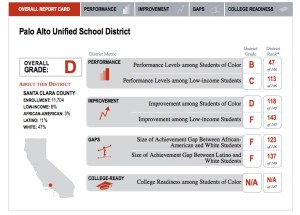
My second fight is at home, right here in Palo Alto. While students of color do well compared to other students of color in the state, the achievement gaps are still huge. Part of the problem here has to do with the fact that 50% of black students in Palo Alto aren’t eligible to attend California’s state universities after graduating from high school. To get into a University of California or California State University, one has to have satisfied something called the “A-G” requirements in high school. Many high schools in California align their graduation requirements with these A-G requirements to make sure every graduate can go to one of these colleges. But not Palo Alto.

Why? Because many of the classes they offer are above what is required by A-G; to offer what would be required by A-G would be, according to some teachers, “dumbing down” of the curriculum. Students don’t take what is required to meet A-G because the classes are too hard. Parents put their kids in summer tutoring and afterschool tutoring just to be prepared for, and pass the class. If a parent cannot afford, or isn’t hip to the tutoring game, then a student will have a hard time even getting through the basic-classes-that-arent-really-basic. Instead of seeing alignment as an opportunity for equity, where a regular class can be added, and the steroids class can be made into a honors, so that there are classes are accessible to all students, the teachers are floating the thinly veiled racial rhetoric of lowering standards.

I decided long ago

Never to walk in any one’s shadow

So I am just all over education news, education articles, education blogs. Someone asked me, given my wild and crazy career path to where I am now, how I got to education as a passion. And the truth is, it wasn’t a passion really until I had children. I didn’t even like kids! But the funny thing is, as soon as I had my children, I started to feel like ALL children are my children. Rather than feeling selfish about securing educational benefits for my kids, I feel like I need to secure educational opportunity for all kids. My heart aches for every child. I never imagined I would feel this way.

If I fail, If I succeed

At least I lived as I believed

I started my SF job yesterday. An hour commute both ways. I collapsed in my bed last night. Tonight, after work, there is a Palo Alto school board meeting. I’ll be there. I’ll be there.

No matter what they take from me

They can’t take away my dignity

Because the greatest love of all is happening to me

The greastest love of all is inside of me

~ The Greatest Love of All, Micheal Masser and Linda Creed

Mothering Without Shame

Photo credit: thinkloud65

Written by CocoaMamas contributor Rachel B.

“I don’t want you to make the same mistakes I did.”

There is not a black mother on Earth who has not said those words to her daughter.  They are said in anger, resignation, frustration and guilt.  We, like any and all mothers, want the very best for our daughters.  We want them to explore every possibility and to experience things that were beyond our reach.  We also want them to avoid the pitfalls, the traps and the trick doors that we befell us.  Instead of imparting to our daughters wisdom, we often give to them our shame and regrets.  We tell them if only we had listened to so-and-so, not gone to that place, stayed there, or hung out with those people, our lives would be radically different.  We are so quick and so sure that the blame lies entirely with us despite many of us being aware of our unique position at the intersections of gender, race and class.  If we had turned left instead of right or had looked up instead of down, life as we know would not be so hard.

We say these words to our daughters knowing that both black and white spaces endanger a black girls’ journey to self-fulfillment.  We know we are judged by a different set of rules.  Our actions, whether positive or negative, acquire a supernatural ability to exalt or demote the entire black race.  We are also keenly aware of the pervasive double standard that still in full effect in our own communities regarding the actions of black men/boys and black women/girls.  Black respectability politics have placed black women as the gate keepers of our culture although many of us resent it.  While teaching our daughters how to navigate a world that has a morbid fascination with our degradation, we seem to follow one of two paths; hanging our heads in shame or distancing ourselves from our pasts.

“I don’t want you to make the same mistakes I did.”

What are those mistakes?  More often than not, they are sexual in nature.  We feel that we gave it up too soon, too easily, to the wrong person at the wrong time.  We tell our daughters’ we were hard headed, naïve, foolish, stupid and spiteful.  We found ourselves in a position where our private vulnerabilities became public shame.  We are so quick to assume and claim responsibility; we ignore the other very real circumstances that lead to make those choices in the first place.  It is painful to even remember that we had to have sex for survival, that those were in positions of power and authority took advantage of our lesser position.  If we had just listened, we never would have been in that car, in that room, at that party, with that boy, with those men.  If we had just listened, everything would have been ok.

If we are not using our shame to deter our daughters, then we are holding up as an admonition to our daughters those who seem to shamelessly embody the loose morals and decay of our culture.  The baby mamas, poor women, junkies, and the sex workers are plentiful and disposable warnings to keep our girls on the straight and narrow.  We point to them to illustrate what will happen if they don’t heed our warnings.  We may have pity, arrogance, condensation, disgust in our voice but the end result is that for our daughters these women and girls cease to be complex and complicated people and become caricatures.  Their “mess” highlights our accomplishments, refinements, education and position.

It is tempting to believe that if you just follow the rules, somehow you will be protected or at the very least buffered from the sexualized racism that is so omnipresent now.  We see the billboards stating that we are a danger to our children, read the “studies” that declare with  authority that we are not desirable, hear at any given time “hoe” and “bitch” out of thumping cars, while walking down the street, or as a “joke”.  We feel the pain, hurt, confusion, and helplessness though we do our best to be as dignified as possible.  We have to be dignified because we know that we are always being watched.  We look into our daughters’ eyes and see sweetness, innocence, intelligence and curiosity.  We watch them as they run and laugh impervious at the moment to the harsh realities of the world.  We as mothers want nothing more than to let our daughters have those moments but we also know the world will not allow such frivolity.  We don’t mean come off as harsh.  We don’t mean to be so judgmental or to suck our teeth at the girls who we determine to be “ghetto”.  We really don’t mean to hiss that “she” is a “fast ass” and predict she’ll end up in “trouble”.  When communications between ourselves and our daughters is at its worst, we yell out in frustration “You want to end up like her?!”

The reality is that no matter what we do or don’t do, black women and girls will continue to be under attack.  Although Mrs. Obama is accomplished in her own right, she continues to be exposed to some of the most vicious racist and sexist attacks.  A maid who was recently sexually assaulted in New York by one of the most powerful men in the world, bravely reported the attack, and underwent an invasive exam afterward has had her honesty questioned, her identity and that of her daughter exposed in French media and her role as the victim questioned.  Even where she resides has been tarnished as an AIDS building.  Even in death, black women and girls have to prove our worth to have justice served.

Our daughters will be the next generation that will be under attack.  They will be the ones who march, speak, protest, write, dance, paint, sing, and pray in creative protest.  They will have at their disposal their own talents that will enable future generations of black women to reclaim their narrative.  What will not help is shame or separation from their sisters.  When we insist that the fault was all ours, they internalize our shame.  When we use those who are the most vulnerable to as a deterrent, we make those girls the other.  What our daughters need is for us to be tender with ourselves.  When we look at our past with soft eyes, we do the same to others.  Our daughters will see that and not accept debts that they did not incur.  When our daughters are witnesses to our healing, they in turn will learn to do the same for themselves and others.

Mistakes and Blessings

Issa Mas of Single Mama NYC got many of us single moms on Twitter thinking when she tweeted:

“Such a strange thing, to have the best thing that ever happened to you come out of the most mind-boggling mistake of your life.”

It’s a thought I’ve had often, trying to reconcile the incredible mistake that was my marriage, with the amazing blessing of the kids that came out of it. I can’t regret my marriage because I’ll never regret my kids. But I’m often torn. When I think of the moments I should have left before the moment I finally did, I’m reminded that if I had, I would have my daughter but not my son. When I think of how foolish I was to have unprotected sex with him so early in our relationship, I remind myself that my reckless choice resulted in the girl who made me into the fighter I am today.

Even now, I’m torn by how to feel about my ex-husband’s lack of involvement in our children’s lives. On the one hand, I’m relieved. When he’s around, he stirs up anger and anxiety. My son can’t stand his father, and my daughter deals with him by keeping her iPod on and tuning him out. But when he’s not around, I feel badly that there’s no parenting balance in their lives. I worry about my teenage daughter not having that relationship with her father to anchor her so she won’t seek out love from random boys and strange men. I worry that my son doesn’t have a role model to assist him with the transition from boy to tween.

Yet, despite how often I beat up on myself for not being perfect at this motherhood thing, I recognize by the only standard that matters that I’ve somehow done pretty well. That standard is – the kids truly are alright. My daughter is motivated and driven. She isn’t a high achiever because I demand that of her, but because she demands it of herself. The standards I set for her in elementary and middle school helped, but as she prepares to enter high school next year, she has an even better handle on what she needs to do to prepare herself for the next level – whatever that is for her – than I do.

My son is probably more confident than he has any business being. His self-assuredness is sometimes dangerous. As one of his teachers told me, “Randy thinks he doesn’t have to study and can just figure it out, which just doesn’t work when learning a foreign language.” Well, sometimes it does, but not consistently. Everything my son loves about himself – his bookishness, his nerdiness, his love of Harry Potter, his hatred of haircuts – makes his father uncomfortable. Not surprisingly, my son wants nothing to do with someone who can’t appreciate his greatness.

I’ve learned tenacity and the power of demanding what you want from my daughter. I’ve learned the power of self-confidence from my son. Time will tell what it is they’ve learned from me, but I know they both know how much I believe in them.

So yes, it is strange how such incredible blessings came from such a terrible mistake. And no matter how crazy it gets sometimes, I wouldn’t have it any other way.

children of privilege

Written by new CocoaMamas contributor Mikila. Welcome her to CocoaMamas!

I recently read an entry regarding children of privilege.  The writer discussed an issue one of her friends was having with her daughter’s growing attitude toward clothing and items of luxury.  The mother of this entry felt her daughter had an unhealthy reaction to her parent’s ability to buy her things.   I too am concerned about my children but I worry about the opposite effect of mine and my husband’s success.

Both my husband and I grew up in very humble beginnings, and worked extremely hard to have a better life than our mothers.’  I constantly wonder that if I over indulge my children will they become selfish and self-centered individuals, or will they reject their comfortable lives altogether out of guilt like some my college classmates did.

Years ago, there a was a Cosby Show episode where Vanessa (played by actress Tempest Bledsoe) was embarrassed that she was rich, all to be informed by her dad Cliff that she need not worry.  He sternly informed her that she wasn’t rich, but that he and her mother were.  I remember watching that episode and thinking, “Is this a joke, I wish my parents were professionals like Claire and Cliff.”

I grew up in the Hamptons on Long Island, NY and was often embarrassed that my mother was on Section 8, while my friends drove themselves to school (many in BMWs and Land Rovers).  I used to wonder what it would be like to live in house where bills were paid, and I didn’t have to work to make extra money to help my mother buy food. It wasn’t until I went to college that I met people who lived on the other side wishing they were me.  I am sure many of you think this is silly and most wealthy black kids don’t wish they were poor, but I have met many who acted exactly like Vanessa Huxtable for the entire 4 years that I knew them.

When I was in undergrad, I remember a lot of my black classmates trying very hard to act like they were poor kids from the ghetto, when in reality they were the children of wealthy professionals.  They entered school one way and left pretending to be another.  These children of privilege denied their lives in an effort to embrace some fantasy world of black poverty they somehow deified.  As the daughter of a mother who worked 2 sometimes 3 jobs, while trying to get 1 degree I loathed the acts of disgrace my peers displayed for 4 years.  Their parents had studied and worked hard to create this life that they pretended never existed.  I often watched on the sidelines wondering what they saw that was so great.  I wished to be in their shoes, and they were pretending to be in mine.

What is it about pretending we enjoy so much?  Why is it that other ethnic groups strive for success and often “fake it till they make it,” while black children of wealth try to pretend to come from less out of some false guilt that they cannot not save all the black kids from the ghetto.  I’ve spent my whole life creating what I believe is a life of comfort, and now I toil over how to raise well balanced children who contribute to society.  They are not pretending just yet, but in time they will encounter people who will either try to make being poor cool, or make them feel guilty about their parent’s status.  These kids will not even realize they are offending the very people they long to imitate.

Thinking back to my years in undergrad, I realize what may have been missing with some of those kids.  I realize most of them were never exposed to the “poor” children from the projects and felt pretending to be them would connect them to roots they feel were ripped away from them with their parent’s success.  Somehow in an effort to protect them, their parents had completely removed them from a society that lacked money, but many times had wealth of culture.

I now strive to expose my children to many different cultures and ethnic groups, while letting them embrace their Caribbean-American heritage.  I want them to be down to earth individuals who are thankful, yet kind to others no matter where they are from.  I also hope they don’t wish they are someone else, and just try to be the best of themselves that they can be.

Mikila is a 35 year-old mother of 2 beautiful children:  an 8 year old son, and a 4 year old daughter.  She graduated from college in 1998, and will be attending Law School August 2011 to study Child and Education Advocacy. She is very passionate about helping parents of special needs children, as she is learning more about how to help her own daughter navigate this world.  She has a super supportive husband who is a very active participant in their children’s upbringing. Mikila is also a partner in a debt management consulting firm. A born-again Christian, Mikila also enjoys volunteer work, music, and helping her children grow into the people they are destined to become.