My Brown Boy?

Written by new CocoaMamas contributor HarlemMommy.  Welcome her to CocoaMamas!

As a Black woman, I was prepared to nurture my brown child.  Showering her with love for her complexion. Empowering him with the strength of his heritage. I had so many books about African-American heroes and trailblazers. Seriously, my grandmother got me a complete set. Lena Horne, Crispus Attucks, Oprah. My kid was gong to love himself, his people and his color.

My husband loves Dave Matthews Band. He played high school lacrosse. Yup, he’s white.

My son? Handsome as all get out and a smile that’s out of this world. Brown? Not so much. He’s Black. He must be; he’s mine.  He’s also my husband’s child. How do I nurture that?

In The Girl Who Fell From the Sky, the main character, Rachel, is often asked where she got her blue eyes. The question is intrusive, but not completely unexpected. The way her grandmother answers however is poignant. “You know Roger’s granddad had these eyes.” This is a lie. A lie told to “protect” Rachel from the white mother who tried to kill her as she herself committed suicide.

Rachel, however, sees the lie for what it is; an attempt to remove her mother, her whiteness, and her complications from her new life. This obviously pained Rachel. If you have to deny a parent, you have to deny a part of yourself.

There’s the rub. You can’t deny a child’s parent and expect the child to be unaffected. Whether you deny the Mom because she’s white or say negative things about Dad because he’s always late with child support.

So where does that leave me? Before meeting my husband, I had a good beat on the world. Biracial people are Black. Yes, race is a social construct, but if you’re Black and something else, then you’re Black. It’s cool to be Black and that’s how society will see you, so that’s who you are. Duh.

It felt good to know so much and not feel ambiguity about race. Then I met this white guy. Then I fell all in love. Now we have this impossibly adorable munchkin we get to raise into a man. A Black man?  Can I call him my little brown boy if he’s not that brown?

Would it be fair to my Scooba to tell him that he’s Black because that’s how society will view him? What if, because he’s so light, people view him as white? How would I feel if he identified as white? Is that “passing”? I would be devastated if he identified solely as white, regardless of how society views him. I would have failed him as a Black woman; as a Black mother. It would mean he was ashamed, that he felt Black was less-than. That he felt I was less-than.

Children are not carbon copies of the parent. You can set a foundation for a child, but he ultimately must get in where he fit in. But how would any of us feel if a part of us that we felt was fundamental to our being was not fully reflected or embraced in our child?

Can I expect him to identify solely as Black? To deny either his Black or white side would be unfair. So when he asks what he is, we’re going to say he’s Black and white. As for how society sees him? That’s society’s problem. Scooba has the right to define himself; as do all of us. President Obama identifies as Black and his white mother approved of this. Am I a jerk that I can’t be selfless and let my son identify as white if he wants to? I’m gonna be that jerk.

Husband and I need to work twice as hard to ensure he sees both parts of himself represented in books we read to him and the media he sees. This means we read Whose Toes Are Those and sing Sweet Honey in the Rock. He’ll see plenty of images of white people, so we’re covered there. We’re going to be extra vigilant not to put him in a box or let others do so either. Scooba determines who he is and where he wants to stand in the world. Is that naïve? Perhaps, but we are not post-racial, so race still matters; and I at least want to have a plan when it comes up. I will fortify my son to stand up for who he is and allow him the space to establish that for himself.

HarlemMommy is a breastfeeding, cloth diapering mother of one. She works with middle schools and loves to read. Her husband is very funny and they love to travel. She also writes at www.BoobsAndBummis.wordpress.com.
Blessed to Be a Blessing

Written by new CocoaMamas contributor Tracy B. Welcome to CocoaMamas Tracy!

I am blessed in that I am surrounded by beautiful Black men. These include (but are not limited to) an older brother, younger brother, husband, and two perfect boys who love their mommy dearly.

When I look at them, I see strength, intelligence, perseverance, purpose, promise and my reasons for living. But somehow, in the midst of all of the positivity and goodness I see in them and feel from them, it saddens me to know that the world doesn’t see the same thing.

For my older brother and I, life has been challenging. Our father was killed when we were very young – and while it has certainly had a profound impact on me, I can scarcely imagine what it has been like for my brother, his namesake. I have watched him grow into an inspiring young man who continues to overcome adversity and defy odds daily. He is a father, a husband, a brother and a mentor and I don’t know who I’d be without him.

My younger brother is a gift from God. He was born when I was 12 years old and has been a joy to our family from the start. Young, smart and saved, he is also an anomaly. A college graduate with a promising future, he is one of those young black men we don’t normally hear about. He loves God and his family and the world is a better place with him in it.

Photo Credit: TellMeWhyImWrong

I married a man who was made to be a great father. When I see the way my husband lights up when he holds our youngest son, I can only smile with pride. This wonderful man brought our first son home from the hospital alone as I recovered from a stroke after his birth. He gently fed our first born with a syringe because he knew that I would want to continue to nurse him when I was able to come home. He takes pride in being a father and he loves his sons tremendously.

Because I am surrounded by strong men who each love me in their own special and beautiful way, I feel extremely blessed. I cannot imagine how anyone who would encounter any of these men would see anything but smart, loving and caring individuals – most of whom would give their last to help someone in need.

I never really thought much about what it was like to grow up as a Black male in America. How could I possibly know what life was like on that side of the spectrum? Being a Black girl, growing into a Black woman – that’s what I know and it is an experience that continues to provide lessons and opportunities for understanding. Becoming a mother was one of the most powerful and scary things I have ever endured.  And as I watch my beautiful young boys grow, I am afraid for them.

It is no secret that Black men are not viewed positively in this world. We could blame television, rap music, or any number of disparate images – but that doesn’t mean a thing. Truth is, when my brothers, my husband, my sons walk out the door, they are seen as criminals, thugs … threats.

I have seen women clutch their bags as my husband passes by because to them he’s a scary, big Black man who’s surely going to rob them. White people have scowled at and scolded my playing toddlers with such hate and disdain in their voices and faces that I wanted to hide my babies away.  People looked and instantly judged my younger brother in his locks and baggy pants, assuming that he was just an everyday thug menace to be monitored.  All the while they remain true to who they are and keep proving the world wrong, but I still worry for them.

I know that they have to experience life – for better or for worse – as who they are. It is beyond our collective understanding why Black people have been burdened with being hated, used and abused. This is not a diatribe about race relations – or at least that was not my intention when writing it. This is a writing to express how much I wish the world would change. I wish I could just love my Black men freely, without fearing that they will be taken away or hurt. I wish I could raise my precious sons and send them out into the world without worrying whether they will encounter racism in school, on the playground, or anywhere – because it is painful and they don’t deserve to have to endure it.

Somehow I hope that they will be able to fly above all of the hate and pain and disappointment in the world. Just as they all are blessings to me, I hope that they will be able to find peace and prove wrong all of the stereotypes that have been passed down from generation to generation. I pray that when they look in the mirror each day they see what I see. May they see their beauty so clearly that it is reflected off of them so brightly that anyone who encounters them can’t help but stand amazed – by their character, their commitment to greatness and caring for their families and themselves.

May my brothers, my husband and my perfect, precious sons know in the depths of their souls that they are loved, that I am proud and that God made them all for a divine purpose. And it is a blessing to be Black. It is a grand responsibility to be a Black man and I am here to help them be the best that they can be – thankfully blessed to also be a blessing.

Tracy B. is best known as an expert communicator and brand development professional. With extensive experience as a journalist for prestigious national publications, Tracy honed her skills and natural talent for recognizing newsworthy subject matter, topics and personalities in positions ranging from General Assignment Reporter to Managing Editor of daily newspapers as well as monthly magazines. A mother, wordsmith, world traveler and woman of many talents, Tracy B. is gifted while yet demonstrating her truest desire to leave a positive mark on the planet. Using powerful and transformational words as vehicles of communication, bridging divides and authoring an American fairytale one day at a time, Tracy intends to change the world, endeavoring to, in her own way, make each day more meaningful than the last.

Black Teachers are Umm…Black Too

My mother is a teacher. She has been a teacher all my life, first at day cares and preschools, then at a family day care in our home. A few years ago, she began teaching in the public school district in Philadelphia. She teaches in an elementary school that is 96% black, with 95% of the children eligible for free or reduced lunch. The school is located in a high poverty, as well as high crime neighborhood. Children come to school with no supplies, sometimes no clean clothes, and often hungry. My mother and her colleagues often not only teach the children, but they feed and clothe them. My mother did not have to become a public school teacher. She chose to because she loves black children.

So when Joel Kline, the former head of the New York City Public Schools, and DropOut Nation, a blog that covers school reform, both criticized the NAACP for joining forces with the American Teacher Federation in their effort to close 19 NYC schools, I instinctively gave pause. Both sources made the claim that effectively said that the NAACP were “hurting black children,” who, in their opinions, the group was supposed to be protecting. The teachers’ union and the NAACP say the lawsuit is based on the fact that the City should be fixing the schools, rather than shutting them down. In their view, the City’s process of gradually phasing out the schools means that the students left behind inherently get a worse education than the students in the schools that replace the shut down schools. The City is also allowing charter schools – which notoriously do not have to hire unionized teachers – access to the facilities previously held by the phased out schools. The City argues that the unions and the NAACP is standing in the way of reform and meaningful student, and parent, choice, and that all the union cares about are teacher jobs. They consistently express their “disappointment” at the NAACP for failure to protect black children.

But aren’t black teachers black too? Continue reading “Black Teachers are Umm…Black Too”

Kids and Money

A few years ago, while visiting the home of a friend, I noticed a book on her kitchen counter about raising kids without a sense of entitlement.

It made sense to me that this friend would have such a book. She and her husband, both professionals, are doing well financially. I didn’t think to copy down the name of the book, because I didn’t think I’d ever find myself in their situation. I was still suffering the financial constraints of the newly divorced. “My kids know we operate on a budget,” I said to myself – and by budget, I meant we generally were living paycheck to paycheck. It never dawned on me that my kids would see our situation as anything other than a struggle.

Fast forward five years. My oldest child, my 14-year-old daughter, is now a teen. Like many teens, her tastes exceed my budget. She wants to wear designer jeans. Shopping is a hobby or a fun pastime. She also loves good food (no Mickey Ds for this kid), concerts and Broadway shows.

Nothing wrong with any of that. I raised her to have good taste. Still, there are practical limits to how much of this I can fund. Continue reading “Kids and Money”

On the Legacy of Brown

“…Brown, seen solely as a school case, must be considered a failure.”

– Robert L. Carter, federal district court judge for the Southern District of New York, former general counsel of the NAACP’s Legal Defense Fund, presented part of the oral argument in Brown v. Board of Education in front of the Supreme Court.

Brown v. Board of Education is known for overturning the legal doctrine of separate but equal, which was settled into national law by Plessy v. Ferguson. Plessy was a case that said that a Louisiana statute that MANDATED blacks and whites sit in separate cars was legal. That court essentially held that separate could be equal, and any connotations of inferiority felt by black people was of their own doing, not by the law itself. Brown overturned that, saying that the state cannot enforce laws that required separation, that de jure segregation was inherently unequal because it connotated that one race, i.e., whites, were superior to the other, i.e., blacks.

Prior to Brown, the LDF hadn’t attacked segregation in public schools on its face. Rather, it had made the claim that blacks schools were not equal in facilities, curriculum, etc., and fought for the courts to order school districts to equalize black and white schools. In many cases, this strategy succeeded. But the LDF realized that they could do more; victories challenging the basis of segregation per se in higher education showed that there really was something inherently unequal in state-sanctioned separation. In law schools, for example, access to other students who were to be future colleagues, an alumni network, prestige and traditions the Court agreed were “intangibles” that equalization of facilities could never overcome.

So Brown was decided this day 57 years ago, and “separate but equal” was declared unconstitutional. Continue reading “On the Legacy of Brown”

“No One Can Say Anything To Me…”

So….Ellen Pompeo is running around giving her opinion on race relations, and what black people need.

(h/t @daowens44 on twitter)

The relevant parts are between 45 seconds and 2:45.

As you can see in the video, Whoopi asks her about her plans to adopt a baby of color, and what people have said about that. Ellen Pompeo says, with a certain amount of what she must of thought was black girl sass, “No one can say anything to me cause I had a baby of color…” [Yeah. I paused too.] Then she goes on her rant about HBCUs and the NAACP. She doesn’t think we need “black schools and white schools,” referring to Historically Black Colleges and Universities. She doesn’t think we need the NAACP awards; we only need “People Awards.” And I don’t think she is referring to the magazine.

What makes Meredith Ellen feel this way, let alone think she has a legitimate voice on these issues, that actually don’t affect her, considering she would have never even attended an HBCU or would get an award from the NAACP**?

Cuz can’t nobody say nuthin’ to her cause she already has a black baby. And a black husband. And who really cares what Jill Scott has to say, right? The experiences of black mothers can’t really be worth as much as those of a white mother of a black child, huh?

Hm. Continue reading ““No One Can Say Anything To Me…””

Looking for Some CocoaMamas

If you hadn’t noticed, it’s gotten a little lonely around here 😦 So I’m looking for some CocoaMamas to join me.

Are you a black mama? Do you blog? Do you want to? CocoaMamas is looking for a few writing Mamas or Mamas who want to write. I’d love to mentor Mamas who want to get into the blog writing business and feature already established writers. I’m interested in ideas on how to make the site better and more useful or informative.

Reply in the comments or email me: gradmommy [at] gmail [dot] com. I really look forward to hearing from you!

From the Crates: These Are My Confessions

originally posted January 2010

The following is an abridged and edited version of a post I wrote more than a year ago, but I thought it was fitting for a Mother’s Day post.

I am not a good mother. At least not by the standards that have been set up for the current generation of a certain ilk of  mothers. A generation who is expected to place their children at the center of their universe, and make all decisions about their adult life revolve around what is supposedly best for the child. A generation that is expected to sacrifice their own happiness to make sure their children are happy. A generation that has been fed the idea that having children is a choice, therefore if you choose to do it, you must accept all the self-sacrificing consequences that go along with it. Continue reading “From the Crates: These Are My Confessions”

Is the high black abortion rate a problem?

I’ll spare you the suspense: I think not. Now read on for the rest.

Here’s my position: I’ve never had an abortion. And I don’t think I ever will. I have friends and family who have. I am staunchly pro-choice. I was kind of pro-choice before having children. I am even more so after having children. It’s a responsibility only those who truly want to do it should take on. We don’t support parents in this country. And arguments about all the people who want unwanted kids are BS. Look at how long kids stay in foster care. 

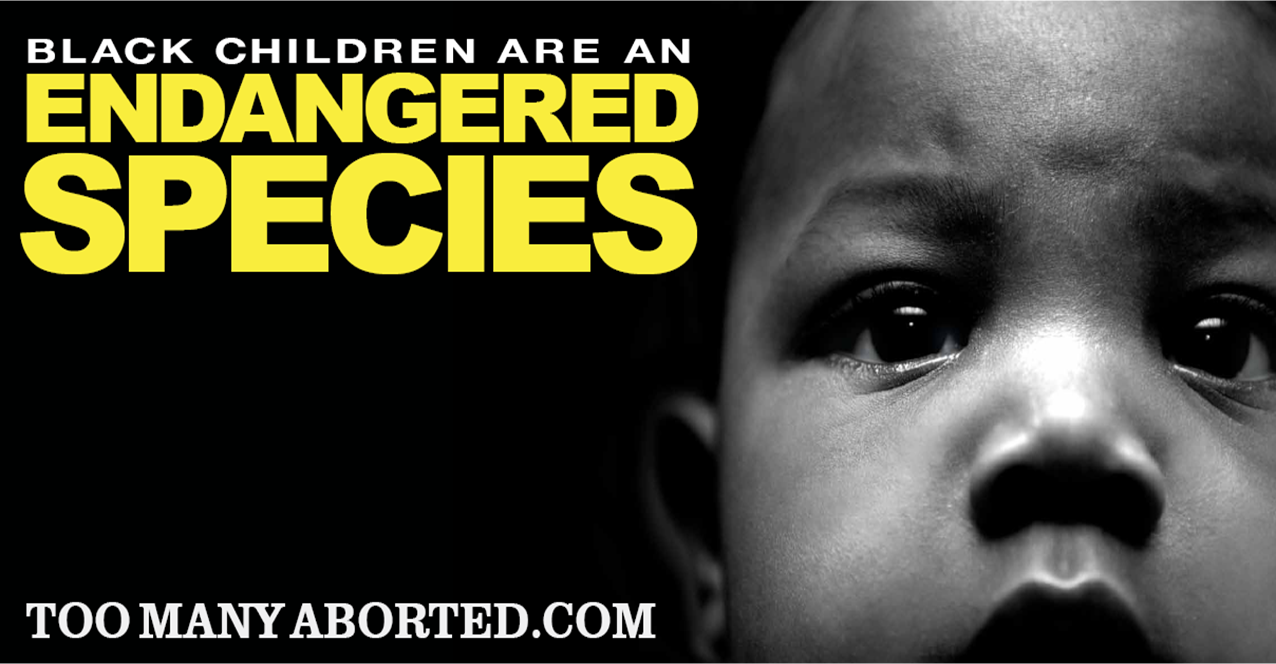
So here’s the deal. As I regularly troll the internets for stories about black children and black mothering, I came across this op-ed from Dennis Byrne, a columnist at the Chicago Tribune, commenting on the billboards across the country that try to shame black women into not having abortions. Although he is neither black nor a woman (his words), he thought it his (duty? calling?) prerogative to comment on the “high abortion rate among blacks.” Here’s the gist:

Political correctness and ideological dictates discourage discussion of the culture of some black communities as explanative of violence, ignorance, high rates of abortion and other dysfunctions. But for those communities, culture is described by the growth of a matriarchy, as displayed by the many grandmothers raising their daughters’ children. By the absence of men in child rearing. By men who prey on young women who have never learned what to expect from decent, caring and responsible men. By the collapse of the family and the destruction of men’s and women’s traditional, balanced roles in making children strong enough to resist the challenges of today’s broader culture of irresponsibility, casual sex, substance abuse and other plagues.

In this op-ed, Byrne rehashes an old, but reborn, theory: that there is something intrinsic to black “culture,” independent of any outside factors, that accounts for the disproportionate numbers of abortions in black communities.

This makes my blood boil. One, because as a scholar who studies culture, he doesn’t know what he’s talking about.

First: on culture. Byrnes defines culture as “the behaviors and beliefs characteristic of a particular social, ethnic or age group.” Um, not quite, homie. Where do these beliefs and behaviors come from? They don’t just spring forth from the middle of the earth, waiting for people to adopt them. Culture is not “created” nor does not exist in a vacuum. Culture is both responsive to and part of shaping structure; many sociologists, such as myself, explain culture as the opposite side of the coin to social structure. The growth of a matriarchy (which is largely a myth, I believe to demonize black women) and the dearth of men available to actually father their children are events, happenings; they are not culture. Nor did not happen outside of the influences of social structure. Many factors colluded to affect that outcome: collapse of manufacturing industry; subsequent high rates of black male unemployment; mass incarceration; felon disenfranchisement; the crack cocaine epidemic.

Culture reflects options available within a given social structure. Yes, people make choices, and they have agency. But agency is not what we think it is as total free will, ability to choose anything and everything. Culture reflects what one BELIEVES to be their options, what one can do with what one is given. So black “culture” can never be defined as one thing, one way of being, one way of behaving. Because we live in a myriad of structural positions, and some of us have options that are not available to others and vice versa. And among the options, some of us choose #1 and others choose #4 and so on.

THIS is not all there is to black culture, despite the moniker...

The “collapse” of the family structure is less to do with any possible independent effects of culture than with the structural effects of class. As I’ve discussed here before, a class structure that allowed for families of any configuration to make a decent living would have more time for child rearing. A school system that did not grossly and blatantly favor wealthier children over less wealthy children would be one in which all women could be educated enough to take care of themselves, and not fall “prey” to vicious and violent men.

If you want to change how people behave, you need to change their options. You need to change what is available to them. You need to change their structural reality.

And two, if the pro-choice side is the “right” side, why should we care about disproportionality?

Making arguments about cultures connection to disproportionality makes clear that true intentions are to get rid of the option to abort altogether. For if you are pro-choice, do you even care about disproportionality? Or rather, should you? If you believe that anytime a woman gets pregnant but for some reason – any reason – does not want to go forward with that pregnancy, she should have the right to choose to end the pregnancy, then every abortion should look the same to you. Regardless of the race of the woman. Disproportionality then appears to be that black women are having more unwanted or mistimed pregnancies, but are also using this option, the option to terminate, more than other women.

This can be interpreted multiple ways, but I’ll offer two that I find the most liberating. First is that black women are more aware of their reproductive rights, are more in tune with what they do and do not want, and are more willing to choose to abort. If you are pro-choice, this doesn’t seem to be a problem – black women are, in not the best language, taking advantage of exactly the right Roe v. Wade stood for – the right to make a decision about your body without anyone else second-guessing you or interfering. Calling these numbers a problem feeds into the idea that black women are not capable, or are somehow ignorant (or culturally deficient), of making this decision for themselves.

Second, this can be interpreted as other women – white, Latino, Asian – are not as gender liberated as black women. Bryne in the article above – as do many men – lament the “matriarchy” in the black community as a disruption of “balanced” gender roles. Who said gender roles had to be balanced? Instead of considering that black women are having too many abortions, maybe women of other races are having too few. In other words, women of other races are less willing to have abortions when they actually would choose to under different structural circumstances. Again, with culture as the flip side of structure, women of other races may feel as though their options (culture) are limited, despite Roe v. Wade, given their structural position.

This is not to say that black women do not experience and live under patriarchy. They absolutely do. But the facts are that black women are less likely to marry than other groups. Not being legally bound to your oppressor is sure to make a difference.

Spoken from a sociologist who studies culture: If you want black women to stop having abortions, if that is your true goal, you need to change their world. You need to make it so that there are no reasons for why a pregnancy would be unwanted or mistimed.

A billboard does not change the world. It just pisses people off.

on baldy-heads and aliens

“Did Big A get a haircut?”

I look over at my precious boy, fresh from the barbershop. His experience with getting a haircut so different at five than it was at three, when her would scream the entire time. Once, there was an entire patch of hair, the size of a quarter that just wasn’t cut cause the barber couldn’t take it anymore! But now, he loves getting his hair cut. It tickles around the ears, he tells me, but getting a haircut is no big deal. And getting to go to McDonald’s afterwards…well, that makes up for any unpleasantness.

So when a preschool “friend,” and I use the term begrudgingly, asked me this afternoon whether Big A had gotten a haircut yesterday, I happily said, “Why yes he did! And doesn’t it look lovely?” Because, of course, I think it does. I love the way the close cut makes little black boys look all grown up by allowing you to focus on their faces. I love how I can really stare into my angel’s eyes, with his long eyelashes and deep brown irises that really seem to look into his gentle soul.

But apparently, I’m alone in this appraisal. For this little girl said, “No. He has no hair. He looks like an alien.”

I was shocked. Taken aback. Then outraged. Angry.

For it dawned on me that this was not the first time some child had said something disparaging about Big A and his haircuts. I remembered him telling me how the kids at the other school called him “baldy-head” whenever he got a haircut, and how they were not saying it in a nice way. I remember him telling me that it hurt his feelings when they said that. I remember him telling me that he was never going to get a haircut again.

As I thought about this, I looked around the playground. As much as we lament what little black girls go through with regards to their hair, I never thought about the fact that little black boys face their own hair issue when surrounded by boys who are not black like them. As the only black boy on the playground, Big A was also the boy who has the least amount of hair. In relation to all the other children, even the boys, he WAS bald. All of the other little boys had a significant amount of hair on their heads – hair that flopped in bangs on their forehead, around their ears, on the nape of their necks. Some boys had more closely cropped hair, but enough to run a little gel in it and make it stand up or lay down. Certainly not bald. And, as we all know, kids DO have funny-shaped heads. When all the hair is removed, things can look a bit…well…strange.

Of course, though, to me, I didn’t see it the way this little girl did. All my life I’ve seen black men get haircuts, from high top fades to taking it all off. It’s normal to me to see men and boys with hair of all different lengths, from locs like my father’s to the floppiness of these little boys to the boxes that were popular in the 90s to Big A’s curly Qs when he was a baby to the close cut he gets today. I’ve seen it all, so none of it shocks me.

But these kids, raised in elite suburbia, have not. They don’t live around people who are different than them who do other things with their hair. So a little black boy with a close cut is a novelty to them. And when something is strange, they ridicule and “otherize” it.

Even when it is as beautiful as this.