Is “Terrorist” the New “DooDooHead?”

I got a call today from the assistant principal at my son’s school.  In a very serious-sounding and sincere message, she informed me that a child in my son’s school called my son a “terrorist” during a dispute in the cafeteria.  I was assured that the other child was receiving appropriate consequences, and that my son’s teacher has been alerted to “keep an eye” on my son.

I appreciated the phone call.  I always appreciate hearing about what is going on with my children at school.

But part of me wonders if we’ve taken student discipline too far.

I’m always on edge whenever I receive a phone call from my son’s school.  Last year, he was suspended for bringing a small pocket knife to school.  At first, he said he brought the knife to school for his “Metals Club.”  Later, he admitted he just thought it was cool and wanted to show it to his friends.  He never threatened anyone with it, and he got very upset when the kids he showed it to began acting afraid of it.

Despite his age and lack of intent to do harm, the NYC Department of Education’s zero tolerance policy meant an automatic suspension from school.  He’s an excellent student, and probably the least violent kid you would ever meet.  But thanks to zero tolerance, he received the same punishment as a child who brought a knife to school with the intent to harm another student.

The NYC DOE’s disciplinary code contains a variety of suggested and mandatory disciplinary actions for a range of student offenses, including “using profane, obscene, vulgar, lewd or abusive language or gestures.” 

It is certainly useful to have citywide standards, rather than leaving everything solely to an individual school’s principal to decide. 

But as I remember it, using “profane, obscene, vulgar, lewd or abusive language or gestures” is a rite of passage of fourth grade. 

I’m not excusing the kid who called my son a terrorist.  For the record, we are African-American, but we are not Muslim.  I do not know the race or ethnicity of the other child, but there is nothing about this incident that makes me believe the other child used the word “terrorist” as a racial or ethnic slur.  I am certain the kid has no idea what that word really means, except that’s he’s heard it enough to know it’s bad, and used it to indicate that my son is a bad person. 

Is that profane, obscene, vulgar, lewd or abusive?  I don’t know. 

When my son got home, I asked him what happened in school today.  He talked about his social studies project, but didn’t mention the terrorist incident until I asked him what else happened.

“___________ called me a terrorist,” he said.

“And how did you feel about that?”

“It upset me a lot.”

“Why?”

“Because I’m no terrorist!”

“And what is a terrorist?”

“They’re bad people who blow things up.”

A bad person who blows things up.  Not a nice word to call someone, sure.  Grounds for any disciplinary action beyond, “Don’t do that again”?  I’m not sure.

I used the moment as an opportunity to talk to my son about name-calling in general, even in jest, and to make sure he doesn’t retaliate – whether it’s against this kid, or some other kid – by calling someone a terrorist.  I hope the other kid gets a similar lecture from his parents.

And then I hope both my son and theirs return to the business of being profane, obscene, vulgar and lewd, as is the wont of 4th grade boys.

What do you think?  Am I under-reacting to this?  Should I take this more seriously?  Is the school overreacting?  How would you feel if someone called your child a terrorist?  Would you want the school to let you know?

Black Girl Pain…

Sometimes I’m at a loss for words when I contemplate the world our children face.

Sometimes I’m at a loss for words when I consider the realities of raising Black children in a world where their image and likeness once idolized and adored has become the source of scorn and sorrow.

Being a Black adult is a trip – few of the subtleties of racism and the backhanded compliments  are rarely lost to us…I’ve become immune to the “you’d be pretty with straight hair…”  and the implications of   “you got light eyes…”. I feel sick and in those moments wish I could swallow a melanin pill and turn myself Blacker than midnight with wilder and woolier hair –  maybe even like Medusa with snakes releasing venom into the heart of those who don’t know the Beauty of my people in all of our glorious shades….

But being a Black kid?

Having to constantly PROVE that you “want” to learn, that you “aren’t like” the prevailing stereotypes…

Being a little brown girl and seeing that the other brown girls who are SUPPOSED to represent you look NOTHING like you.

Oh where or where have all the brown girls gone oh where. oh where could they be?

I think I first realized it when I saw the “Living Single” billboards. I KNOW that the sistahs (Joan and em) represented the diversity of Black: from mocha latte to lovely chocolate…. yet I remember slamming my breaks, and going back around the corner when I looked up and saw the advertisement. Staring down at me was a group of women, all  the same muted, palest shade of beige… As yellow as I’ve been called, I was offended.

And it has continued…the women and girls becoming lighter and lighter and lighter…leaving me to wonder : oh where or where have all the Black girls gone, oh where oh where can they be…

There are a few these days I’ll see, but certainly not enough to inspire our young daughters and sisters and nieces to look in the mirror and REVEL.

Not enough for our sons to proclaim Black is beautiful: from red bone to midnight…Black is BEAUTIFUL.

SO we must. By embracing ourselves and Each Other.

Chronically Colored

I have chronic illnesses. I have bipolar II, fibromyalgia, gastroparesis, and now something wonky is happening with my bladder (sorry if that is TMI). When you have chronic illnesses, you have to be chronically on it – taking care of yourself is not an option, it’s a necessity. Especially when you have other folks depending on you. But especially because you have you depending on you. You were put on the earth to do great things, and you can’t do them if you are always sick.

Sometimes I forget this. I don’t do things that are “bad,” like smoking cigarettes, or doing illicit drugs, but I do things that are “bad” for me, in my personal situation. I might have too much wine. I might not get the 9 (yes 9) hours of sleep that my body demands. I might drive my car to campus instead of riding my bike, removing the little bit of cardiovascular exercise I need to ward off the depression. I might “forget” to eat. I might be on the internet for hours instead of getting my work done. I might overcommit. I might say no and feel guilty. I might not go to church. Things that help me heal, I might not do.

Having chronic illnesses means being constantly on the watch. I have to watch myself, watch my moods, watch my habits, watch my bodily functions, watch my behaviors. Whenever I think things are okay, that I can back off, turn away, something happens and… BAM! I’m sick, on my ass, clawing my way back to the light. I have to be forever vigilant if I am to stay well.

It’s kind of like being a parent of color.

As a parent of color, we are constantly on the watch. I’m constantly listening to my children’s language, making sure no words of self-doubt or self-hate have crawled into their mind space. I’m constantly monitoring their daily interactions, wanting to be sure that the adults around them are affirming of their existence. I’m constantly aware of the children they play with, noting if issues of skin color come up, noting who they naturally veer toward, noting who they avoid and who avoids them. I can’t listen to the radio in the car, or watch BET, cause my own people are conspiring against them. I’m constantly thinking these days about the kindergarten that will happen next year, how my boy might be the only black child in his classroom, and subsequently, his sister left behind to be the only black child left in her preschool classroom.

Being “colored” is like a chronic condition. Just when you think it’s safe to be “normal,” to be a normal mom who sends her kid to school with no worries other than will she finally let go of my leg this morning….BAM!

Be vigilant.

Politics of Black Hair

When rocking my daughter to sleep, I often spend time delighting in the patterns her hair makes on her head.  Like many people, her curl pattern is not uniform; it’s looser in the front and top, creating a soft crown of hair that I love to touch.  The hair in the back is more tightly wound, creating beautiful coils that dot her scalp.  The hair on the sides gently fan out in little waves, framing her tiny ears.

When I take her out in public, however, I sometimes forget to see the beauty of her hair, scanning as I am for the disapproval of others.  I find myself apologizing for the lint that her curls tend to trap.  If she’s just come from her father’s care, I interrogate him: “did you brush it before you left?!?”  In response to suggestions that her hair is short, I tensely explain, “it is growing; it’s just curly, so you can’t tell.”  The well-intentioned offers by relatives to “cornrow it so that it can grow” do not help.  In response, my back stiffens, and I plaster a smile on my face: “oh no; she’ll never sit for that.”

And, she won’t sit for it.  My 15-month old doesn’t like to be restrained, and since learning to walk and run, she doesn’t have to be.  But the truth is, I don’t want her hair braided or corn-rowed, because I like her poofy little afro.  Her short hair isn’t bothering her none, and it certainly doesn’t bother me.  My daughter is beautiful every day, whether her hair is long or short, lint-speckled or fresh from a washing, curled tight or billowed around her head like a halo.

I wish I could tell people this.  Tell white folks who have no experience with black hair that her coils are near perfect in their uniformity; that although more complicated to handle, black hair is the most versatile in the world.  Tell black folks who should know better that black hair needs moisture, not grease; gentle detangling, not too-tight cornrows; that every kink, standing for itself, does not have to be brushed out.  I’d like to tell everyone to abandon their obsession with long locks for my girl; stop teaching her at such an early age that she is less beautiful with tightly coiled hair.

But mostly I just smile and nod; it seems like such an uphill battle, and at this point in my life, I’m used to it.  After having worn locs for 2 years, a cousin asked me before I got married, “you’re gonna perm your hair for the wedding, right???”  When I go to the salon to get my hair re-tightened, the other stylists insist on standing near my chair, staring at my hair, and asking inane questions like “how does it stay???” Just yesterday, I thumbed through the pages of Essence magazine, and found not one article on natural hair care.  There was no end, however, of articles offering maintenance tips for chemically straightened hair.

I don’t begrudge other women the opportunity to make hair choices that are right for them.  But it saddens me that my family and friends don’t always appreciate the beauty of textured hair.  I don’t understand how you can be a licensed hair stylist but have absolutely no understanding of the basic mechanics of dreadlocs.  It’d be nice if acknowledgment and celebration of natural hair on black women went beyond a superficial pop-culture fixation on larger-than-life afros and perfectly groomed locs.

Until that day comes, I continue trying to shield my daughter from an onslaught of messages that undervalue her beauty, while navigating an aesthetic landmine of my own.  I’ve been talking about cutting off my locs and rockin’ a short afro for 2 years now, but I can’t work up the courage to do it; it seems I, too, am invested in a white beauty standard that prizes long hair.  Taking scissors to it all, however, just might be what liberates me from all this hair oppression, finally freeing me to delight in my child’s hair–and my own–whether we’re inside the house or out.

So much on my mind that I can’t recline…

Grad school is a trip.

Everybody wants evidence. Sources. Citations. Quantitative. Qualitative.

Daily I’m bombarded with “how do you know?” , “where did you get this?” and my favorite “who else has said this?”.  As you can imagine, anecdotal evidence nor my experience just isn’t enough. That’s my professional life though, so I expect it….

I get offended when, during informal conversations, parents and teachers  ask my opinion and then quickly dismiss my suggestions.

It happened recently.

Twice.

In their “Yeeeahhhh, butttt….” I could hear “Where’s your evidence?”, “Who else said this?”… “How do you know?”

Well this one’s for ya’ll:

I’m one of the luckiest ones I suspect; I have the good fortune of being both a parent and a teacher. Thirteen years in the classroom and sixteen years as a parent have made me something of a resident “expert”. According to Malcolm Gladwell in his book Outliers , 10000 hours is all that being an expert in virtually ANYTHING requires.

Hmmm….in terms of being a mother, I figure that’s 24 hours in a day X 365 days in a year – 65 days of summer and winter vacations away from him puts me at 7200 hours in a year.  If I multiply that by 16 years that gives me 115,200 hours.

As far as my teaching goes: 6 hours/day multiplied by 160 (low estimate) school days in a year puts me at 960 hours a year. If I multiply that by 13, I get 12480 hours of teaching. That does NOT include summer school teaching OR my position as an adjunct faculty member.

So yeah. I’m an expert. Dagnabit. 🙂

On Parenting/Teaching

The first two years are CRUCIAL for setting the tone. Much like the first two weeks of school. In both instances, the decisions you make (or don’t), the culture you create (or don’t), and the rapport you develop (or don’t) with the young’uns determine the next 9 months or 16 years.  I’m not saying it’s impossible to establish balance, peace, and harmony later on, but understand the struggle that awaits…

And even when the foundation has been laid, no crystal stair spirals to greet thee.

I tire of us blaming the children.

I tire of the shock and awed adults who just “can’t understand” how this happened.

I tire of the blame being placed on teachers.

I tire of the blame being placed on parents.

Our children/students don’t really need us to be their friends.

Our children/students need us to be their parents and teachers.

Our children/students don’t really need us to be cool and hip.

Our children/students need us to be firm and consistent.

Our children/students don’t really need us to smother, shelter, and protect them from the real world.

Our children/students need us to equip them with the critical consciousness, spiritual/ethical/moral grounding, and emotional competence to navigate and negotiate the real world.

Our children/students don’t need to do as we say.

Our children/students need us to do as we say.

Sincerely,

Salina (expert parent and teacher :))

WebMD Can Kill You

As anyone with an Internet connection who’s ever wondered about that weird bump on their back, that unfamiliar sensation in their chest or that rumbling in their tummy knows, the one thing you don’t want to do before going to see your doctor is look up your symptoms on WebMD. 

WebMD and similar medical information sites are the opposite of the doctor’s creed: “first do no harm.”  When you type symptoms into these sites, they invariably find the most lethal, life-shortening diseases imaginable.

Thanks to WebMD and its progeny, a few years ago, I thought the benign mass my doctor found during a routine examination would turn out to be an extremely rare and incurable form of bone cancer.  Earlier this year, WebMD had me convinced I was suffering from esophageal cancer.  In the back of my mind, I had already started thinking about contingency plans for the kids’ parenting, whether or not my life insurance was paid up, etc. 

It turned out I had a small stomach ulcer that was completely cured with a few weeks of medication and sensible eating.  That episode also cured me of self-diagnosis via WebMD.

Apparently, I should have passed the lesson down to my daughter.

On the first day of school last week, my 13 year-old daughter rushed me at the door as soon as I got home.  “Mommy, I got a fever at school!”

I felt her forehead.  She felt mildly warm, but nothing alarming. “Umm-hmm. Did you take anything?”

“No.”

“Take some Advil.” 

She scowled at me, clearly annoyed that I wasn’t fawning over her.

There was no school for the rest of the week because of Rosh Hashanah.  I knew whatever was causing this mild temperature spike would be over in time for school on Monday.  She, of course, was not so convinced.

The next day, she again announced that she had a fever.  Not enough of a fever to cause her to cancel plans with her best friend, nor enough to choose to stay home instead of seeing Wicked with me.  It was just enough of a fever for her to demand peppermint tea from Starbucks before the show and to try to get me to run down and buy her concessions during the show’s intermission. 

I agreed to the peppermint tea, but refused the snacks.  WebMD didn’t say Twizzlers can help reduce a fever or soothe a sore throat. 

“You don’t care that I’m sick!” was the not-unexpected response.

The next day, she announced, “Mom, I have strep throat.”

“Really? And this is based on….”

“I looked up my symptoms, and I have all the symptoms of strep.”

I felt her forehead.  Not even slightly warm this time.  “You don’t have strep.”

“Why not?”

“For one, you don’t have a fever anymore.  This isn’t strep.”

“Mom, I’m really sick!  You have to take me the doctor!”

I wanted to laugh, but didn’t.  WebMD strikes again, I thought.

Being the unsung dramatic actress that she is, my daughter did not let the strep thing go until I finally agreed to take her to her pediatrician.

The nurse checked her temperature (normal), ears (uncongested) and throat (slightly reddish but otherwise unremarkable), and then asked, “So what’s been going on with you?” 

My daughter began reciting the list of symptoms of strep throat from WebMD.

 “Okay, honey, but is that what’s going on with you?”

“Yes!”

The nurse took a throat culture.  We waited the required five minutes for the results.

“Good news!  It’s not strep.  There’s a nasty throat virus going around, but it typically clears up in about 3-5 days, which is about where you are now.  So you should be able to go to school on Monday.”

I shook my head.  It cost me $55 for the doctor’s office to confirm the “nothing’s wrong with you” diagnosis that I had made in my living room.  My daughter felt vindicated by the mention of “throat virus.”  I thought of my mother, who would have blown sulfur powder down her throat and made her drink two tablespoons of cod liver oil.

I gave my daughter the “don’t self-diagnose using WebMD” speech afterwards, but I don’t hold out much hope.  After all, she’s a kid with an Internet connection and access to a site that helps reinforce her belief that she’s much smarter than Mom.  I just hope she doesn’t self-diagnose herself into hospice care before she makes it out of 8th grade.

whose tubes are these?

While still in the hospital, after I gave birth to my second child, I had the fleeting thought that maybe I should have my tubes tied. I approached the subject with my doctor and she didn’t give my semi-request a second thought. “In order for me to have done that for you at 27,” she said, “you would have had to have asked a LONG time ago!” By a long time ago, I suppose she meant eight or nine months. She did the right thing, because although I talked big stuff about not wanting any more children, I completely planned, and currently cannot imagine my life without, my third, and final, child.

This last time around, I was adamant the entire pregnancy. My doctor got to the point where she just recited my request for me on her way into the room during regular visits. As it happened however, she was on vacation when I went into labor three weeks early. I ended up with a very frank, satirical, smug surgeon. It didn’t bother me just how dry and tired he clearly was, because I was in “third baby mode.” I was quite certain that I was an old pro at this point and all would be well. Somewhere after the epidural it occurred to me however that I had forgotten to bring up the tubal ligation. I stared up at my c-section team in a panic and blurted out the big news. My first response came from my surgeon, who I later affectionately likened to Larry David. He told me, “well you know this is a Catholic Hospital and they adopt policies which are generally against that procedure.” I was immediately flippant, if the Catholics wanted to frown on me for giving birth to only three kids they could go right ahead. Sorry, but the epidural had set in by that point and I was about as frank as he was after that.

The one-two punch was concluded by the only black female attendant in the room. She blurted out that, “because I was on Medicaid I would not be covered for that procedure.” Now I was certain I must have been on drugs. Thankfully, Larry David checked her and told her I had Aetna and I didn’t have to black out on her real quick before my baby was born.

It was finally settled, not only would my insurance cover it, my regular OB had it written in my chart that I was serious about tying those knots and it was taken care of. It left me wondering though, how is it that birth control is still left in the hands of others in today’s fouth-wave-feminist age? How much voice do we really have in the “control” of our bodies and birthing plans? Particularly when it would be far less painful if our male partners put forth the effort!  I wonder if the Catholics would sneer at that snip as well?

And So It Begins…


Garvey's 1st Day on Earth

 I knew from the moment we decided upon his name, Garvey, he was going to be someone special. Of course, every parent feels this way about his/her child(ren). But, something in my soul knew he was meant to be. We didn’t plan him, he just kinda made his way to us. We fought a lot, but he brought us together. In the saddest moments I’ve had recently, his smile, semi-funny-but-not-really-funny jokes made me laugh, his dancing has kept me entertained… he’s been my rock. He is going to go far in life… His life has purpose!

Natural-Born Revolutionary

And now, he is going to school.  I discussed here the struggles we were having finding somewhere for him to go to school. On Friday, we finally found out where he is going to school and it happens to be one of the better schools in NYC. It’s conveniently located a few blocks from his father’s job, and my research tells me this is exactly where I want my son to begin his educational path to greatness. I’m quite pleased. He will live with his father during the week and stay with me on weekends. We worked this out in his best interest and I anticipate his success with this arrangement.

And so we’re opening the next chapter: School.

If I cry one more time…

New school clothes: Check
Fresh haircut: Check
Thomas and Friends Bookbag: Check
The Ability to Wipe Himself After #2: Check

Lately, I’ve just been watching him, this firey ball of energy who loves hugs, kisses, trains, and Michael Jackson. This beautiful prince whose future is so bright, this man-child I made. I’m just in awe of him sometimes… I get caught up in loving him so much, it can be overwhelming.

I’m ready. I’m ready to let my baby go out into the outer world we call school. I’m ready for him to make new friends, have new experiences, and be in the care of someone responsible for a bulk of his education. I’m ready for the cuts and bruises. I’m ready for pictures of turkeys made of his handprint. I’m ready for his first written sentence. I’m ready for him to say, “Mommy, don’t kiss me in front of my friends!” I’m ready for everything that comes with taking this next major step…

…I think.

*sniff*

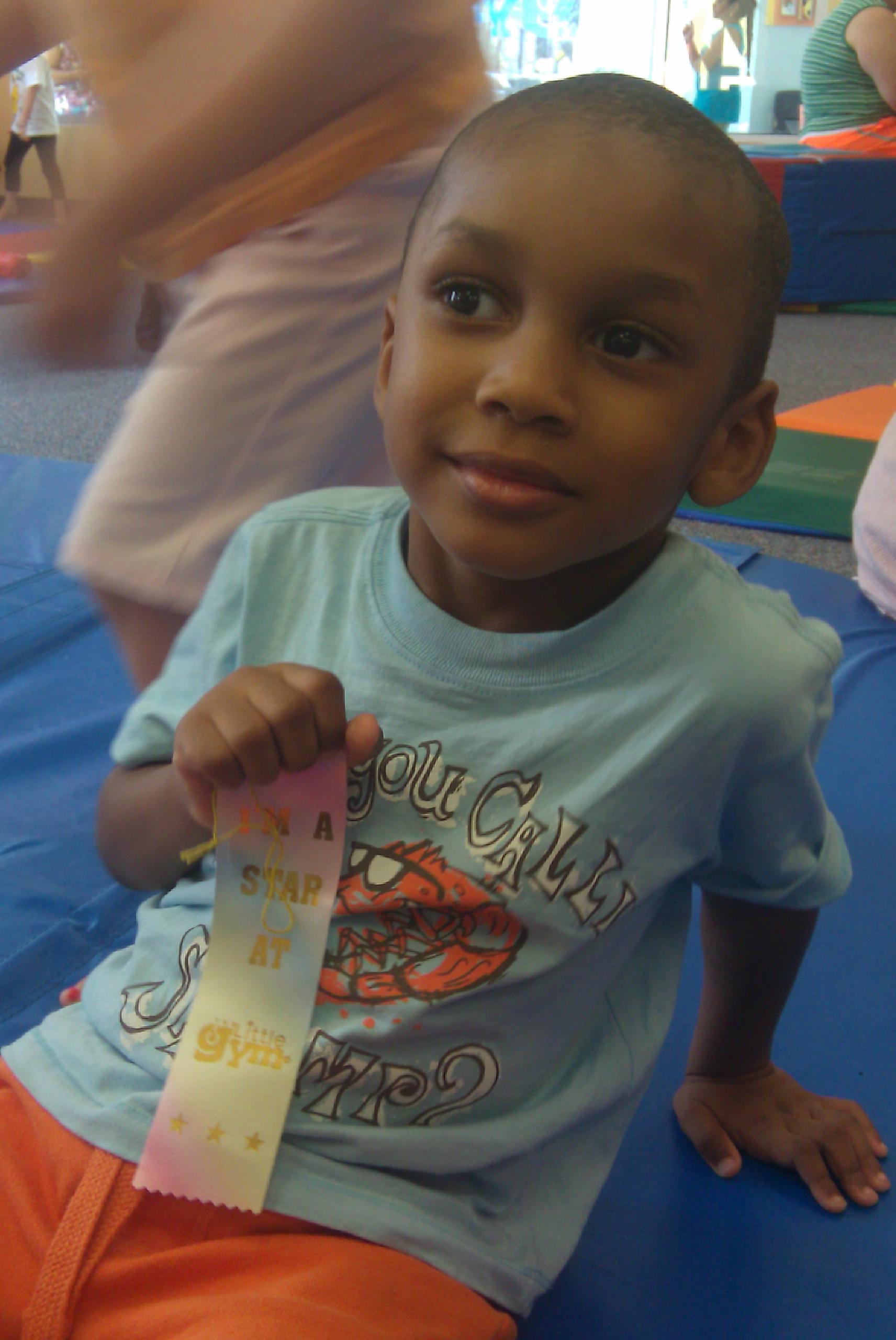
I'm A Star

Yes, Baby… you are

Fathers and Daughters

I still remember his deliberate movements; his even-paced, leisurely walks around the block in the late afternoon sun; the slow grin into which he would break when I read to him in French.  At 66, my grandfather was not the authoritarian he had been when raising my mother.  With my sister and me, he was all warmth, his smiles and displays of affection a constant reminder of his approval of us.  He visited during the summers, and the room in which he stayed was named “chambre de Pere-Pere” even after he returned to Haiti at the end of his visits.  After he died, my mother summarily announced that the room was no longer “Grandfather’s room;” instead, it was just the TV room.  She wore only black and white for one year to mourn his passing, despite the fact that their relationship had not been everything she wanted it to be.  One of the first colored items of clothing she wore when her grieving period was complete was an embroidered short-sleeved linen shirt that had belonged to him.  Even now, when I see men wearing Guayaberas in the streets of Miami, I am reminded of my Pere-Pere.

For reasons at once complex and simple, my daughter does not know her maternal grandfather; they have never met.  My relationship with my father is strained; and the offenses that have passed between us are made heavier by our cultural differences.  A West African man, he is comfortable neither acknowledging the pain he has caused his children, nor spontaneously reaching out to connect with his daughters; because he is an elder, we must contact him first, and keep contacting him even if he chooses not to respond.  An American girl, I’m well versed in pop psychology; I know that toxic people, even parents, do not deserve space in my life.  As a result, I’ve made peace with the distance between us, no longer needing his validation.  We talk on occasion, but the conversations are often muddled by his insistence on settling the score, noting what I did or did not do that requires his reprimand.

It’s okay, necessary even, to give myself what my father has not been able to give me.  But what of that which my father could give to my daughter?  I would love to marvel at his ability to be tender and understanding with her in a way he cannot be with his first-born, much like my mother probably marveled at my grandfather’s soft touch with my sister and me.  There must be something liberating about being a grandparent; freed from the burden of active parenting, grandparents are only expected to offer love, unfettered by the messy complications of disappointment in failure, or anxious hope for success.  And just as easily, grandchildren offer only love in return, aware that a grandparent’s love is more truly unconditional than that of their parents.

I think about the possibilities of that unconditional love between grandfathers and granddaughters when I do call him; I am always hopeful that our conversation will finally be less about who wronged whom, and more about catching up.  My daughter babbles cheerfully in the background, and instantly his voice softens.  “Oh, I can hear her,” he says wistfully.  “She must be so big, now.”

Black to School

A new year has began. I look around me in my Civil Procedure class, and of the 60 or so students, I am one of four black people. Not a bad number, you might think. But I know better. Just because they are black, doesn’t mean we’re fighting the same battle. I’m just sayin.’ I don’t know them, so I assume I’m fighting alone until experience tells me otherwise.

The class begins with a discussion of Walker v. City of Birmingham, decided by the Supreme Court in 1967. Already my stomach is sinking. Anything about Birmingham, Alabama in the 1960s is not really something I want to talk about on the first day. Not when I’m surrounded by fresh-out-of-undergrad-white-folks-who-have-never-paid-a-bill-and-really-believe-they-are-here-based-on-their-own-“merit”. Shit.

But in it we go. Short law lesson: The case is about Walker et al, with the et. al. including MLK Jr. and Ralph Abernathy, appealing a decision by a lower Alabama court. The city had an ordinance on the books that gave it broad discretion in who to issue a permit to. Bull Connor refused them a permit to march twice during the Easter weekend in 1963. They started small protests anyway, so the city got a judge to issue an injunction – an order that said they were not allowed to march or protest in any way. Now the ordinance was pretty unconstitutional, and the injunction just mimicked what the ordinance said. But the ordinance is a statute, and the injunction is an order of the court.

The men marched anyway. Bull Connor and his police arrested them and jailed them, of course. Then the city filed a motion for contempt of court, because the men violated the injunction. And that’s the issue that went to the Supreme Court. And the Supreme Court upheld the contempt order. You cannot violate an injunction, no matter how unconstitutional it is, out of respect for the “rule of law.” You must challenge the injunction, in front of the court who ordered it, before you violate it.

Fine. I love legal analysis. Of course, there are reasons to agree with the court’s ruling, and reasons to disagree. There were dissenting opinions.

What gave me pause in this class was that after we’d discussed the case, the professor decides that we all need to understand the “context” of the case. Generally, I’m all for that. I’m a sociologist; I believe context is paramount all the time. But when you are the 1/4 black contingent, and suddenly huge powerpoint photos of black people, black children being hosed, attacked by dogs, beaten with billy clubs, and inhumanely jailed, you wonder if “context” is really the right word.

The next slide put up is Martin Luther King Jr. sitting in that Birmingham jail, writing his Birmingham letter, and the professor asks the class, what would you have done in this man’s situation, and then adds on quickly, well, of course this is a trick question because these images being projected into living rooms across America is what led to the Civil Rights Act of 1964. And everyone laughs.

But to me, what made it a trick question was the fact that these people would have never been in MLK’s position, never in his position to put black children on the street because all the black adults were in jail, never in MLK’s position to break the law in homage to justice over order, never in MLK’s position to stare down water hoses and dogs because their skin color would never have been black. It is not a hypothetical they have to truly contend with.

But for me, and the millions of students that go into classrooms this year, the hypothetical feels real. A girlfriend of mine told me a story of her six-year-old who was taught about segregation and MLK in his first grade classroom. This mother is very light-skinned, and her child brown-skinned. After the lesson at school, the child came home and told his mother that if things ever “went back,” he’d have to leave her. He might also have to “fight, like MLK did.” Why? Because the teacher didn’t take any account of the fact that in teaching this “lesson,” the only black child in the classroom might take it literally, and not place it in its historical context.

In other lessons, this teacher, attempting to be “historically correct, not politically correct” had black children act out being slaves on a field trip to a plantation while white children looked on. This teacher bound the hands of two black girls in a lesson about slavery order to make it more lively. Another teacher had black children create fugitive slave posters of themselves.*

While black parents have fought hard to have “our” stories told in schools, something has gone horribly wrong in implementation. Has your child been the recipient of this psychological attack disguised as a history lesson? What is the alternative for teaching all children about the sordid legacy of oppression in this country without making the historically oppressed relive their oppression?