
What She Sees

When my daughter was born, complications at the hospital made it so that we were discharged before we established breastfeeding.  I was desperate to nurse her, believing that it was the healthiest start for her, and I was already wary from pumping around the clock.  Our pediatrician advised me to go to a particular lactation center near my home. “Don’t worry,” he assured me; “They’ll get you on track.”  And he was right: Magalee* had me breastfeeding during my very first visit to the center.  It took over 2 months for breastfeeding to become comfortable for me, and I returned to her on an almost weekly basis.  Some of the visits were comic:

Me: It still hurts when she latches on!
Magalee: Okay, put her on the breast….
Magalee: What the heck is that?  That’s not what I taught you!
Me: Well, the book said—
Magalee:  What did I tell you about those books???

Over the next year, even after breastfeeding was firmly established, Magalee continued to be a guide for me as I learned to take care of my baby.  I called her with whatever questions or concerns I had, and she always responded with the same patient and encouraging attitude she had during my first visit with her.  Her belief that I could take good care of my child eventually encouraged me to develop confidence in my own parenting abilities.  As months went by, I learned more about her.  I had always detected a Haitian accent, but she had blonde hair, white skin, and green eyes. I eventually learned that although her ancestry was Syrian, she had been raised in Haiti.  I learned that she dreamed of opening her own restaurant.   “Your leaving this center will be such a loss,” I said to her; her skills, and the success of the center, were legend around the city.  “But you have to follow your dreams.  I’ll come to your restaurant!,” I told her.

As the baby grew older, I spoke to her less and less, although I recently ran into her at our pediatrician’s office for my daughter’s 18-month check-up.  It turns out she has been taking her own son to the same doctor since he was a child, and he was now in for a check-up, even though he was almost 18.  “Magalee!,” I exclaimed when I entered the waiting room.  I was so excited to show off my baby–now a walking, talking, fantastically engaging toddler–to her: “Can you believe this is the newborn you first helped me nurse?,” I asked.

As I waited to be seen by the doctor, we got to talking about Haiti, and why her parents eventually left the country.  She told me the disturbing story of how her parents were robbed at gunpoint in their home, but miraculously escaped alive.  I shook my head and said, “It’s so sad; the country is in such ruins, and just thinking about the work it will take to rebuild it is overwhelming.”  She responded with:

“Please; Haitians don’t even like their country; they destroy it.  They’re hostile to us, calling us white cockroaches.  They don’t see that we’re helping advance the country.  We’re starting business, and employing them.”

When discussing developing countries, people often fail to take note of the history behind the country’s economic state. As has been addressed by scholars, Haiti’s suffering can be traced directly to the isolation and economic rejection the country faced at its inception, as punishment for being the first black country in the Caribbean to successfully fight for its independence. Haiti’s suffering can also be traced to meddling in its domestic affairs by more powerful countries like the United States. Haiti’s suffering can, for sure, be tied to ruthless autocrats and dictators that have taken advantage of the country’s resources for personal gain. Haiti is not, however, suffering merely because its inhabitants “don’t like their country.”

Uninformed by historical context, it is easy to blame the inhabitants of disenfranchised communities for their poor attitudes or mental outlook; for failing to “appreciate” what they have, even if what they have is barely anything, and even if the critics themselves are so accustomed to having plenty, that it’s unlikely they would be “grateful” to share the fate of less well-off peoples. I recently read an article about George Washington, who believed that slavery was a fair deal. In his mind, slaves should have been happy to work to the best of their ability in exchange for food, clothing, and shelter.  It never seemed to occur to him that his slaves would not think it such an equitable arrangement.  Suggestions that Haitians are irrationally resentful of the wealthy foreigners who make money using Haitian labor echo Washington’s sentiments. While nobody deserves to be called a “cockroach” just for making a living, surely one can understand how frustrating it is to know that in your homeland, Syrians have likely been given advantages you will never be given to get ahead.  That knowledge is not any less painful just because those Syrians have now thrown you a few bones.

The comment didn’t surprise me–I’ve heard such unsubstantiated critiques of people of color before–the source did. As soon as the words left her mouth, I realized that Magalee didn’t really consider herself to be Haitian at all. Rather, she was a Syrian living in Haiti, blaming the people of color around her for many circumstances beyond their control; mistaking pain and frustration for apathy and laziness. She wasn’t at all who I thought she was.

Although I thought her comment reductive and ahistorical at best, racist at worst, I didn’t say anything in response.  I was standing in front of an examination room, my child—stripped down to just her diaper—on my hip, as we waited to be seen.  Babies and parents were all around us, and nurses were scurrying to and ‘fro.  It just didn’t seem like the time or place to get into a debate about the state of race relations, politics, and economic disenfranchisement in Haiti.  And even if it were, I wouldn’t have known where to start.  Instead, I furrowed my brow and nodded, indicating to her that I was listening.  As I sit here now, reflecting on the encounter, however, I feel sad.  It hurts to think that this woman who I respect so much, and who was such a source of support for me, has racist and uninformed ideas about Haitian people; about my people.  I had thought Haiti was something she and I had in common, but now I see that we see Haiti from two different vantage points; and that I don’t like what she sees.  I’m disappointed that I failed to offer up a snappy-yet-elucidating response.  So what if the timing was poor?; sometimes, people need to be checked, right? Finally, I wonder whether, if I had said something, I could have even changed her mind at all.

*Not her real name. Continue reading “What She Sees”
it’s always sunny in california

Excerpt from “The Best Interest,” LBC (c) 2010

And so at one moment on that cloudy, damp, and rather cool March day, the day after her 29th birthday, she knew who they said she was, an accomplished young woman, wife and mother, and brilliant, they called her. How does she do it all? Yes, with bipolar disorder that she’d endured for over twelve years, who was right then having a really bad episode, but still one whole person, who could predict what would happen next in a logical fashion. Intelligence evidenced by high scores on the law school admissions exam. Admitted into one of the top three universities in the country. Confident, self-assured, determined. In one moment she knew things were bad, awful, interminable in that moment but the moment, even if it lasted for weeks, was temporary, and she could handle temporary as she’d handled temporary before. Because she had to do this.

But inexplicably in the next moment a separation occurred and she was not one anymore and what was once temporary was then permanent. She’d heard of this before. She’d seen seven therapists in the past twelve years. Some of them helpful, many of them not. One whose wife died, one who was a student, one who worked at the university, even one who was pregnant at the same time she was, but in twelve years, never…They’d all asked, when she’d been very low, Nana, any suicidal thoughts? And, yes, she’d thought about suicide, and, yes, she’d thought about dying. In an abstract way, she thought about who’d come to her funeral and how hard would her mother cry, or what might happen if she stepped in front of the bus instead of getting on it. How would her bones crush and would she die instantly or would she feel pain? But she always came back to herself and her flesh and she’d touch herself and she’d be there alive. Those were just thoughts, nothing more.

But the thoughts that day were of self-inflicted death and they were real, not of her imagination. She felt death from the inside, cold and hard and permanent as it seeped outward. She saw the plan as it emerged in her mind and it was so easy, so alluring, so neat. Much simpler than when she was in the car that morning, as she drove the kids to day care. Then she thought about swerving into incoming traffic but she didn’t want to hurt anyone else or hitting a tree but they all looked too puny to do the job well. The visual of the pills was clear and direct, nothing to work out, nothing to decide. Just lie down and die. It was a picture of justice, an answer to the problem of her and her badness.

“Just do it.” She heard that voice clearly. Her voice saying, Just Do It. She was saying things she never heard herself say, and that voice was frightening.

Another voice, her motherly, sensible, rational, together, voice said, “Call someone.” By instinct, like a child who can rattle off the phone number of a neighbor to call in the event of an emergency, she picked up the phone and pressed call. Sorry I can’t come… she hung up, and pressed call again, this time to her husband at work. It rang and rang and rang and before she even heard the rejection of You’ve reached, she hung up. Her hand shook and then her arm and within seconds her whole body was shivering. She looked over her shoulder, and her own body moving made her think that other things were moving in the room. She saw the plan again, and felt her body walking up the stairs, toward the bathroom, toward the medicine cabinet. Sertraline, Cymbalta, Topamax, Geodon, Lithium, Triliptal, Lunesta, Ambien, Paxil, antidepressants, anti-psychotics, sleeping pills, hundreds of multi-colored tablets, oblong, circular, square, pills that she took to try halt and prevent the episodes, to stay steady, to achieve a state of equanimity. So many pills; one would never know that as a child she couldn’t take pills unless her Daddy crushed them up and mixed them in applesauce. For a moment she stood there and in that flash of lucidity she noticed the irony of how she took pills that help and pills that help the pills that help; pills that made her sleepy when sleep was inappropriate, jumpy when jumpiness looked crazy, but also calm when calming was longed for. No one would be home for hours.

Her unfamiliar voice taunted her, “Easy way to die.”

She was not so sure. But she said, “I want to die.”

Her voice said, “Let’s go.”

She ignored her and questioned her and said, “Do I?”

She stared at the life-taking pills for what seemed like hours but could have only been seconds, and she asked herself again, “Do I really want to die?” She gripped the sink and dropped her head.

And sitting there were the children’s toothbrushes, well-loved and well-worn. One blue and one pink; the little girl’s with bristles going every which way, the young boy’s neat and orderly as if right out of the package. Why or how this pierced through, one only knows, but she thought of how her children still followed her around the house the way they used to when they were babies, even when she went to the bathroom to do a number two, the smell didn’t bother them. How they pulled on her clothes and constantly demanded her attention: Mommy, mommy look at me, look at me, while they did things they knew they shouldn’t do, like stand on the couch or throw toys, their need for their mother’s attention just that great even though reprimand was sure to ensue. How they’d ask with earnest eyes Mommy are you mad at me when she’d chastise them for standing on the couch or throwing toys, or put them in time-out or tapped their hands with the wooden spoon. How they assailed her with Can you do this mommy while they’d stand on one leg or turn around in a circle or do a favorite yoga pose. How her baby girl and little boy preferred their mother 90% of the time to any other person and were so hurt by her that 10% when she became a person neither they nor she recognized. The mother’s world turned to water as she turned around, left the bathroom, and again picked up the phone.

“Hello? Hello? Baby, are you there?”It took her several moments to respond in between sobs as she tried to catch her breath.

“Baby. I can’t do it anymore. I want to go to the hospital and stay there.” That was it. She had nothing else to say.

Silence. Then a long sigh. “Okay. Okay. I’ll be there in a minute.” He’s going to be so mad at me, she thought as she waited. The front of her shirt was thoroughly soaked. As the door opened, she began, “I’m so sorry, I’m sorry, I’m sorry,” as soon as she thought he was close enough to hear. But when he sat next to her his whole torso collapsed and he just looked at her and she realized that he was tired of having to tell her, “It’s okay.” She stopped apologizing.

But not for long because in the emergency room there were many little shameful events. Events that she responded to by being sorry. Sorry that her husband had to witness the nurses questioning, “Well, why would a pretty girl like you want to hurt yourself?” And really expecting an answer. Or overhearing the cops posted outside her bed talking about the “nutjobs” they’ve had to watch over the past few days. Or during the shift change watching them point her out like she was an exhibit at the zoo.

Around six he said, “It’s getting late.”  “And someone has to pick up the kids.” And of course it was not just someone, it’s him, he had to pick up the kids because she, the psychiatrist on duty had just told them, was about to be admitted into the hospital, taken up to the psychiatric ward. “Okay,” she said, “You should go.” She didn’t want him to leave, she was terrified, but she didn’t want him to see anymore of her degradation. She didn’t know what was up there and she wanted to be able to take it in and understand it before he did. She told him she would just be going to sleep. She didn’t look at him. “The kids, they need their routine. Stability. They need you.”  She paused again, wiped her eyes. “Make sure you give them a bath, read them a story.” Her husband looked at his wife, and let out a deep sigh. He said nothing, just grabbed both of her shoulders, hard, and kissed her on the forehead. He turned, and walked away.

“How are you feeling this morning? Your breakfast is waiting for you in the lounge.” On her first full day in the hospital, she asked her nurse if she could take her breakfast in her room. She dreaded what, and who, she would find in the lounge. The answer was a polite but unyielding no. “You’ll feel a lot better once you get up, get dressed and eat. So let’s go.” Her nurse took her by the arm and gently but firmly pulled her out of the bed.

It was hard not to look into the other patients’ rooms as she walked down the hall. There was a woman she noticed last night who seemed to constantly be on the verge of hysterical tears. This woman, thin and blond with glasses, always had a tissue in her hand, close to her face, and her knees drawn into her chest. Another woman, at least 60 years old, was waif-like, nothing but skin and bones. And another, young, with skin like milk and jet black hair cut into a chin length bob, whose entire room was covered in sheets. All were white. All of these women were being coaxed out of their rooms, into the lounge for breakfast.

They sat at a small dining table that would seat about 10 people, but there were only seven of them that morning. There was construction being done on the floor that day, so their introductions were conducted over the dull noise of a jackhammer. Of the seven women, she came to find out, five were mothers. Five of the women at the table, situated on the 4th floor of the University Hospital, on the psychiatric wing, were away from their children.

Deadlines make me feel like this. Caught in a downward tailspin. So hard to get out. Thank God for the sunshine and the no-rain. I need to make it through this week. Cause I can’t go back there.

Cheaters as Relationship Gurus

Popular gossip/entertainment site The YBF made a splash yesterday when it posted a YouTube video from Mary Harvey, Steve Harvey’s ex-wife, in which she talked of Harvey’s infidelity during their marriage, including his affair during their marriage with his current wife, Marjorie. The ex-Mrs. Harvey also posted a salacious letter from one of Steve Harvey’s jump-offs.

Not surprisingly, this revelation spawned comments ranging from “I knew he was a low down dirty dog! How dare he try to be some kind of relationship guru!” to “Yawn, old news, old girl needs to move on.”

It is old news, in a way. Steve has admitted his cheating ways. It was already known that his current wife was his side piece. He’s not the first nor the last man to cheat, to marry his side chick, or to say he can tell women how to avoid low down dirty dogs because he was once one himself.

Although Harvey’s relationship books are best-sellers, there are those who resent his emergence as the media’s African-American relationship expert.

Can a person with multiple divorces under his belt seriously be considered a relationship counselor? Or, as Harvey argues, should we listen because of those past failures?

In my opinion, the fact that Harvey is a (reformed) cheater neither qualifies nor disqualifies him as a relationship expert. Anyone who has ever been in a relationship has ideas and opinions about relationships, based on their own experiences. And all of those people are capable of giving both good and bad advice.

I write about being divorced, so I am often asked to write about marriage – particularly, about lessons learned. I managed to partner with and marry the one person on this planet who was incompatible with me in every single way imaginable. Apparently, this is because I am an overachiever.

The biggest lesson I learned about marriage? Don’t marry the wrong person. Or, as I said to a friend shortly after I filed for divorce, “Choose better.”

I can’t tell people how to know he’s Mr. Right, because I’m still trying to figure that out. I have some ideas on how to know you’re dating Mr. Wrong.  But I don’t claim to be the Mr. Wrong expert. One person’s Mr. Wrong is another person’s Mr. Right or Mr. Cool For Right Now.

All I know is this: you are the expert of you. No one can tell you what’s best or worst for you, except you. The only thing another person can do is provide some guidance that might help you make the right choices for yourself.

Which leads me back to Steve Harvey. The fact that he cheated on his wives and has been divorced a bunch of times doesn’t mean much to me. The advice he dispenses should be judged on its own merits.

That said, I’m not a huge fan of his relationship advice, and not because of his own relationship history. I read his book “Act Like A Lady, Think Like A Man.” While I do think he makes some good points – such as the importance of establishing standards for how you expect to be treated early in a relationship – I don’t care for his “men are simple” brand of relationship advice.

I don’t think men are simple. I think men are wonderfully complex human beings. Harvey says men need loyalty, support and sex. Don’t women need the same things, too?

For the record, I also think the aphorism, “why buy the cow when you can have the milk for free?” is deeply flawed. It assumes sex has no value for women except as currency in trade with men.

Men and women alike should be smarter about and embracing of sex and their own sexuality, which doesn’t translate to strict “wait till the third date” rules. Other people can give you guidelines, but you have to establish your own rules about sex and intimacy.

As for Mary Harvey, the ex-Mrs. Harvey? I feel badly for her. You don’t save letters, emails, and other evidence of your ex-husband’s infidelity this many years after the divorce, if you have truly moved on. She appears to still be in a lot of pain over her husband’s betrayal of their wedding vows.

If telling her story helps her process that pain and helps other women in the process, then her revelations are a good thing. If she’s still coming from a place of bitterness and vengefulness, she will need to heal for her own sake, no matter what she writes or posts on YouTube. Only she knows what her motives are. I wish her well.

A Legitimate Question, I Think

I’m going to act like a a martyr in this post. I apologize in advance for that. People who act like martyrs have always rubbed me wrong. For one, I was raised in a suck-it-up kind of a family in which you might get some measure of sympathy if, say, there was a lot of blood or a broken something or other. But anything short of those two and you were more than likely on your own. And it was not until I met my husband—who comes from a quite sympathetic family—that I realized anything may have been out of the ordinary in my upbringing. At my husband’s urging (and particularly since we’ve had kids), I’ve tried to be more “compassionate” about complaints that I would have been laughed out of town for when I was little. (Let’s just say there’s a lot of “I’m so sorry your feeeeelings are huuuurt” bandied about in our home and I even manage to not say it sarcastically.)

In the last ten days or so, most of us had that big flu slash respiratory sh*t storm that seems to be going around lately. First my daughter, then my son, then me. We fell, one by one, like dominoes. When my daughter got sick, I was there 24/7. When my son got sick, I was there 24/7. And then when I got sick … well, there I was. My two beloved girlfriends helped me out with rides here and there, but for a couple of days there I had to slog through about eight hours of the most essential chores, including driving (and trust me, I had no business behind the wheel), when all I wanted to do was collapse under the blankets. And given how much school my kids had missed when they had been sick, not going to school and a half-dozen after-school classes was not an option.

And my husband did his best to be helpful but ultimately he had to go to work and even though I wanted to beg him to stay home because I really, truly, could not move, I didn’t. I felt guilty.

I even tried to hire someone but as it turns out that is not so easily done: (a) at the last minute; (b) on a short-term basis; and/or (c) on a budget.

So here comes the martyr part: I want to take a moment and ask a question. I really need to know the answer because maybe I’m missing something here: When anyone in the family’s sick, mama’s looking out for them. But who exactly is looking out for mama?

The Lottery

In the era of education standards and accountability, the debate regarding the potential of charter schools to reform American public education, particularly for children of color, has heated up. Against this backdrop, several films have recently been released about charter schools. In anticipation of a classroom discussion I intend to conduct about one of them, I recently watched the “documentary” The Lottery. In this case, the quotation marks are intentional, because boy, was this one shoddy piece of documentary work.

My critiques of The Lottery are numerous, but I’ll start with data, or the lack thereof. Sackler, the film’s director, did not attempt to provide viewers with any data about charter school performance compared to traditional public schools. But then again, I don’t blame her. If she had, she would have had to admit that the most comprehensive study of charter schools to date found that fewer than 20% of the schools provided its students with better educations than public schools, almost half offered comparable educations, and more than a third offered their students inferior educations. Talk about your inconvenient truths.

But the absence of useful data was just one of many failures in the film, with unfair portrayals of the major players in education reform being the next problem. The Lottery shamelessly demonized teacher’s unions without bothering to interview even one union rep or pro-union advocate in defense of the organizations. This, despite the director’s decision to interview, almost exclusively, pro-charter advocates, some of whom likened unions to thugs and mafiosos. Now, I understand that there are plenty of villains to cast in the education reform debate. Even if, however, the unions are every bit as obstructionist as the movie suggests they are, and are dumping bodies in the river to boot, it is only fair to give them the opportunity to voice their perspective. If the director’s intent was to pin blame for public school failure on teachers, that’s fine, but she then shouldn’t have called her film a documentary. She should have called it propaganda, because that’s what it was.

Moreover, I have to defend the unions a little bit on this one. Anyone with an understanding of labor struggles in this country has to acknowledge that unions can and do play a vital role in protecting workers’ rights. Although it is true that union contracts have often enshrined due process procedures that result in the retention of many sub par teachers, it is not true that due process in itself is inherently problematic. Nor do I buy the argument that because these sorts of procedures are “never tolerated in the private sector,” they should not be tolerated in the public. To the contrary, due process is the name of the game in the public sector, and for good reason. Teaching at a public school is a public job, funded by public dollars, meaning that all qualified citizen are entitled to the job. And if, after having given the job to a citizen the government wants to take that job away, there are procedures that must be followed, for the government does not have the right to arbitrarily take away from citizens that which has been provided for only by citizens’ grace. I agree that some of these procedures have gotten out of hand, and that if we are to take the teaching profession seriously, it has to become easier to dismiss underperforming teachers while rewarding effective ones. But we cannot, and should not, get rid of due process. You want the freedom to engage in both justified and arbitrary firings? Go to the private sector.

While conveniently avoiding relevant data and scapegoating teachers and the unions that protect them, the movie lacks any substantive discussion about the real problems with American public education: segregation; funding disparities; poverty; inadequate health care and food insecurity among students. Instead, the film misleadingly suggests that reform is synonymous with charters. And it does so while exploiting black people to make the point. Prominently featured in the film is the contentious battle between a Harlem charter school that petitions to be housed in a soon-to-be-closed-down failing public school, and the black and brown parents who protest the charter school’s petition. Between participant interviews and clips from the heated public hearings on the issue, you walk away with the impression that parents of color are ignorantly opposing the very movement that is going to save their children. Missing from the film is any legitimate analysis of why these parents are so oppositional or what it feels like for a community to have their neighborhood school closed without education alternatives for their kids; most of these parents, after all, will not be able to obtain a spot for their sons and daughters in the new charter school. She never considers what it does to a community when a center in that community–a public school–is shut down. Needless to say, I didn’t appreciate the way in which Sackler’s portrayal legitimated the cultural deficit model that is regularly foisted on black people in this country.

And as if that weren’t enough, I was disgusted by the film’s presentation of the actual lottery. As has become all the rage, many oversubscribed charter schools hold public lotteries, at which anxious parents and their children gather in an auditorium to learn whether their child has won a coveted spot at the school. The parents of students’ whose names are called jump up triumphantly, running to the front of the auditorium, ushering their children towards clapping teachers and administrators who welcome the child to the school. The parents of students’ whose names are not called sit in the chairs despondently, ultimately heading home, clearly defeated by their bad luck. It is heartbreaking to see the looks on parents faces who had pinned their hopes on wining a spot, and the sad faces of their children who realize that their parents’ devastation has something to do with their limited opportunities. These schools say that they hold these lotteries to illustrate demand in poor communities for their services. I say they are exploiting the hopes and dreams of these families, and their beautiful black and brown babies, for a cheap publicity stunt, and that The Lottery was complicit in that exploitation. Not surprisingly, only 1 of the 4 families portrayed in the film won admission to the featured charter school.

In defense of the movie, some say that it at least “started a conversation,” but I don’t think the movie did anything positive to further an honest and realistic dialogue about public school reform in our country. Most people who saw the film are not like me or the other writers on this blog who are knowledgeable about public school education. Most viewers don’t realize that crucial data is missing. They don’t understand why parents in the film opposed the arrival of one small charter school in exchange for the closing of their neighborhood school. Most people sat down with a box of popcorn, were entertained by the drama which unfolded on the screen, and walked away with a skewed understanding of charters as the answer, unions as the devil, and black people as backwards for fighting the closing of their neighborhood school.

When discussing the film with one friend who happens to be an educator, she used the theory of “structural functionalism” to discuss what is happening with public education: poverty and marginalization of many exists to ensure wealth and access for the few. As a person with a B.A. in sociology, I agree that the theory is relevant here. And yet, social science terms can problematically make societal issues seem academic, objective and neutral, numbing us to the real injustice that is operating in the background. I’ve got a better way to sum up what was going on in that “documentary,” the charter school movement, and in American public education in general: this is some racist and classist $hit.

doing it again

This is the second night in a row that I didn’t see my kids after I dropped them off at preschool at 9:30 am. Last night it was because by 5:30pm, when their dad was picking them up, I was already in the bed, knocked out from exhaustion. Today it was because I had classes from 1:15 through 7, only to make a quick pit-stop at home (where they were already in the bed) on my way to choir practice at church. I didn’t make it in until 9:45pm. Tomorrow, we’ll spend the morning together, because their morning preschool is closed, but they’ll have to come with me to my office because I have a meeting with my advisors. I suppose I’ll entertain them with a movie they can watch on my computer. I wouldn’t necessarily call that quality time.

Since the quarter started last week, I’ve been perpetually exhausted. I have done no yoga, my exercise of choice. I started out doing a daily meditation before bed, but that has also slowly disappeared. I’m taking two law classes, two workshops, and a beginners piano class. I have to co-op in the preschool at least once a week. I’m singing in the church choir. I’m TA’ing a class.

I enjoy all of these things. Although I wish I’d not taken all of them on. But I want to honor my commitments. They all “fit” into my schedule. Last quarter, I was a wreck because I wasn’t sleeping and I wasn’t eating. This quarter, I’m getting 8 hours of sleep and I’m eating three meals, a definite improvement. I think I’m tired now ’cause I just haven’t found my rhythm. At least that’s what I’m telling myself. And I spend too much time on the internet. Hence, I’m here with you. But that’s for another day.

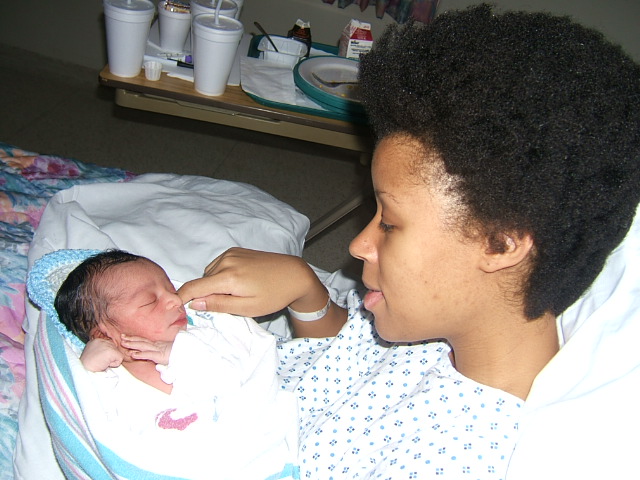
But the kicker really is this: I want to do it again. I want to do THIS again:

That’s the Big A, moments after he was born, January 20, 2006. He’ll be 5 in just a week.

I want another baby.

I know, it seems crazy. My life is crazy. The timing seems all wrong.

But something is strongly pulling at my heart, pulling at my body, something that I can’t explain, can’t account for, something….dare I say, PRIMAL?

I’ll be 30 years old this year. I had the Big A when I was 24, right before I turned 25. So much has happened in the last five years, including getting married, the Little A, grad school, a cross country move, going into the hospital, healing from that trauma. And one would think, quite rationally, that throwing a third child in the mix, a third child to where the kids outnumber the adults, would be a risky decision. I know that.

But the past five years have been all about taking risks. And for the most part, they’ve turned out to be winners. And what’s that saying – the bigger the risk, the larger the reward? And that other one – there really is no good time to have kids?

I don’t know. What do y’all think? I won’t be offended. Really. (Unless you say that I’ve already screwed up the kids I have. I will take that personally so don’t go there. Let’s just talk about the future, shall we?)

failure to launch

While media has recently been inundated with narratives of successful, educated, professional black women who are unmarried/unpartnered, I feel like I have experienced some what of a “witnessing” of this reality vicariously through many of my close friends. These are women whom I have always admired, and in some rare instances even resented. They have “the life;” no familial burdens/responsibilities, better salaries, freedom to travel and move about the planet, etc. I have come to adopt a courteous silence about this however.

Last night my very good friend told me that she had cut it off with her boyfriend. I was saddened for her. I knew full well that she was dreading the prospect of starting over and I honestly thought that the ex was a great guy. I think she does too; their timing is just “off.”

When this is a white situational comedy or Hollywood Blockbuster it is easy to shrug this off. It seems white women negotiate enough privilege in life where I honestly don’t “feel bad,” when they are thirty plus and living as bachelorettes. I also think I’m progressive enough not to want to force-feed a hetero-normative mandate onto any one of my single sisters. I do however see clear limits to my feminism, and their’s, at junctures where the nuclear fantasy is not quite panning out for them. They want IT “ALL” and so I want it for them, by extension.

I’m wondering what all our CocoaMamas think about the concept of “failure to launch?” While it is meant to describe bachelor males who are stuck in an infantile state of promiscuity, commitment “issues,” and self-endulgence, I can’t help thinking in this instance that it’s all my single girls that are unwed and all of my husband’s friends are either married or in committed relationships. Are my hot, single, fit, educated, professional black girlfriends failing to launch???

Inspiration

At the beginning of a new year, as I take time to re-evaluate things going on in my life, choices I’ve made, and experiences I’ve had over the last year, I come to the place of contemplating inspiration. Maybe we can think of it as motivation, though I think there are some variances in the definitions of the two words.

My greatest inspiration is my son. When I think of why I do just about everything I do, I always come back to him. My divorce, my weight loss, my move, my financial planning (thus my career choices), every thing I do, I do for him.  It’s interesting how someone so small, so young, so innocent can inspire me in so many ways. We’d like to think we’re supposed to be the inspirations for our children, and we are. I just offer that the level of inspiration we receive from them far outweighs that.

I wonder what I did before I was a mom. Wonder what fueled my decisions… what was my motivation. I can’t even remember and at this point, it doesn’t matter.

I wonder, though, what happens for those who lose their children. What becomes their inspiration or motivation? This forces me to consider how immensely changed my life was the moment I became a mother and how, in all of my efforts to do so, reclaiming the “me” before I had a child is impossible. I will never be that woman again. I might lament the loss of “freedom”, the loss of “fun”, the loss of being responsibility-free, but to what end? What I’ve gained, at the very least in form of inspiration, is incomparable, irreplaceable.

I love my son. I need my son. He inspires me.

Who inspires you?

What inspiration do you draw from your children?

What has becoming a parent changed for you, in terms of your goals/plans?

Just An Innocent Question

I was born and raised in America, have a college degree and English is my first language. My 3rd grade educated grandfather felt that grammar and enunciation were important so I am, in fact, articulate. Thanks to a flat iron my natural hair is often straight and when it isn’t my fro earns me the exotic label more often than not. Perhaps the straightness of my nose contributes to that characterization; I guess I owe that and my love of a good drink to my Scottish heritage.

Why is origin of my genes a pressing concern in 2011? Why is the “Mixed” question asked with a tinge of hopefulness, as if a certain combination of racial pieces will somehow unlock a treasure trove of American post-racial goodies? It is so tiring to hear people run down the list of bits and pieces that comprise a broken whole. We are all brown Americans at varying levels of consciousness (or lack thereof). Investigating my ancestry in an attempt to reconcile my face with your perception of beauty makes me feel tired and sad for your limited vision. Maybe it’s just innocent curiosity, and you are a student of faces, an artist. It’s just that I’ve been a Black woman in America for decades so I’m skeptical/jaded/over it.

I’ll answer the question though…
 
I’m mixed with
Angst & fury
Melanin & moxie
Tenderness & tenacity
Hardheaded sensibility and cool logic
Fiery passions and childlike wonder
By turns memorable and able to move without being seen
All of these traits and the unspeakable longing of my ancestors
Combine in the greatest chemistry experiment ever.
 
Explosions
                Fusion
                                Synthesis
                                                Transformation of the highest order has taken place…
 
Every time I do not respond to provocation.
             Each tear that I hold back when I witness a hungry child.
             As I stifle screams, knowing that Black men are jailed for profit
             When I don’t give in to the lightheadedness that washes over me when I hear a mother’s screams, her child a victim of circumstance.
 
The fact that I am able to sit still and appreciate the color variations of a flower’s petals
Experience it with all my senses, and pick up on music playing softly in the background
 
…while Rome, in the form of my community, burns to a crisp
 
Is a testament to the perfection that is possibility
 
And what is a remix but a combination of possibilities?
 
So yeah, I’m mixed…

The Reluctant Co-Parents

When my ex and I divorced, one thing we spent no time at all discussing was custody and visitation.

The divorce judgment included a supervision order.  He wanted no part of supervised visitation.  So he vanished.

For the better part of three years, we heard little from and saw nothing of my ex.  I was ok with that.  I put my big girl “S” on my chest and handled my business like the Supermom I figured I had to be.  I juggled publishing parties, parent-teacher conferences, soccer games, baseball games, gymnastics and ice skating lessons for two children of different gender at different schools, often with conflicting schedules.

To manage all of this, I relied on the kindness of strangers and friends alike, but not nearly as much as I should have.  Mostly, I wore myself out.  I felt like the worst mom ever, because I was never 100% available for either child.

And then one day, my ex took me to court.  The specific relief he sought wasn’t available.  What he really wanted was to see his kids again.

I was not averse to that, in theory.  I was ready to get out of the Supermom business and back into the Carolyn business.  My life was nothing but work and the kids.  I found myself getting excited when my kids were invited to birthday parties where the parents were served wine and beer, in exchange for our staying to help out.  Drinking wine with grown-ups at kids’ birthday parties was pretty much my only adult outlet.

I found myself resenting my kids, and I knew something had to give.

We spent two years in and out of court.  Nothing was resolved.  My ex still refused to participate in supervised visits in any meaningful way.  The judge wouldn’t allow visitation until she was satisfied that the supervision order was no longer needed.  She couldn’t get that satisfaction, since he refused to participate in supervised visits.  We were at a standstill.

Meanwhile, the kids were getting older.  They were now able to speak for themselves, instead of needing a social worker to speak on their behalf.

I, too, was getting older.  And lonelier.

I finally pulled my ex aside in court one day and said, in effect, let’s just work out an arrangement, because you’re never going to get what you want here. 

Perhaps because his failure to settle the divorce had turned out to be such a poor decision, he was more willing to listen this time. 

And so two people who could barely exchange a civil word with one another, who had engaged in the stereotypical Family Court shouting matches, who had dealt with orders of protection during the marriage and divorce, and who still refused to disclose our exact addresses to each other — became co-parents.

It has been a struggle and a blessing.

My ex and our children are getting to know one another all over again.  At first it was fun, more like a mini-vacation than a regular part of life.  But when the kids asked me, on the eve of their third Weekend at Dad’s, “why are we going to Daddy’s again?” — I knew it wasn’t going to be an easy journey.

My ex and I never agreed, even when we were together, on house rules, strategies for discipline, or any other parenting decision.  The decision-making mostly fell to me.  So he tends to ask me what he’s allowed to do and not do, like he’s the babysitter. 

I told him recently, “I can’t micromanage your parenting.  When they’re with you, I have to trust your judgment as their father.” 

Those were the right words to say.  I’m not sure I really do trust his judgment in all cases.  But this co-parenting thing won’t work unless I allow him to parent when the kids are with him. I have no reason to think they’re in danger when they’re with him.  I need to relax and let go.

I do selfishly get to plan a social life around the weekends when he will have the kids, like most divorced couples do.  I have taken full advantage, and then some. 

I’ve felt a little guilty, like: Did I agree to co-parent with my ex just to get a break from the kids?  But then — what’s wrong with getting a break from the kids? 

The kids have told me when they really wanted/needed/preferred to spend time with me versus going with their father.  It’s a delicate balance, respecting their wishes versus preserving their father’s right to see them on a regular basis.  I’m sure I’ll get the balance wrong at times, right at others.  It’s only been three months.

My son will turn 10 this year.  Puberty is right around the corner.  There are things his father will need to tell him that I can’t (or would have to look up). 

My daughter turns 14 this year.  Her father has already had the “boys” discussion with her from, as she put it, “a boy’s perspective.”  She said it was useful hearing basically the same things I’ve been telling her, but from someone who could talk about how boys think and feel.

I’m still a fairly reluctant co-parent, but growing less reluctant with each visit.